Capital Gains Tax on Business Sales in Canada After 2024 Budget Changes
The inclusion rate stayed at half while the lifetime exemption climbed to $1.275 million.

Canada's capital gains tax rules for business sales look almost identical today to how they looked before Budget 2024 shook things up, but "almost" is doing a lot of work in that sentence. The inclusion rate sits back at one-half, the Lifetime Capital Gains Exemption is higher than it used to be, and a promised new tax break for entrepreneurs never made it off the drafting table. What follows maps exactly where the rules landed after eighteen months of proposals, deferrals, and reversals, and what that means for anyone planning to sell a Canadian business.
How the rate hike moved from proposal to deferral to cancellation
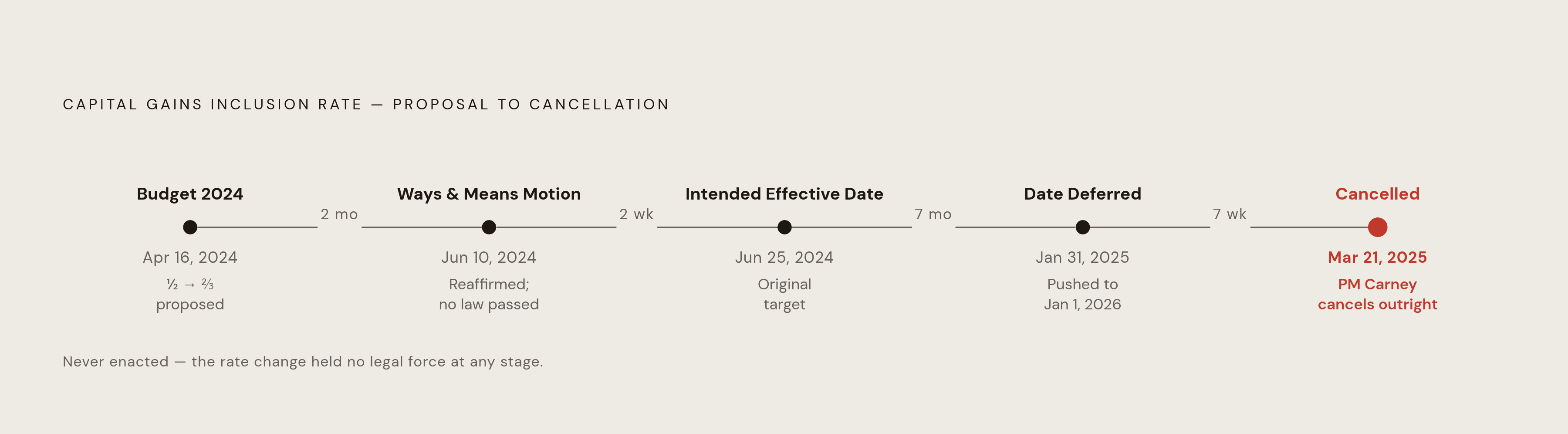
Budget 2024, tabled April 16, 2024, proposed raising the capital gains inclusion rate from one-half to two-thirds. The structure had two tracks: corporations and trusts would pay the higher rate on all capital gains, while individuals would only face two-thirds on gains above $250,000 in a given year. The Parliamentary Budget Officer estimated the change would raise $17.4 billion in income tax revenue between 2024-25 and 2028-29, which gives some sense of how much was riding on this.
Opposition came fast and from a wide range of corners. Cottage owners, doctors incorporated through professional corporations, small business owners, and venture capitalists all pushed back, arguing the change would touch far more people than the government's messaging suggested and would discourage investment in Canadian companies. An economist and a small-business advocacy group raised similar concerns, with the latter becoming one of the most vocal critics tracking the policy's progress.
What if the proposal never actually became law? That's essentially what happened, and it is the detail that trips up a lot of people who stopped following the story somewhere in mid-2024. On June 10, 2024, Finance tabled a Notice of Ways and Means Motion reaffirming the measure, but no full legislation passed at that point. Then, on January 31, 2025, the government deferred the effective date from June 25, 2024 to January 1, 2026. That deferral was itself a signal that the measure was losing momentum. On March 21, 2025, Prime Minister Mark Carney announced the inclusion rate increase was cancelled outright.
The Canada Revenue Agency's own conduct through this period shows how administratively messy this got. Despite the fact that no legislation had ever received Royal Assent, CRA initially said it would collect tax on the higher two-thirds rate for 2024 transactions, administering a proposed rate as though it were settled law. After the cancellation was announced, CRA reversed course and said it would issue reassessments to restore the one-half rate for anyone caught in that window.
The rate hike was never law. It was a proposed measure, administered for a stretch as though it carried legal force, that died before ever receiving Royal Assent. CFIB's tracking of the file shows both major federal parties have since pledged to abandon the hike, which suggests the cancellation isn't a pause waiting for a future government to revive. It looks more like a closed chapter.
What the current inclusion rate means for a seller's tax bill
The current rule is that the capital gains inclusion rate remains at one-half. Only half of a net capital gain counts as a taxable capital gain, and this applies equally to individuals, corporations, and trusts. No tiered structure survived the back-and-forth. Whatever complexity Budget 2024 tried to introduce, it did not stick.
Walk through what that means in practice. A seller who realizes a $2 million capital gain on the sale of a business includes $1 million of that gain in taxable income. The other $1 million never enters the tax calculation at all, at least not before applying the Lifetime Capital Gains Exemption or any other deduction. That's the inclusion rate doing its job: it determines how much of the gain is even exposed to tax, before the seller's marginal rate gets applied to the included portion.
The inclusion rate decides what portion of the gain shows up as taxable income, while the seller's marginal personal income tax rate, which varies by province and by total income for the year, then determines how much tax is owed on that included amount. The inclusion rate determines what portion of the gain is taxed as income. The seller's marginal personal income tax rate, which varies by province and by total income for the year, then determines how much tax is owed on that included amount. A seller in one province paying a certain marginal rate on their included gain will owe a different dollar amount than a seller in another province with an identical gain, even though both are working from the same one-half inclusion rate.
One more mechanical point that trips people up during a sale year: net capital losses from prior years can be carried back or carried forward to offset capital gains. Where the inclusion rate at the time the loss was incurred differs from the rate at the time it's applied, adjustments may be required to reconcile the two. Given how much the inclusion rate has been in flux over the past two years, sellers with older capital losses on the books should have an advisor review the position before assuming a loss offsets a gain dollar for dollar.
How the Lifetime Capital Gains Exemption at $1,275,000 shelters sale proceeds
Before Budget 2024, the LCGE sat at $1,016,836 for 2024. Budget 2024 raised that limit to $1.25 million for dispositions on or after June 25, 2024, and paused indexation until 2026. Unlike the inclusion rate hike, this piece of the budget survived. The $1.25 million LCGE increase made it into Bill C-15, the Budget 2025 Implementation Act, No. 1, and became law even as the broader inclusion rate proposal collapsed around it.
Now that indexation has resumed, the 2026 figure is $1,275,000. That's the number sellers planning a transaction for next year and beyond need to work with.
The exemption covers eligible capital gains on the disposition of Qualified Small Business Corporation shares and qualified farm or fishing property. It's a cumulative lifetime limit: a seller can apply it across multiple transactions over the years until the full amount is used up, not just in a single sale.
Multiple family members each holding shares in the operating company opens up something genuinely useful for families running a business together. Where multiple family members each hold shares in the operating company, each individual can potentially shelter up to $1.25 million (or $1,275,000 going forward) in capital gains on their own portion of the sale. Doane Grant Thornton has pointed out that for a family of four with shares properly structured across each member, that could mean sheltering up to $5 million of capital gains from tax entirely. That figure sounds almost too good, and it should come with a caveat: this kind of multiplication requires careful structuring well ahead of a sale, and it is not something that happens automatically just because multiple family members happen to hold shares.
CFIB's own example lays out the arithmetic cleanly. Take a seller with a $2 million capital gain who has the full $1.25 million LCGE available. The first $1.25 million of that gain gets sheltered entirely, tax free. The remaining $750,000 gets the standard one-half inclusion treatment, producing $375,000 of taxable capital gain. Compare that to a seller with no LCGE available, who would face $1 million of taxable capital gain on the same $2 million sale. That gap, $375,000 versus $1 million in taxable income, is the entire reason QSBC qualification matters so much, which leads directly into the next question: what exactly does a corporation need to look like to qualify.
One administrative note before moving on: sellers who realized gains between June 25, 2024 and the point the legislation settled should confirm their filing position with an advisor, given how CRA's reassessment process played out during the back-and-forth described above.
Why the LCGE only applies to share sales of qualifying corporations
The LCGE applies to share dispositions. It does not apply to a corporation selling off equipment, goodwill, or other assets directly, no matter how large the gain on those assets turns out to be. That single distinction sets up much of what follows, and it shapes how deals get structured long before a sale ever closes.
Three tests need to be satisfied, and all three matter both at the moment of sale and over the period leading up to it.
The first is the Small Business Corporation test at the time of sale. Ninety percent or more of the fair market value of the corporation's assets must be used primarily in an active business carried on mainly in Canada. CRA treats "all or substantially all" as meeting that 90% threshold.
The second is an ownership and holding period test. Throughout the 24 months immediately before the sale, the shares must not have been owned by anyone other than the individual seller or a person related to them.
The third is a 24-month lookback asset test. More than 50% of the fair market value of the corporation's assets must have been used in an active business in Canada throughout that same 24-month period before sale.
CCPC status must be maintained at the moment of sale itself, and changes to the ownership or control structure of the corporation can disqualify the shares from LCGE treatment altogether, even if everything else about the business looks fine.
Excess passive assets are the trap that catches otherwise well-run businesses off guard. A business owner who has built up a large investment portfolio inside the company, or who is sitting on excess cash beyond what the operating business needs, risks failing the 90% active-asset test at exactly the moment QSBC status matters most. The business might be perfectly healthy and profitable, but if too much of its balance sheet sits in passive investments rather than active operating assets, the LCGE simply isn't available on the sale.
Selling shares to a non-arm's-length corporation, an adult child's holding company, for instance, and receiving shares or notes from that corporation in return can trigger anti-avoidance provisions in the Income Tax Act that may recharacterize the proceeds in ways that effectively deny the LCGE on the transaction entirely.
QSBC qualification is the hinge on which the entire LCGE turns. It's a status that can be lost for reasons that seem almost administrative, too much cash sitting in the company, a passive investment account that grew larger than intended, but those reasons are often fixable if someone catches them early enough. That is exactly why the next two sections matter.
How the share sale versus asset sale choice shapes the seller's after-tax outcome
A share sale means the seller disposes of ownership in the corporation itself. That triggers a personal capital gain, opens the door to the LCGE if QSBC status holds, and doesn't trigger any corporate-level tax on the sale itself. The corporation just continues existing under new ownership.
An asset sale works differently. The corporation sells its individual assets, equipment, goodwill, client lists, whatever the buyer is after, and the corporation itself pays tax on each asset sold, including recapture of capital cost allowance on depreciated equipment. Then, when the seller wants to actually get the remaining proceeds into their own hands, they pay personal tax again to extract that money from the corporation. That's double taxation, and it is exactly why an asset sale typically erodes proceeds compared to a share sale.
So why would any buyer ever agree to a share sale? Often, they don't want to, and this is where negotiations get interesting. Buyers generally prefer asset sales because purchased assets get a stepped-up cost base equal to the purchase price. That lets the buyer claim capital cost allowance going forward on the full fair market value of what they bought, not on the seller's old, depreciated cost. Sellers want share sales for the LCGE and to avoid double taxation; buyers want asset sales for the stepped-up basis and lower exposure to the target company's historical liabilities. The price difference between the two structures often becomes one of the central negotiating points in a deal, with each side pushing for the structure that favors them and the final number reflecting some compromise between the two.
Hybrid structures exist to bridge that gap somewhat. Section 85 elections and certain asset deals that treat goodwill as eligible capital property can split the difference in specific circumstances. These aren't simple do-it-yourself moves though, and getting the structuring wrong can undo the tax benefit entirely, which is reason enough to bring in professional advice before settling on a deal structure.
The after-tax gap between a share sale and an asset sale on the same headline purchase price can be substantial, particularly once the LCGE is shielding the first $1,275,000 of a share-sale gain from tax entirely. Two sellers might agree to what looks like the same price on paper and walk away with meaningfully different amounts once the structure and the tax treatment are factored in.
What the Canadian Entrepreneurs' Incentive was and what sellers lost when it was cancelled
Budget 2024 didn't just raise the inclusion rate and the LCGE. It also proposed something called the Canadian Entrepreneurs' Incentive, designed to reduce the inclusion rate to half of whatever the prevailing rate was, working out to roughly one-third under the proposed two-thirds regime, on up to $2 million in eligible capital gains per individual over their lifetime.
The incentive was set to phase in gradually rather than apply in full right away. According to the government's own January 2025 deferral announcement and CFIB's tracking of the file, the CEI would have started in the 2025 tax year at $400,000 of eligible gains, then climbed by $400,000 per year until it reached the full $2 million cap in 2029. (Wolters Kluwer's reporting described a slower phase-in of $200,000 per year reaching $2 million by 2034, so there's some discrepancy in how the schedule was reported. The operative figure here follows the government's own deferral announcement.)
Stack that $2 million CEI cap on top of the $1.25 million LCGE, and CFIB calculated that entrepreneurs could have ended up paying tax on a meaningfully smaller share of capital gains up to $6.25 million. That's a striking number, and it explains why the incentive generated real interest before its cancellation.
But the CEI was never available to everyone. Budget 2024 explicitly excluded a list of sectors from eligibility: restaurants, hotels, arts and entertainment, recreation, finance, insurance, real estate firms, and professional corporations such as those used by doctors and lawyers. Anyone selling a business in those categories was never going to benefit from the CEI regardless of what happened to it later.
What happened to it later is that Budget 2025 cancelled the CEI outright, as a direct consequence of the inclusion rate hike being cancelled. Scotia Wealth Management's 2025 Federal Budget Summary describes the government's rationale: the CEI existed as a partial offset designed to soften the blow of the higher inclusion rate. Once that higher rate disappeared, the incentive built to offset it no longer had a policy reason to exist.
So what did sellers actually lose? For business owners in eligible sectors, the incentive would have meaningfully reduced tax on gains between $1.25 million and $3.25 million, the range sitting between the standard exemption ceiling and the combined ceiling with the incentive included. That relief is gone now. Sellers in the excluded sectors, professional corporations, real estate, finance, lost nothing from the cancellation, since they were never going to qualify in the first place.
Zoom out, and the net position for most sellers looks like this: with both the rate hike and the CEI cancelled, sellers are back at the same one-half inclusion rate that existed before any of this started in April 2024. It's a wash on the inclusion rate itself. The one lasting change is the LCGE, which is now permanently higher than it was before Budget 2024 ever got tabled.
Planning actions a seller should take now given the current rules
Start the QSBC status review early, ideally two to three years before a planned sale, given that the 90% active-asset test and the 24-month lookback both look backward in time. Excess cash sitting in the corporation, passive investment portfolios that grew larger than the business needed, or other non-business assets are common reasons a company fails the active-asset test right when it matters most. These disqualifiers are fixable, but only with enough runway to actually fix them before a sale closes.
Consider, too, whether family members hold shares or could reasonably hold shares in the business. Doane Grant Thornton's analysis finds that LCGE multiplication through family ownership can shelter as much as $5 million for a family of four, though attribution rules and other constraints mean this needs proper structuring well in advance rather than a last-minute share transfer before closing.
Determine early in the sale process whether the deal will land as a share sale or an asset sale. That single decision affects LCGE eligibility, the tax cost sitting on both sides of the table, and the entire tenor of the negotiation that follows, so waiting until the letter of intent stage to think about it puts the seller at a disadvantage.
Review capital loss carryforwards too. Existing net capital losses can offset capital gains realized on a sale, though the adjustment factors mentioned earlier apply where the inclusion rate at the time the loss occurred doesn't match the rate in effect when it's applied against a gain.
And for anyone who transacted in 2024 specifically: confirm with an advisor that any reassessment restoring the one-half inclusion rate has actually been issued and processed by CRA, given how much back-and-forth that agency went through over the course of the year.
Put together, a $1,275,000 LCGE that's now indexed and legislated, a one-half inclusion rate that held steady through all the turmoil, and thoughtful deal structuring add up to real protection for sellers of profitable Canadian businesses, particularly those spanning a wide range of revenue up to the tens of millions, provided the planning starts early enough to matter. None of this works as a one-size-fits-all formula, though. Outcomes depend on the province a seller operates in, how the corporation is structured, personal financial circumstances, and the specific terms a buyer is willing to agree to. What the rules offer is a framework, and the businesses that get the most out of that framework are the ones that start asking these questions long before a buyer shows up at the table.
Sources
- Capital Gains Changes | CFIB
- Capital Gains Inclusion Rate - Canada.ca
- Archived - Tax Measures: Supplementary Information | Budget 2024
- Increasing the Capital Gains Inclusion Rate
- Federal Budget 2024 Highlights | Wolters Kluwer
- Selected Tax Measures in the 2024 Federal Budget – Canada | Knowledge | Fasken
- Government of Canada announces deferral in implementation of change to capital gains inclusion rate - Canada.ca
- pm.gc.ca