Selling a Family Business Without Destroying It
Manage the family dynamics alongside the financial deal or risk losing both.

Selling a family business is two deals wearing one suit. There's the financial transaction, the one everyone assumes is the whole story: valuation, buyer, terms, close. And there's the family negotiation that decides whether the people who built the business still speak to each other at a holiday gathering after the wire clears, largely invisible to outside advisors. Owners who close well treat both as live, simultaneous transactions and manage each one on purpose. Owners who don't tend to end up with a business that closed its doors instead of its books, or a deal that closed and a family that didn't survive it.
The wave of exits arriving now and why the window matters
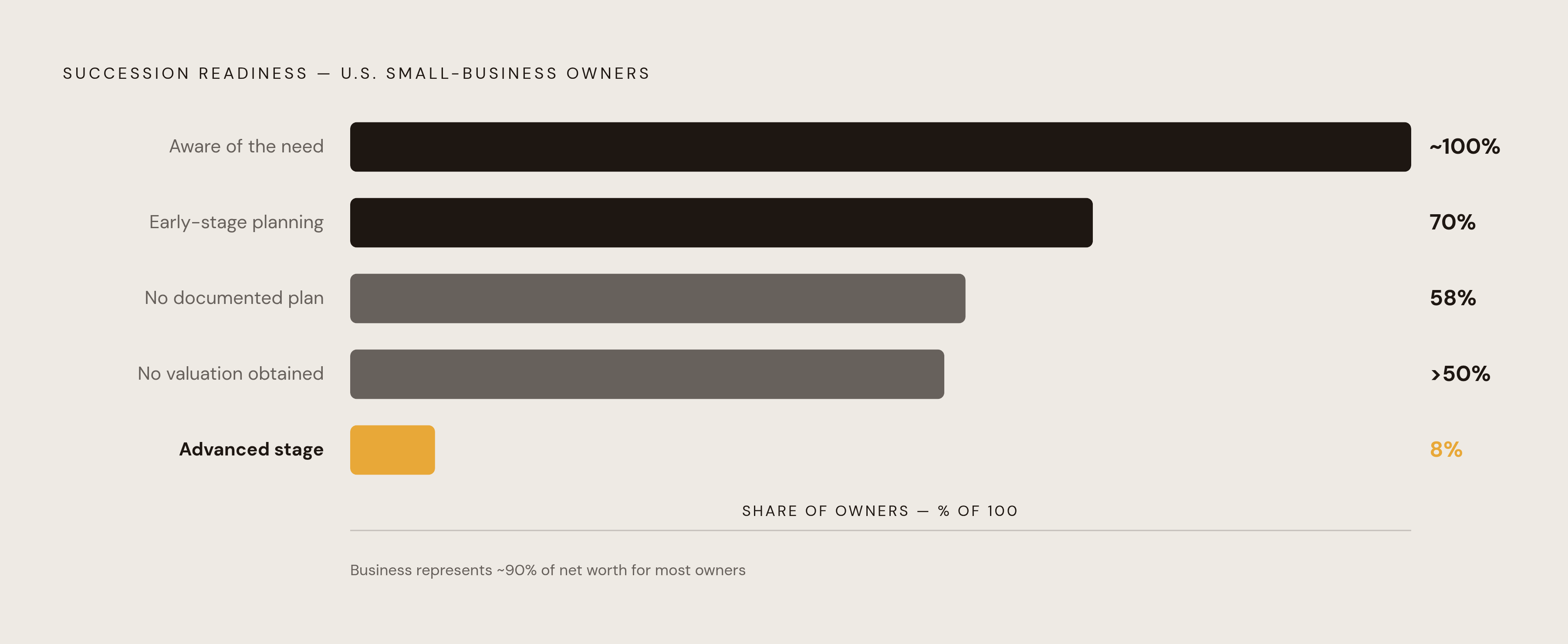
The math on who owns small business right now is getting hard to ignore. Baby Boomers control roughly 51% of the current domestic business market. business market, and more than half of small-business owners nationally are past 55. Among Boomer owners specifically, more than 58% have no documented transition plan at all. Across the coming decade, the projections point toward roughly 6 million small and mid-sized businesses coming to market by 2035, with more than 1 million of them viable candidates for a sale or an employee-ownership transition, representing something like $5 trillion in enterprise value. Annual exits could climb toward 665,000 a year, a volume of ownership transfer that has no real precedent in the country's business history. business history.
Here's where it gets uncomfortable. One firm's 2025 Family Business Survey found succession planning actively affected 44% of domestic family firms over the past year, compared with 34% globally, so domestic family businesses are, relatively speaking, further along. But "further along" is a low bar. A JPMorganChase survey found that 70% of owners describe themselves as in the early stages of succession planning, while only 8% have reached an advanced stage. More than 58% have no documented transition plan at all, and most have never gotten a professional valuation done. For a lot of these owners, the business is 90% of net worth. That is not a business problem sitting off to the side of retirement, it is the retirement plan itself, and an undervalued or failed sale becomes a financial crisis with a much longer tail than a bad quarter.
None of this is happening in a buyer's drought, either. IBBA/M&A Source data shows 83% of deals over $5 million attracted at least three offers. Private equity firms are sitting on roughly $2.5 trillion in dry powder looking for a home, and 72% of intermediaries surveyed by IBBA expected 2026 to match or exceed the 2021 deal peak. So what's actually constraining outcomes? Not buyer appetite. It's seller readiness, and that gap between available capital and available preparation is where a lot of the destruction detailed in the next section actually starts.
What "destroying" a family business looks like
"Destroying" doesn't always mean the business closes. Sometimes it means the business survives and something else doesn't.
Financial destruction is the most visible version: selling at a steep discount, or not selling at all, because the operation can't run without the founder in the room, the books are a mess, or the whole process got started reactively instead of deliberately. Legacy destruction is quieter and slower. The deal closes, everyone shakes hands, and within months the brand gets folded into something else, the culture gets replaced, half the workforce is gone. The owner assumed continuity was part of the deal. It wasn't, because nobody wrote it down.
Relational destruction is the one that gets discussed least and costs the most. Egon Zehnder's research on family business psychology points to something founders rarely say out loud: stepping down can feel like a kind of personal erasure, not a milestone. That fear makes founders delay their own succession process, sometimes for years, sometimes until the decision gets made for them by health or market timing rather than by choice. Harvard Business Review, in a 2022 piece on the subject, describes the resulting stalemate: the founding generation won't let go of control, the next generation doesn't feel trusted with any, and both sides sit in an expensive standoff while the business drifts.
The "fair equals equal" fallacy is one pattern to watch for. Splitting ownership evenly among siblings feels like the fair thing to do, right up until one of them is running the company sixty hours a week, one wants a distribution check every quarter, and one wants to sell the whole thing and move somewhere quiet and far away. Equal shares among unequal contributors is a structure built for conflict. The fix isn't complicated in concept, even if it's uncomfortable in practice: separate economic value, management authority, and voting control into distinct buckets instead of collapsing them into one equal split.
Then there's the question of family members on the payroll, which almost nobody wants to raise until a buyer forces it. Every acquirer evaluates family members on the payroll purely on merit, no sentiment attached. If a relative's title outpaces their contribution, diligence will reveal it, and it's a far better conversation to have inside the family first than to have a stranger's spreadsheet reveal it during a data room review.
Private equity brings its own version of legacy risk, and it depends heavily on deal type. A platform acquisition, where the business becomes the foundation of a new roll-up, tends to preserve more of the original identity, at least initially. An add-on acquisition, where the business gets folded into an existing platform, often means the brand, leadership, and culture get absorbed and eventually disappear. Whichever direction it's headed, legacy protection has to be negotiated into the deal before signing, not requested afterward as a favor. A more basic misalignment causes all of it: owners walk into a sale process thinking the only goal is maximizing price, only to discover, usually too late, that they also cared about cultural fit, or confidentiality, or keeping the plant in the same town. That late discovery is one of the most common sources of seller regret, and it's avoidable if the goals get named early.
The two transactions happening simultaneously during every family business sale
Strip away the deal terminology and every family business sale is running two negotiations at once. One is financial: valuation, buyer selection, deal structure, price, terms, close. The other is familial: alignment on what everyone actually wants, who plays what role going forward, how proceeds get split, what legacy protections matter, and what the founder does with a Tuesday morning once there's no business to run.
These two transactions aren't parallel tracks that happen to run side by side, they're load-bearing for each other. Choose a buyer purely on price and the family may inherit a legacy outcome nobody agreed to. Sibling conflict left to simmer unresolved leaks into diligence, spooks a buyer, and can kill a deal that was otherwise clean on paper.
Most owners get the sequencing backward. They try to nail down the financial deal first, assuming the family conversations can happen "after," once terms are basically settled. But that's exactly the moment when emotional stakes peak and negotiating leverage evaporates: the deal is close, everyone's exhausted, and now is supposedly the time to hash out who gets what and who feels slighted. That is the worst possible moment to start that conversation, not the best.
What does it look like to run both deliberately? Practically, it starts with a written statement of goals, done before any buyer enters the picture: a price floor, the legacy protections that are non-negotiable, what family members expect their roles to look like, and a realistic timeline. That document turns the family negotiation into something resolved in advance rather than something litigated live, mid-process, with a buyer watching. From here, the natural next question is what the financial transaction actually requires operationally.
What the financial transaction demands: valuation, preparation, and the variables that move the multiple
Valuation multiples move around more than owners expect, and sector affects the multiple significantly. DealStats Value Index data shows the median EBITDA multiple across all industries swinging from 3.5x in the fourth quarter of 2024 up to 3.8x by the second quarter of 2025, then back down to 3.5x by the end of that year. For larger deals, GF Data's full-year average held steady at 7.2x EBITDA in both 2024 and 2025, still below the 7.6x multiple recorded at the 2021 peak. Sector variation stretches the range further still: information sector businesses have commanded multiples at the high end, while arts, entertainment, and recreation businesses are at the low end. Positioning and industry selection aren't details, they're a meaningful chunk of the eventual price.
BizBuySell's 2025 Year in Review recorded 9,586 completed transactions at a median sale price of $350,000, and those businesses sold, on average, at 94% of asking price. Businesses priced honestly, with real preparation behind the number, are moving close to ask. The gap isn't in buyer willingness, it's in how few sellers show up with a defensible number in the first place.
Owner dependency is the single biggest lever on valuation, and it's not close. A business that can't function without the founder physically present is a business buyers discount heavily, because they're not just buying cash flow, they're buying risk, and an owner-dependent operation is a risk they have to price in. Reducing that dependency, building out a management layer, documenting processes, delegating client relationships, is the highest-return preparation move available to a seller, full stop. Buyers also reward strong margins, recurring revenue, and financials clean enough to survive an audit without surprises.
Most Boomer owners have never had the business formally valued, even though it represents the bulk of their net worth. That valuation is the starting number for the family negotiation about proceeds. It's the starting number for the family negotiation about proceeds, so skipping it doesn't just risk a bad sale price, it removes the foundation the family conversation needs to happen honestly.
Buyer type changes the math too. Strategic buyers and financial buyers approach valuation differently, and the type of buyer can shift the final number meaningfully depending on how they model the business. And the tax backdrop shifted meaningfully heading into 2026: the federal estate and gift tax exemption rose to $15 million per person under the One Big Beautiful Bill Act, effective January 1, 2026, which changes how family transfers can be structured alongside, or instead of, a third-party sale. None of this happens overnight. Financial and operational preparation generally takes one to three years to fully show up in a valuation multiple. Owners who start thinking about this the year they want to sell are already behind.
What the family negotiation demands: governance, roles, and the conversations most owners avoid
Governance paperwork is where a lot of family businesses quietly go wrong. It's actually where a lot of family businesses quietly go wrong. Buy-sell agreements and operating agreements need to spell out, in specific terms, how equity transfers when someone leaves, what happens if an heir decides they want out, and how inactive family members are treated relative to those actually running the operation day to day. Vague language here doesn't stay vague, it becomes a fight later, usually at the worst possible time.
Old shareholder agreements deserve a hard look before any process starts. Some restrict who's even allowed to hold ownership stakes, or require unanimous sign-off before a leadership change can happen, provisions written a generation ago that quietly become roadblocks nobody remembers agreeing to. Reviewing and updating these agreements before engaging a buyer avoids discovering, mid-negotiation, that Grandpa's partnership language from a generation ago is now holding the deal hostage.
The ownership structure conversation deserves its own honest airing, separate from any deal pressure. Equal shares among unequal contributors, as covered earlier, breed resentment almost by design. The fix is a structure that separates economic value from management authority and voting control, so the sibling running the company, the one drawing distributions, and the one who wants to cash out and move on can all get something that fits their actual relationship to the business, rather than a flat one-third each that satisfies no one.
Family employees need an honest internal reckoning before diligence forces one externally. Who's genuinely adding operational value, and whose role ends when the deal closes? That's a question the family needs to answer for itself first, on its own terms, rather than have a buyer's team surface it during financial review.
The founder's life after the sale isn't a side issue either, whatever it might feel like. What the founder plans to do next shapes earn-out structures, consulting agreements, non-competes, all real deal terms with dollar signs attached. And if there's no answer to "what's next," that vacuum tends to bleed into family dynamics in ways that have nothing to do with the transaction itself.
Communication is where a lot of this breaks down structurally. One firm's 2025 survey found that 93% of domestic family firms say they have a clear sense of company purpose, but only 53% actually share that purpose within the family. If the "why" of the business isn't communicated internally, aligning everyone on an exit strategy is going to be harder still, because there's no shared foundation to build the agreement on. Nearly two-thirds of family-owned businesses have no documented or communicated succession plan at all. That's the starting deficit. The practical fix is a goals-alignment meeting, a written priority statement covering price floor, legacy terms, timeline, and role expectations, and an agreed process for resolving disagreement before any buyer is sitting across the table watching the family work it out in real time.
Choosing the right buyer for a family business that wants to stay intact
Not all buyers want the same thing, and that difference matters more for a family business than a straightforward financial screen will ever capture. Strategic buyers pay a premium when the fit is right, but they're also the most likely to integrate the target into something larger and rebrand it out of existence, so legacy protections need to be explicit line items in the letter of intent and the purchase agreement, not gentleman's agreements over a handshake.
Private equity and financial buyers are underwriting a return, typically over a defined holding period, and whether management stays on varies deal by deal. Earn-outs and equity rollovers can align incentives reasonably well, but the platform-versus-add-on distinction covered earlier is the real tell for whether the original brand survives the transition. Family offices, by contrast, often hold for ten to thirty years, and some operate with what amounts to permanent capital, no fixed exit horizon at all. For an owner who cares more about continuity than squeezing out the last dollar of price, that patience is often the better fit. Employee ownership structures and management buyouts sit at the other end: they tend to preserve culture and protect the existing workforce most reliably, usually at a lower price, and the financing involved is genuinely complicated.
Confidentiality isn't a nice-to-have during any of this, it's load-bearing. A process that leaks word of a pending sale can rattle employee morale, spook customers, and unsettle suppliers before a deal even closes, sometimes badly enough to sink the deal itself. Staged, structured disclosure, where only the people who need specific information get it, when they need it, isn't bureaucratic caution, it's basic risk management.
And legacy protections, whatever they are for a given family, brand name, key employee retention, keeping the facility where it is, honoring community commitments, need to live in the term sheet, not in a hopeful conversation after the wire transfer clears. If it matters, it needs to be in writing, with teeth. Buyer selection, done well, isn't just a financial screen either. A buyer whose culture, time horizon, and operating philosophy actually match what the family cares about is often worth accepting despite a lower headline price than a buyer offering more money who's going to dismantle what took decades to build. Matching processes that cross-reference financial fit against operational and cultural signals, rather than screening on price alone, compress how long it takes to find that right buyer pool, and cut down the risk of a founder's actual goals getting lost in a generic, price-first process.
The role of professional advisors in running both transactions at once
Splitting the financial advisor from whoever's handling family dynamics sounds sensible on paper. In practice it often means each one optimizes for their own lane while the intersection between the two goes unmanaged by anyone. Most of these deals actually break at that intersection.
The preparedness numbers make the case on their own. The JPMorganChase survey referenced earlier found that only 8% of owners have reached an advanced stage of succession planning, and BizBuySell's data shows 53% of sellers say they're lacking the guidance they need. That's not a gap in intention. Owners know they should be planning. It's a gap in execution, and execution is exactly what an advisor is supposed to close.
An investment banking advisor's job on the financial side is fairly well understood: valuation, buyer identification, running the process, negotiating terms, structuring the deal, getting it to close without the whole thing collapsing under its own weight. What's less commonly built into that role, but arguably belongs there, is helping the owner actually articulate and write down family goals, stress-testing legacy terms before they ever reach a buyer's desk, and making sure the family's non-financial priorities show up in the deal structure itself rather than getting quietly dropped along the way.
Pairing AI-driven buyer matching with institutional deal advisory finds the right buyer pool faster and with more precision than either a purely manual search or a purely algorithmic one working alone, because it screens for financial fit alongside the strategic, cultural, and operational criteria the family actually negotiated among themselves. This is the exact segment where the dual-transaction problem is hardest and gets served least: profitable, founder-led businesses doing revenue somewhere between the low hundreds of thousands and the tens of millions, too small for the large M&A shops to prioritize, too complex to navigate with no advisor at all. The outcomes data reveals the cost of skipping advisory support starkly. Of the roughly 200,000 small businesses listed for sale each year, only 30% ever find a buyer. Owners who run a structured, advised process improve those odds considerably, and the ones who don't overwhelmingly either leave value on the table or never close at all.
Starting before you're ready to sell: why three years out is the right moment to begin
The honest answer to "when should this start" is earlier than feels necessary. The financial transaction rewards time specifically because reducing owner dependency, building recurring revenue, cleaning up financial statements, restructuring governance documents, none of it happens in a quarter. Each takes years to fully register in a valuation multiple, and starting the moment the decision to sell gets made means starting already behind.
The family negotiation runs on the same clock, maybe more so. Conversations about roles, proceeds, and legacy are dramatically easier to have when nothing is urgent yet, when there's no buyer waiting and no deadline pressing on the room. Pressure doesn't make those conversations more efficient, it makes them worse, because urgency is exactly what kills honest dialogue between people who've spent decades avoiding the hard version of this talk.
McKinsey's estimate that 6% to 13% of small-business closures over the coming decade are avoidable is describing owners who had something worth keeping and simply ran out of runway. It's describing owners who had something worth keeping and simply ran out of runway, businesses with real value and no plan to realize it in time. Time was the variable that mattered, not demand, not market conditions, not the quality of the underlying operation.
One firm's 2025 data showing succession planning affecting 44% of domestic family firms over the past year is, in that light, a genuinely encouraging number, evidence that a meaningful share of owners are starting the process rather than waiting for circumstances to force it. But "started" and "prepared" aren't the same word. Three years out isn't an arbitrary marker plucked from nowhere, it's roughly the minimum runway the financial preparation needs to move a multiple meaningfully, and it's enough time for a family to have the hard conversations while everyone can still afford to be patient about them. Owners who begin there, rather than at the moment they've already decided to sell, are the ones most likely to close with the business, the price, and the family all still standing.
Sources
- Succession planning statistics in 2025: preserving a legacy
- 2025 survey of US family owned businesses: PwC
- Family Business Succession vs. Sale: Which Path Fits You? · Iconic
- mckinsey.com
- Selling a Family Business: How to Handle the Emotional and Financial Complexity | Adaptive Capital Partners
- Why 2025 May Be the Perfect Time for Family-Owned Businesses to Exit | Kinected Advisors
- Jamie Dimon Says the American Dream Is Slipping Away. The Dysfunctional Boomer Retirement Wave Is a Major Part of the Problem. | Fortune