Non-Compete Agreements in Business Sale Transactions
How state law, scope, and price shape a seller's non-compete.

A non-compete in a business sale determines more than whether a seller can open a competing company. It shapes post-sale work, investment choices, and the tax cost of the transaction. Knowing how a non-compete works under the law and what it is worth helps sellers protect their future while giving the buyer the protection it has a right to seek.
Why buyers insist on non-competes and what sellers are actually giving up
At signing, a seller accepts a purchase price and gives up some freedom to work in the industry they know best. That second exchange can receive far less attention than the first. Yet a broad covenant can exclude an owner from familiar work for years, including activities the owner never thought of as competing. The restriction deserves the same scrutiny as the price.
The buyer’s rationale is straightforward. The purchase includes its hard assets, customer relationships, reputation, and the expectation that the business’s cash flows will continue. Without a covenant, the seller could close on Friday and open a competing business on Monday, drawing on the relationships the buyer just purchased. Courts have recognized the legitimacy of protecting that goodwill since the 19th century.
Sellers should therefore negotiate how much restriction the purchased goodwill justifies. Understanding that purpose gives sellers a stronger argument than objecting to the covenant’s existence.
How a sale-of-business non-compete differs from an employment non-compete — and why that distinction controls everything
Courts generally treat a seller’s promise not to compete more permissively than an employee’s promise. The exchange is different. A seller gets substantial consideration as part of the purchase price, while an employee may get only the chance to keep their job. The buyer also has a recognized interest in protecting purchased goodwill, and sellers typically negotiate with counsel, an advisor, and the option to walk away.
Those differences change what courts will uphold. A five-year, regionally scoped restriction on a former HVAC business owner may be enforceable in most states, while the same restriction on an HVAC technician would be vulnerable almost everywhere. Sellers who assume employment law applies may be too sure they can challenge a covenant later.
The documents should make the distinction explicit. In an asset sale, the selling entity and the individual owners usually need to sign, while in a stock sale, each selling shareholder must sign on their own. The covenant should clearly state that it forms part of the consideration for the purchase price.
For sellers staying on as employees, the practical lesson is to separate the sale and employment covenants into different documents. Placing the sale restriction in the purchase agreement or a standalone ancillary agreement makes its basis clearer and helps prevent a challenge to an employment covenant from undermining it.
What the FTC's failed rule means for sellers in 2026 — and what it never would have changed
The Federal Trade Commission’s attempted nationwide ban does not protect sellers in 2026. In April 2024, the FTC voted 3–2 to prohibit most worker non-competes. In August 2024, the federal court in the Northern District of Texas vacated the rule nationwide in Ryan v. FTC, finding that the agency lacked statutory authority and that the rule was arbitrary and capricious.
The FTC appealed in October 2024, then voted 3–1 to dismiss its appeals in September 2025. On February 12, 2026, it published a notice removing the rule from the regulations. The rule is neither effective nor enforceable.
More importantly, it never targeted bona fide business sales. Its text expressly excluded covenants entered into through the sale of a business entity, an ownership interest, or all or substantially all operating assets.
Some state restrictions enacted during the federal debate remain in place, chiefly affecting employment covenants. The FTC has also shifted toward case-by-case challenges to employers’ broad worker restrictions. For sellers, state law remains the operative framework for enforceability, duration, and scope.
How enforceability varies by state — and the jurisdictions that matter most
Texas enforces sale covenants that are reasonable in time, geography, and activity and ancillary to an otherwise enforceable agreement. The Texas Business and Commerce Code recognizes goodwill as a protected interest under § 15.50(a), and five-year covenants are commonly upheld. California also allows sale restrictions, though it takes a strict approach to ordinary non-competes. Its Business and Professions Code provides an exception for a shareholder selling all of their ownership interest, with geography tied to where the business operated. Courts have rejected attempts to use nominal ownership stakes to invoke that exception.
Delaware applies a traditional reasonableness analysis, but recent Chancery decisions show a growing preference for voiding overbroad restrictions over reducing them. Maximum drafting is therefore a gamble. Stepped-down geographic and duration provisions may fare better than an absolute restriction written at the broadest possible scope.
The Massachusetts Noncompetition Agreement Act imposes tight employment rules but exempts qualifying sales involving significant owners receiving significant consideration or benefit. Such a seller can sign a five-year covenant without a garden leave requirement. Minnesota, Oklahoma, and North Dakota likewise permit goodwill-related sale covenants despite barring most post-employment restrictions, though their permitted scope is narrower than in most states.
Wyoming’s employment ban, effective July 1, 2025, exempts business sales. Virginia’s restriction for employees who are non-exempt under the Fair Labor Standards Act, which also took effect July 1, 2025, does not target business sellers who have commercial representation. Illinois’s Freedom to Work Act excludes certain goodwill and ownership transactions from its definition of a covenant not to compete. None of these exceptions automatically validates a particular agreement.
For a multi-state business, which law governs? Governing-law and venue clauses can affect the answer substantially. These state distinctions are a starting point for counsel’s analysis, which requires reviewing the business, transaction, and actual covenant.
How duration, geography, and activity scope are set — and what courts actually uphold
In most deals, restrictions last two to five years, and three years is common in the middle-market. Longer terms can be easier to defend when earnout payments or consulting compensation continue during the restricted period. Terms beyond seven years are generally reserved for very large transactions, specialized businesses, or meaningful continued payment streams.
Geography should follow where the business actually operated. A regional HVAC company supports a different territorial argument from a national business. For a physician practice, too, the boundary should follow where it served patients rather than a radius chosen because it sounds customary. A worldwide restriction on a business serving one metro area creates an obvious mismatch.
Activity scope supplies the third boundary. It should describe only the business models and services purchased. For sellers evaluating a draft, the lesson is to compare its territory with actual service records and seek named exclusions for intended consulting, passive investments, unrelated work, and pre-existing activities.
Overbreadth is not a reliable escape route. Courts in many jurisdictions may narrow a restriction, but recent Delaware decisions show why neither party can assume that result. An injunction can also stop the seller from competing while litigation is still under way, before a final ruling settles the dispute.
The tax allocation problem that costs sellers tens of thousands of dollars at closing
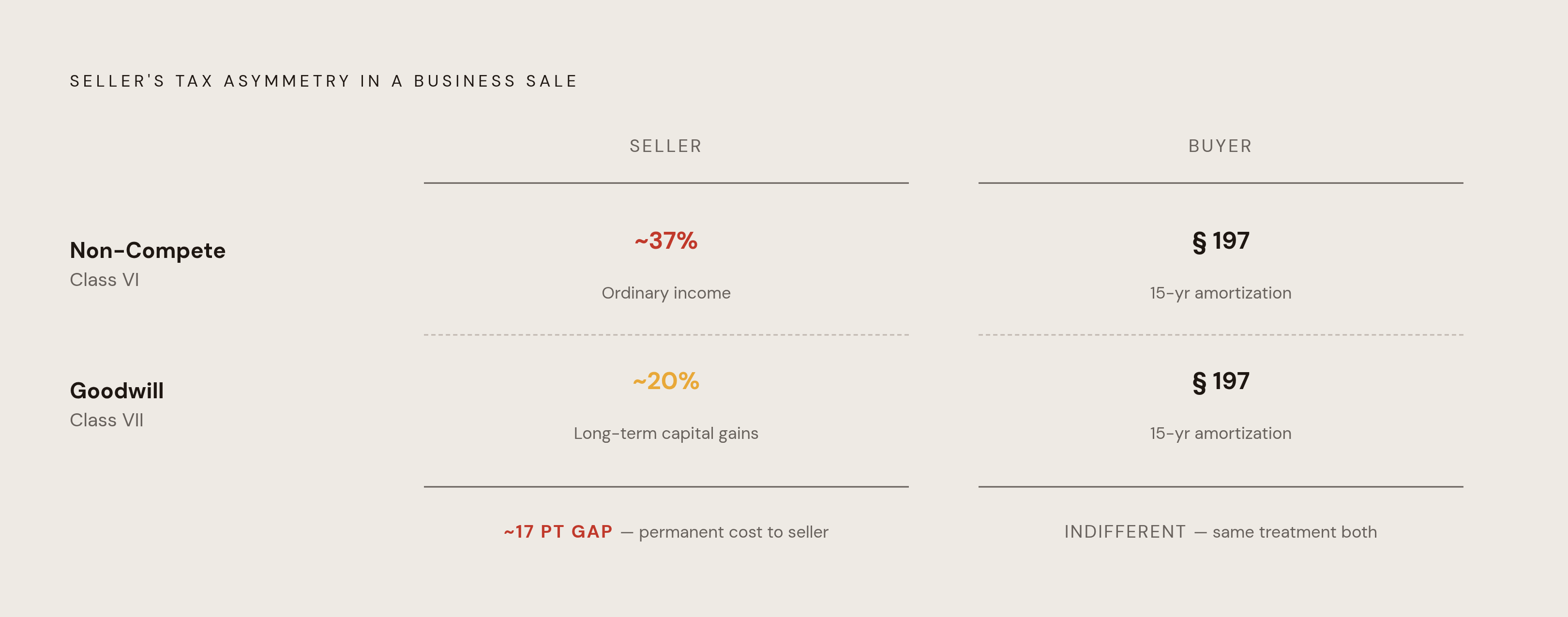
Consideration allocated to a non-compete is taxed as ordinary income. The amount paid for goodwill is taxed at the lower long-term capital gains rate. On a meaningful allocation, that difference can create a substantial, permanent tax cost. It is not merely a timing issue.
The buyer’s federal tax position is different. IRC § 197 provides the same ratable amortization treatment for non-compete covenants, classified as Class VI assets, and goodwill, classified as Class VII assets. Between those two categories, the buyer is therefore largely indifferent from a federal tax perspective. That asymmetry creates room for a seller to improve the allocation without increasing the buyer’s after-tax cost.
For sellers, the practical step is to discuss a defensible allocation toward goodwill with tax advisors before accepting the closing documents.
Personal goodwill needs its own planning, mainly for C-corporation owners. Customer relationships and operational knowledge may belong to the individual rather than the corporation, potentially allowing that portion of the price to receive capital gains treatment outside the corporation. But a prior employment agreement or non-compete may already have transferred those relationships to the entity. This requires pre-sale analysis.
How non-competes are valued — and why the allocation is usually under-negotiated
A non-compete’s economic value comes from the competitive loss it prevents. The central valuation approach is the with-and-without method. It compares projected business cash flows with the restriction against projected cash flows if the seller could compete, then expresses the difference in present-value terms. The method prices protection rather than treating the covenant as an unexamined closing condition.
The gap can be substantial in a service business. Customers may know the seller personally, relationships may be concentrated, and switching costs may be low. When that is the case, a seller who can compete puts more of the cash flow the buyer bought at risk. In a different business, the non-compete may be worth less.
If the covenant’s value is modest relative to the goodwill transferred, a lower Class VI allocation and higher Class VII allocation can be both defensible and tax-advantaged for the seller. The buyer’s ability to amortize the covenant does not by itself justify allocating more to it, because goodwill is also amortizable.
The IRS requires both parties to use Form 8594 for qualifying asset purchases where goodwill or going-concern value attaches. Allocation therefore belongs in both the transaction discussion and the seller’s later tax preparation. Knowing the terms used in valuation helps sellers discuss allocation with counsel and tax advisors before the numbers are set.
What sellers can realistically negotiate — and how to approach those conversations without killing the deal
The strongest negotiating position accepts the buyer’s need for protection while questioning restrictions that exceed it. “This is standard” does not explain why a particular business requires a particular boundary. A seller can instead ground the discussion in the acquired services, customer territory, payment structure, and intended post-sale work. Specific objections are more useful than a general demand for freedom.
Sellers should bring up non-compete terms during letter-of-intent discussions. Duration can be pushed toward the shorter end of the reasonable range, and an earnout-linked restriction should not outlast the earnout without additional justification. Geography can be expressed through named territories or a specific radius rather than a national prohibition on a regional business. Activity definitions can distinguish the acquired service from work the seller wants to preserve.
Carve-outs should expressly cover intended passive investments below an agreed ownership threshold, unrelated advisory or board roles, and continuing pre-existing activities. Tax allocation and separate sale and employment documents also belong in the negotiation. These decisions need to be reflected in the drafting.
An investment banking advisor engaged before the letter of intent can help frame these points as deal structure. Experienced transaction counsel supplies the legal judgment. Together, that process is more protective than relying on a later challenge to a covenant that follows the seller for years and may be enforced by injunction.
What sellers planning their exit should do before the non-compete conversation starts
Preparation begins with a concrete question about the next chapter. Does the owner want to consult, invest, return to the industry, or retire? Abstract optionality is harder to translate into an agreed carve-out than a defined activity the seller intends to continue.
The next conversation concerns entity structure and personal goodwill. For a C-corporation owner, that means examining whether customer relationships remain personal or have already been transferred through existing agreements. Tax advisors need time to assess that history. The issue cannot reliably be repaired after the transaction’s structure is set.
Sellers should look just as early at where the business operates. Customer lists, service records, and revenue by territory provide evidence for a proportionate geographic boundary. They also help distinguish the services being sold from adjacent activities the owner may pursue.
Bringing in advisors early can help sellers link those decisions to which buyer they choose and how they structure the deal. AI-driven buyer matching paired with investment banking advisory is one model available to founders of profitable businesses across the US and another national market. Its relevance here is the opportunity to engage before a buyer’s draft defines the starting point. At that stage, tax positioning, governing law, and covenant scope remain more flexible, giving sellers room to shape an exit that fits the life they intend to lead.