Earn-Out Structures in Small Business Acquisitions
How to protect yourself when part of your sale price depends on future performance.

Earn-out structures in small business acquisitions can bridge a genuine valuation gap, but a promised payment is not the same as a collectible one. Whether a seller captures the expected value or finances a discount in disguise depends on the payment structure, the chosen metric, and the contract’s limits on buyer control.
Why earn-outs appear in small business deals and what they are actually doing
A seller sees a major contract taking shape and prices the business on the earnings it could produce. A buyer sees the same opportunity but will not pay upfront for a result that due diligence cannot fully establish. Neither party has to abandon that view for a deal to proceed. Instead, they can place part of the purchase price behind a future performance condition. If the business meets the agreed target after closing, the seller receives that part of the price.
That arrangement responds to information asymmetry. The seller knows the pipeline, margins, and customer relationships more closely than a buyer can learn them during a sale process. Yet the seller can know all that and still be wrong about a projection, while the buyer can have doubts about it and still see value in it. An earn-out lets actual performance arbitrate the disputed value.
This is why earn-outs work better for a product launch, a recent turnaround, or a major contract in progress than for a business with a long, stable earnings history. In those situations, the disagreement concerns a future result that can be tested. The mechanism moves part of the valuation decision beyond closing. Its quality therefore depends on whether the agreed test measures the opportunity the parties were debating.
Where earn-outs actually get used — and where they don't
Before examining that test, a seller needs to establish whether the financing permits an earn-out at all. Earn-outs appear in a meaningful minority of private transactions, with greater use in the lower middle market than at the smallest end. Their use drops sharply in smaller acquisitions where SBA financing dominates. That makes them a recurring concern for sellers dealing with private equity, strategic acquirers, or private credit buyers.
SBA SOP 50 10 8, effective June 1, 2025, requires a fixed, determinable purchase price documented at closing. SBA SOP 50 10 8.1, effective October 1, 2026, supersedes that version and retains the fixed-price requirement. Contingent consideration tied to future performance does not qualify. In an SBA complete change-of-ownership deal, deferred contingent price must therefore come out of the purchase agreement to preserve loan eligibility.
The permitted buyer rebate runs in the opposite direction. Under that structure, the seller refunds part of the price if the business misses targets. It does not create seller upside. A founder selling to an SBA-financed buyer has different choices for the deal structure than one selling through conventional or private credit.
The four earn-out structures and what each one signals about risk allocation
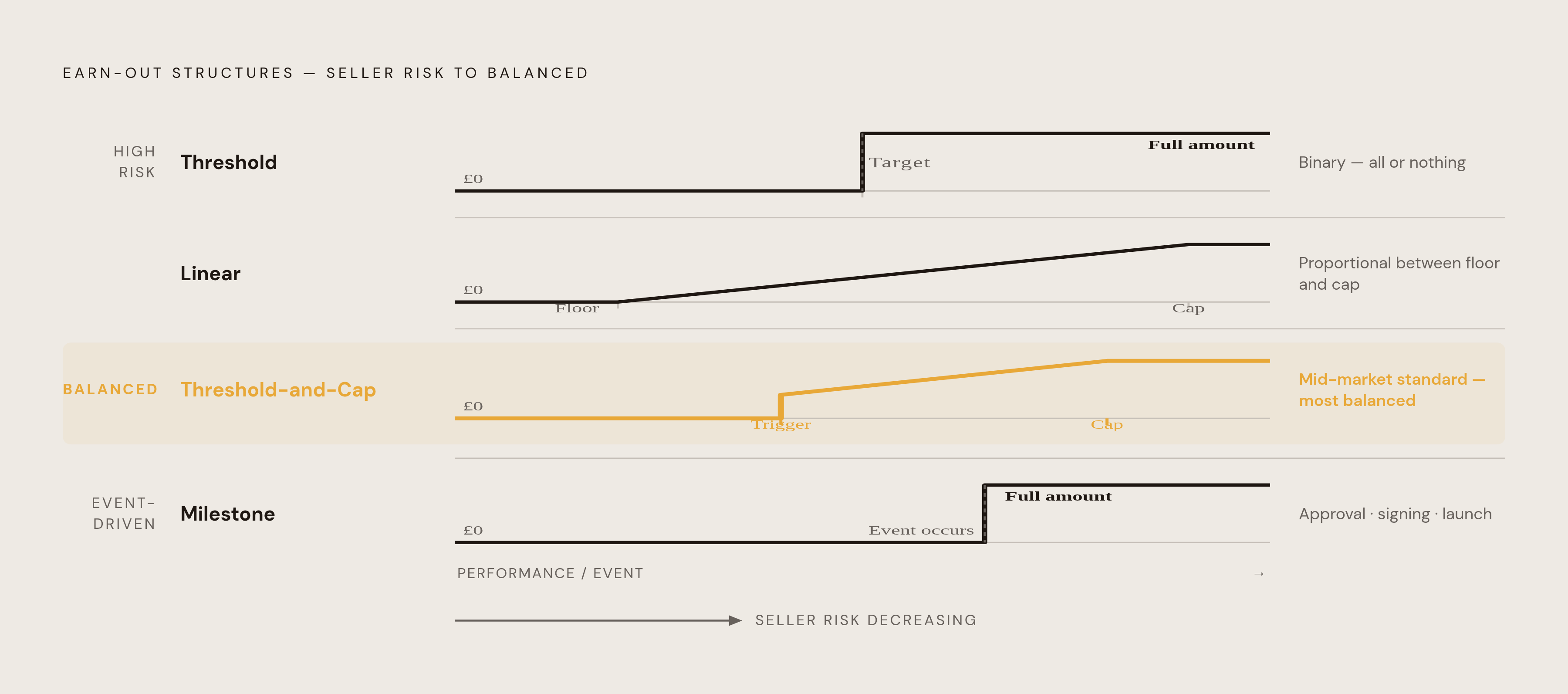
Once an earn-out is available, its payment shape determines how much performance risk each party carries. A linear earn-out pays proportionally between a defined threshold and a cap. The seller receives something for performance above the floor, while the cap limits the buyer’s exposure. It cushions the seller against an all-or-nothing outcome within that range, but performance below the floor still earns nothing.
A threshold earn-out makes the trigger decisive. Nothing is paid until the agreed metric crosses it, leaving the seller exposed to a complete loss of contingent consideration if the business misses by any margin. Coming close to the target may still add value to the business even though the contract pays nothing for it. This structure places the risk of falling short most heavily on the seller.
A threshold-and-cap earn-out combines a trigger floor with a payment ceiling. It is considered the most balanced structure and is recommended as the mid-market standard for SME transaction mandates. The floor keeps the buyer from paying when performance falls short, while the ceiling limits how much the buyer has to pay in all. That balance does not make every proposed threshold or cap reasonable. The seller still needs reasonable threshold and cap levels for a credible path to payment.
A milestone-based earn-out instead ties payment to an event, including a regulatory approval, a contract signing, or a product launch. It is useful when the disputed value lies in that event. Its binary character can match the uncertainty more closely than an earnings formula would.
Why the metric choice is the most consequential decision a seller makes
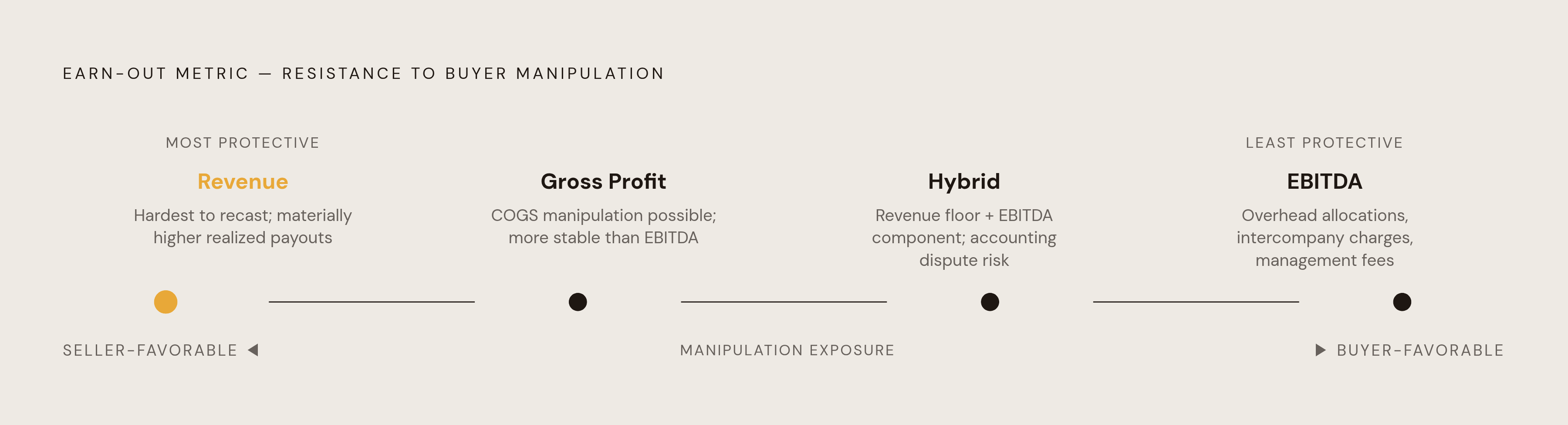
Within any financial earn-out structure, the benchmark determines what the seller must actually achieve. Revenue is harder for a buyer to manipulate through post-closing cost decisions than EBITDA. Corporate overhead allocations, intercompany charges, management fees, and replacement personnel costs can suppress EBITDA without reducing reported revenue. Revenue-based earn-outs also have materially higher realized payouts than EBITDA-based earn-outs.
A seller who remains in charge of operations could pursue top-line growth at the expense of margin and long-term health. EBITDA aligns more closely with how the business was valued, which explains buyers’ preference for it. Yet it also exposes the seller to costs the buyer controls after closing. A lawful business decision can reduce the payment without any finding of bad faith.
Gross profit sits between the two measures. It is more resistant to manipulation than EBITDA, less resistant than revenue, and useful where the seller’s contribution chiefly concerns margin. A hybrid that combines a revenue floor with an EBITDA component addresses both parties’ concerns, but adds complexity and more room for accounting disputes.
The parties need a measure that captures the seller’s contribution without handing the buyer avoidable control over the result. The parties need to choose that measure at the term sheet or preliminary agreement stage, while the seller still has leverage. If EBITDA is used, a precisely defined adjusted-EBITDA formula needs explicit add-backs that neutralize the relevant cost levers. Leaving that formula for later leaves the substance of the bargain unresolved.
How buyer control after closing converts a fair earn-out into an unpaid one
Even a careful formula cannot answer every question about how the acquired business will be run. After closing, the buyer can control pricing, customer allocation, management, and integration. Without express contractual restrictions, those choices can change the earn-out result without breaching the agreement. The seller’s forecast may still be sound even as the conditions it was based on disappear.
Retail Pipeline, LLC v. Blue Yonder Group, Inc. illustrates the legal boundary. The court held that, absent contractual language to the contrary, a buyer is not generally obligated to operate its business to secure or maximize the seller’s earn-out payments. A generous ceiling therefore offers little protection against a broad operating clause. The contract may preserve the possibility of upside without preserving the conditions needed to earn it.
An acquirer may have bought the business to integrate and improve it. An obligation to maximize the earn-out could conflict with rational decisions about the wider business.
Targeted operating covenants offer a narrower compromise. They can require ordinary-course operations, restrict new intercompany charges, prohibit integration during the earn-out period, or impose a good-faith obligation to pursue the targets. The appropriate scope depends on the metric’s inputs. The aim is to protect those inputs.
What earn-out disputes actually look like and why they are hard to win
When those boundaries are unclear, the dispute often concerns conduct or interpretation. Vice Chancellor J. Travis Laster of the Delaware Court of Chancery has written that “an earn-out often converts today's disagreement over price into tomorrow's litigation over outcome.” A seller must then establish a contractual claim after surrendering control of the business. Disappointing performance alone does not establish a breach.
The Area-I founder’s lawsuit against Anduril Industries concerns that distinction. After Anduril acquired Area-I LLC in 2021, the founder alleged that Anduril diverted revenue and impaired operations to avoid a substantial earn-out payment. Those allegations about post-closing conduct remain unproven. They show why access to the buyer’s operating decisions can become central to an earn-out dispute.
Schneider National Carriers v. Kuntz shows a different failure mode. An unclear requirement for the annual tractor-count led to a long trial with a large number of exhibits. In the end, the court used extrinsic evidence to accept the seller’s reading of the agreement and ordered a large payment. The seller prevailed, but only after litigation resolved language the agreement had left uncertain.
Medal v. Beckett Collectibles concerns an express payment protection. The court denied Beckett’s motion to dismiss claims that it breached the stock purchase agreement by failing to accelerate earn-out payments after terminating founder Andrew Medal’s employment without cause. That ruling allowed the claims to proceed, leaving their final resolution open. Separately, if an earn-out depends on the seller staying employed, the IRS can reclassify it as ordinary compensation rather than capital gain, leaving the seller with less after tax even if there is no dispute over how the business was run.
When an earn-out genuinely serves a seller and when upfront compromise is smarter
These risks make acceptance a decision about the whole bargain. An earn-out is strongest when the projection is specifically defensible, such as a signed contract or pending regulatory approval. A short period, a revenue-based metric, negotiated operating covenants, and a specified dispute process strengthen that case.
The seller is at risk when integration starts right away, EBITDA has no protective add-backs, and a large share of the total consideration depends on future performance. Having no post-closing role or visibility further weakens the seller’s position. Where the valuation gap is small, accepting less at closing can be smarter than pursuing a larger but uncertain total.
The proper mental model is “upside, not guaranteed price.” Across metrics and deal types combined, realized earn-outs pay only a fraction of their maximum, so sellers should treat partial payment as a base case. The upfront payment should therefore be an amount the seller can live with alone. Otherwise, the earn-out can become a discount in disguise, with value already built recast as something still to be earned.
A large EBITDA earn-out over three years without operating covenants calls for negotiation or rejection before signing. That does not discredit earn-outs as a category. With the right conditions, they legitimately close a gap and capture value a buyer will not pay upfront.
What a seller should have in place before agreeing to any earn-out
The final test is whether the negotiated protection appears in enforceable contract language. Before signing, the agreement needs a precise metric formula, any necessary add-backs, and operating covenants matched to the buyer decisions that could affect payment. The cap also needs to be achievable.
The seller also needs regular reporting rights on a stated schedule. Access to the relevant financial information must allow independent verification of the metric. A dispute process should distinguish calculation disagreements from claims about conduct. Neutral-accountant expert determination is faster and cheaper than arbitration for calculation disputes, while an M&A-experienced arbitrator offers a more informed decision-maker for conduct claims than a general civil court.
An acceleration clause should make the remaining earn-out immediately payable if the buyer terminates the seller’s employment or role without cause during the earn-out period. Its trigger and payment effect need clear wording, rather than reliance on a general expectation of fairness. Financing eligibility should already have been settled at the term sheet stage. If the buyer uses SBA financing, the discussion must move to other deal-structure levers.
For founders three years from a sale or already in an active process, this is where investment banking advisory can make a measurable difference to take-home proceeds. Expert guidance can stress-test the proposal against both the contract mechanics and what the buyer is actually proposing to do. That work belongs within deal-structure negotiations, while the seller has not yet committed to a buyer. The objective is not the largest stated earn-out, but a bargain whose contingent value has a credible path into the seller’s hands.
Sources
- The Art and Science of Earn-Outs in M&A
- Delaware Court of Chancery Finds in Favor of Buyer in Earnout Dispute
- Managing earn-out provision litigation risk: avoiding common pitfalls
- Earn-out disputes in M&A deals: how can businesses protect their interests? - Keystone
- Earn-out disputes in M&A deals: how can businesses protect their interests? - Keystone