M&A Deal Timeline for a Sub-$50M Business Sale
Where you spend your time and money before the buyer arrives shapes the entire sale timeline.

The sale of a smaller business follows a sequence. Its timeline depends on business size, readiness, buyer fit, and the terms agreed before diligence begins. Owners have the most power to shorten the process and protect proceeds before a buyer gains exclusivity.
Why the sale of a smaller business has no single clock — and why that matters before you do anything else
The familiar six-to-twelve-month estimate is too broad to serve as a sale plan. IBBA/M&A Source Market Pulse Q4 2025 shows why deal size matters when interpreting the calendar. An owner of a larger business who benchmarks against the Main Street median has a calibration problem: planning against the wrong clock.
Size changes more than elapsed time. It affects the buyer pool, whether the process is led by a broker or an M&A advisor, and the intensity of the work that follows. A useful estimate starts with the kind of business being sold and the process its likely buyers will need. Only then can a headline duration become a working plan.
The two-part structure every smaller-business sale timeline actually follows
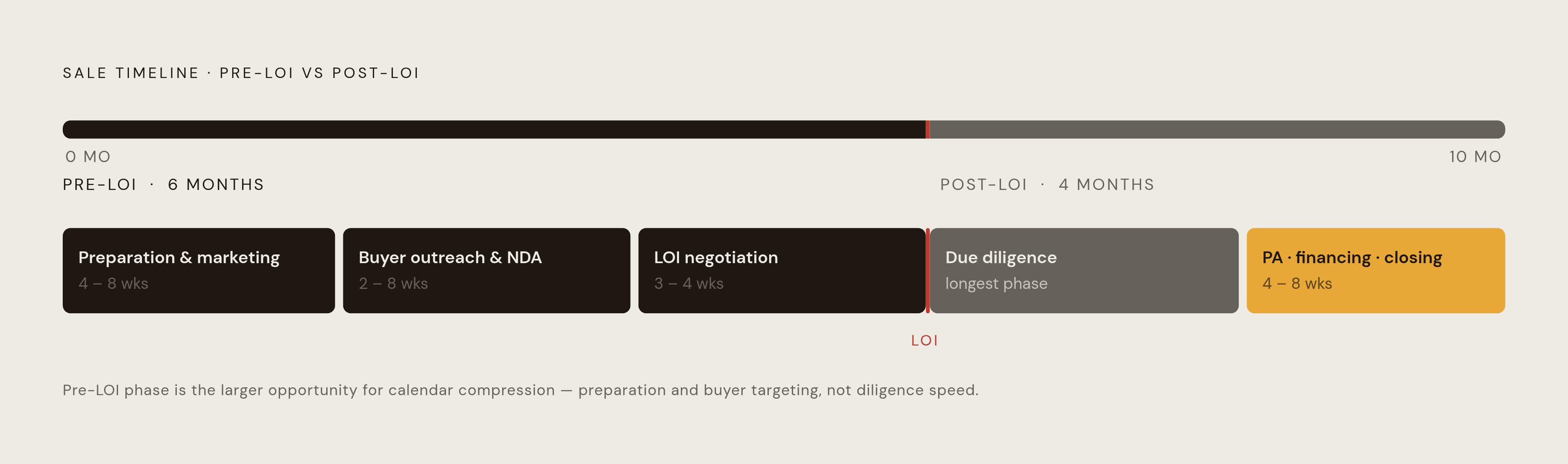
The letter of intent, or LOI, is the hinge between finding a buyer and completing a transaction. Before it, the seller is finding, qualifying, and negotiating with potential buyers. After it, the selected buyer investigates the business while the parties work toward a definitive agreement and financing. The LOI binds exclusivity, confidentiality, and expense allocation, but it does not bind price or closing.
IBBA/M&A Source Market Pulse Q4 2025 reports that LOI-to-close is shorter than the pre-LOI phase for most deal sizes. For a mid-range business, roughly four of ten total months sit after the LOI, leaving six to reach a signed offer. Diligence can be the longest single phase and still take less than half the total time. The broader search and negotiation process takes more time, which makes preparation and buyer targeting the largest opportunities for calendar compression.
Preparation: the phase that owners skip and advisors cannot recover
Preparation looks postponable because no buyer is yet asking for the work. But the work does not disappear when outreach starts. The seller must deal with financial gaps, unclear contracts, and owner dependency either while still in control of the process or later under pressure from the buyer. The same issue usually costs less to fix before it becomes a diligence finding.
The preparation work includes financial normalization, EBITDA documentation, valuation modeling, and buyer positioning. It also includes a contract review, an analysis of customer concentration, plans to deal with management dependency, and legal cleanup. A seller who already closes monthly financials accurately may move through preparation in weeks, while one who has not reconciled EBITDA can spend a quarter getting ready. Lyndon Advisory’s Business Sale Timeline Benchmark 2026 puts the usual time for preparation and marketing materials at four to eight weeks, though financial cleanup and managers having little time to spare make the slow case take longer.
The advisor community broadly recommends beginning exit preparation one to three years before a sale. The objection that a sale is still three years away overlooks the payoff windows of tax structure, management succession, and contract terms. Financial records can be cleaned up closer to launch, but it takes longer to rebuild a management team. Early planning gives owners room to reduce customer concentration and restructure revenue that depends on them personally. Organizing that work in a data room before launch carries the benefit into marketing and gives eventual buyer review a prepared foundation.
Marketing and buyer outreach: where the calendar is spent and the price ceiling is set
The initial outreach stage can be short even when the full path to an LOI is long. Lyndon Advisory’s 2026 benchmark puts buyer outreach and the NDA process for smaller, broker-led deals at two to four weeks typically. The slow case extends to four to eight weeks when the buyer universe is narrow or NDA negotiation is protracted. Those ranges describe an outreach gate.
The quality of the buyer list determines what that gate can produce. A healthy mid-market NDA conversion rate, measured from teaser sent to NDA signed, is roughly a quarter to nearly half. A lower rate is an early signal that the list or teaser may not fit the business. If outreach produces no acceptable indications of interest, or IOIs, expanding the pool afterward adds weeks and leaves the original opportunity lost.
A wide, well-tiered list built from proprietary relationships and structured data creates competition among relevant buyers. AI-driven buyer matching can compress this work by providing faster access to qualified interest, identifying and qualifying buyers that manual outreach would miss or reach slowly. IOIs and management meetings then serve as gates toward a credible LOI, rather than proof that time spent marketing has created value.
LOI negotiation: the three to four weeks that fix the terms everything else is measured against
The three to four weeks of LOI negotiation set the reference point for the rest of the deal. At this stage, the seller can still compare competing offers and use them to negotiate. Signing exclusivity changes that position because the seller can no longer solicit or entertain other buyers during the exclusivity window. The buyer gains a protected period to investigate, while the seller gives up active alternatives.
That exchange is easy to misread when attention settles on the headline price. Confidentiality and expense allocation are binding, but the price can still change after diligence, and the deal may still fail to close. The prudent comparison across LOIs therefore includes price, structure, conditionality, and timeline. Rushing into exclusivity may save negotiation time while surrendering the leverage needed to protect the eventual proceeds.
The working capital peg and escrow terms affect how much the seller gets, while the earnout structure and the size of the seller note affect when the money arrives and what risk the seller still bears. Negotiating these points at LOI is more protective than leaving them for the purchase agreement under exclusivity. In particular, an earnout or seller note can carry the seller’s exposure beyond the legal closing date.
Due diligence: consistently the longest single phase and the most common source of price slippage
Diligence checks whether the business backs up the deal described in the LOI. Its core workstreams are financial, including Quality of Earnings, legal, operational, and tax. The Quality of Earnings review, or QoE, is now routine enough at the small-deal level that its findings have become a leading cause of deal failure. The buyer is no longer evaluating a marketing case alone, but examining the records behind it.
This is where the distinction between a proposed price and a binding price becomes consequential. Re-trading is the renegotiation of terms after diligence findings challenge the original offer. Because the LOI price is non-binding, a finding that hurts the deal can allow the deal to proceed at a reduced price. Re-trading affects a significant share of lower middle market deals, with QoE EBITDA discrepancies most often driving the gap between LOI price and close price.
Financial findings are not the only threat. Diligence-related failures, combining non-QoE findings and QoE EBITDA discrepancies, were the leading driver of broken LOIs in 2025. Non-QoE findings frequently involved undisclosed legal or compliance risks, customer concentration concerns, and contract issues. These are not merely missing documents that delay a checklist. They can change the buyer’s assessment of what is being acquired and whether the agreed terms still make sense.
A prepared data room helps because it lets the seller address potential red flags before the buyer controls the review. Proactive disclosure likewise reduces the chance that a known weakness arrives as a surprise under exclusivity. During diligence itself, responsive, organized data-room management shortens the review cycle. By contrast, delayed or disorganized responses are a controllable source of timeline extension precisely when the seller has fewer negotiating options.
A clean business, however, does not guarantee a fast review. Buyer resourcing, third-party consent requirements, and lender timelines remain outside the seller’s control. SBA-backed acquisitions add a parallel financing constraint because SBA 7(a) loans finance a large share of the purchase price in smaller deals. Approval-to-close can take several weeks to a few months on clean deals, so financing and diligence must run in parallel to avoid extending the calendar. For the smallest transactions, simultaneous sign-and-close can shorten the post-LOI period, reducing the time between signature and wire from weeks to hours.
Purchase agreement, financing, and closing: the final four to eight weeks and what can still go wrong
It usually takes four to eight weeks to draft and negotiate the purchase agreement. Although this stretch is shorter than diligence, it has its own sources of delay, including indemnification scope, representation and warranty disputes, earnout structuring, and disclosure schedule preparation. Those terms may still be open even when a buyer wants to go ahead. The final agreement must turn the negotiated structure into the terms on which ownership and funds actually transfer.
IBBA/M&A Source Market Pulse Q4 2025 reports that most sellers got most of their proceeds in cash at close, including senior debt and buyer equity. It also identifies seller financing as a common way to bridge valuation gaps. That distinction matters because a purchase price is not necessarily the amount received on closing day. The financing structure determines how much remains exposed after ownership changes hands.
Earnouts and seller notes both bridge differences that might otherwise prevent agreement, but they also shift risk past closing. An earnout leaves part of the seller’s proceeds dependent on the agreed post-closing terms. A seller note similarly leaves proceeds to be received after the transaction closes. These structures can help complete a deal without making the seller’s economic exit complete.
Working capital true-ups and post-closing adjustments can also leave the amount the seller gets in doubt. They can reduce the seller’s proceeds weeks after the wire and erode value that appeared settled. Careful negotiation of the working capital peg at LOI reduces the most common surprises, which connects the final accounting back to the earlier leverage point.
Owner-controlled levers that compress the calendar at each phase
The practical framework is to match each action to the point when the owner still controls it. Before launch, accurate monthly financials and a clean EBITDA bridge shorten both preparation and later review. Reducing owner dependency and customer concentration strengthens the business presented to buyers, rather than asking negotiation to compensate for unresolved risks. These changes require runway. Early preparation therefore has more leverage than urgency once a process is live.
Before the LOI, the task shifts from readiness to competition. A broad but well-tiered buyer list helps reach relevant buyers without treating every possible buyer as equally useful. Maintaining competing LOIs until the last responsible moment preserves the ability to compare whole proposals, including their headline prices. Once exclusivity begins, the owner’s practical control narrows toward timely responses, organized records, and a review process with fewer surprises.
An experienced M&A advisor who combines structured outreach with investment banking expertise can run the sale process while the owner keeps running the business. AI-driven buyer matching helps that model when it finds qualified buyers faster, but financial preparation and care in negotiating terms are still needed. Owners who manage the sale themselves typically extend the timeline while compressing their own EBITDA through the demands of the process.
Owners can therefore plan around removing constraints before they become a buyer’s reason to wait, renegotiate, or walk away. Some constraints will remain, particularly lender timing and buyer capacity. Early planning and the right advisory model do not guarantee a faster sale or a particular price. They give the owner a real edge by preserving control for longer and using it before the calendar becomes someone else’s.