Financial Records Cleanup Before Going to Market
Clean books can multiply your sale price by thousands of dollars, not hundreds.

A specialty contractor with solid revenue and a ready buyer watched the deal unravel in two weeks. The buyer's accountant asked for proof of cash, a routine step meant to tie recorded deposits back to reported revenue, and the numbers would not reconcile. Nothing fraudulent had happened. The business had simply never kept its books straight, and that alone was enough to collapse an otherwise sound transaction. This is the mechanism at the center of every business sale: a buyer's offer is constrained not by what the seller says the business earns, but by what two gatekeepers, the buyer's own CPA and the lender underwriting the acquisition loan, can independently confirm from documents. Neither works from narrative. Both work from paper trails, bank statements, and tax filings, and East Coast Advisory frames the implication cleanly: buyers do not pay for what a seller claims to have earned, they pay for what the records show, what a CPA can trace to a bank statement, and what a bank is willing to lend against. Pacific Business Sales describes the same structure as a sequence of three gates. Financial statements set the asking price, then they have to survive buyer due diligence, then they have to clear lender underwriting, and a deal only closes if all three open in order. A seller who treats bookkeeping as a back-office chore is, without realizing it, gambling the sale price on whether a stranger's CPA can reconstruct a story the seller already knows to be true. An offer survives contact with diligence based on that asymmetry, not on the health of the underlying business.
How messy books translate directly into a lower multiple
Seller's Discretionary Earnings and EBITDA are the two metrics most small and mid-market deals get priced against, and both are multiplied by a factor to produce a valuation. That mechanical fact has a brutal consequence: every dollar of earnings a buyer cannot verify does not just vanish from the numerator, it vanishes at the full multiple applied to it. A business selling at a 4x multiple that loses a given amount in defensible add-backs during diligence does not lose just that amount of value. It loses $400,000. The damage compounds upward rather than accumulating in a straight line, which means a handful of undocumented or sloppily categorized expenses can quietly erase a figure far larger than the expenses themselves. The same logic runs in reverse, and this is the part sellers tend to underweight. A dollar of add-back that survives scrutiny, because it is genuinely one-time, properly documented, and traceable, is worth the full multiple in proceeds at closing. Cleanup, seen this way, stops looking like overhead and starts looking like one of the highest-return activities available to an owner preparing to sell. AE Tax Advisors makes a related point about the quality of add-backs themselves: a non-recurring expense presented to a buyer has to actually be non-recurring. Relabeling a cost that will keep showing up after closing, just to dress up the earnings picture for a sale, does not just cost the seller that single line item when a buyer's CPA catches it. It erodes confidence in every other number on the page, and a buyer who starts doubting one adjustment will start re-checking all of them.
The specific red flags buyers and their CPAs look for first
A short, recognizable list of problems causes most of the multiple compression visible in small and mid-market deals, and an owner who knows the list in advance has real room to fix what is fixable before a buyer's CPA ever opens the books. Personal expenses buried inside business accounts sit at the top of that list. AE Tax Advisors names the usual offenders directly: vehicle payments on cars with personal use, family cell phone plans run through the business, travel that blends business purpose with personal trips, and insurance policies covering family members who do not actually work in the company. The relevant test for any of these is not whether the expense qualified as deductible under IRC Section 162. The test a buyer actually applies is whether the expense will keep recurring after they take ownership, and anything that fails that test has to be either removed from the earnings picture or documented as a specific, traceable add-back. The complication is that these expenses rarely sit in an obviously labeled account. These expenses get absorbed into ordinary-looking categories in the general ledger, so catching them requires a line-by-line review of transactions.
Aspirational add-backs make up the single most common deal-killer at the quality of earnings stage. Payroll paid to a family member who performs no real role, a country club membership logged as business development, a personal vehicle run through the company with no documented business-use percentage: all three get stripped out during diligence, and when they go, the multiple applied to them goes with them. Pacific Business Sales draws a hard line on what even counts here. An add-back can only be used if it actually appears on the tax return as an expense. An item recorded on an internal P&L but absent from the filed return cannot be used to support valuation, no matter how real the seller insists it was.
That points to a broader problem: misalignment between what the tax return says and what the internal financial statements say. East Coast Advisory is specific about the standard buyers expect: three years of internal statements need to reconcile to three years of filed tax returns and to bank records. A gap between them is not automatically disqualifying, but a gap the seller cannot explain tends to be fatal, because it signals the buyer cannot trust either document on its own.
Inconsistent accounting methods from one year to the next compound the problem further, since they make trend analysis unreliable even when each individual year's numbers are technically accurate. Bank reconciliations that were never completed, or that contain forced adjustments to make a balance sheet close, are another recurring flag, and Bookkeeping and Accounting Inc. lays out why these failures cascade through the rest of the books: unrecorded deposits can hide real revenue, duplicate entries pulled from bank feeds can inflate expenses, and personal charges run through a business credit card contaminate what gets reported on the tax return. Finally, sales tax non-compliance, meaning unregistered nexus in states where the business has a filing obligation, uncollected tax, or simply unfiled returns, creates a liability a buyer will not agree to assume. Fixing it requires a nexus study and, in many cases, a voluntary disclosure agreement with the affected states, and that remediation takes months.
The cleanup timeline
A number of these fixes cannot be rushed, because the records a buyer and a lender underwrite against have to season over time. Converting a business from cash-basis to accrual accounting is a good example. The conversion itself might take a bookkeeper a few weeks, but the resulting statements only look credible to a buyer after an extended run of monthly closes performed under the new method. Flip the method two months before going to market, and a buyer's CPA will notice the statements were never actually operated on an accrual basis, they were converted retroactively to look that way. The same logic applies to add-backs. An add-back documented in the year it actually occurred, with a contemporaneous note explaining what it was and why it will not recur, reads as legitimate. An add-back reconstructed after the fact, once a seller has already decided to list the business, reads as a reconstruction, and that reconstruction itself becomes a red flag during diligence.
One might argue that 24 months of lead time sounds excessive for a business whose books are already reasonably well kept. For a business that is already disciplined about separating personal and business expenses and closing its books monthly, the real requirement shrinks toward producing at least one full year of genuinely clean trailing statements, which is still longer than most owners expect and far more credible to a buyer than numbers normalized retroactively right before a listing goes out.
A four-phase roadmap for getting books market-ready
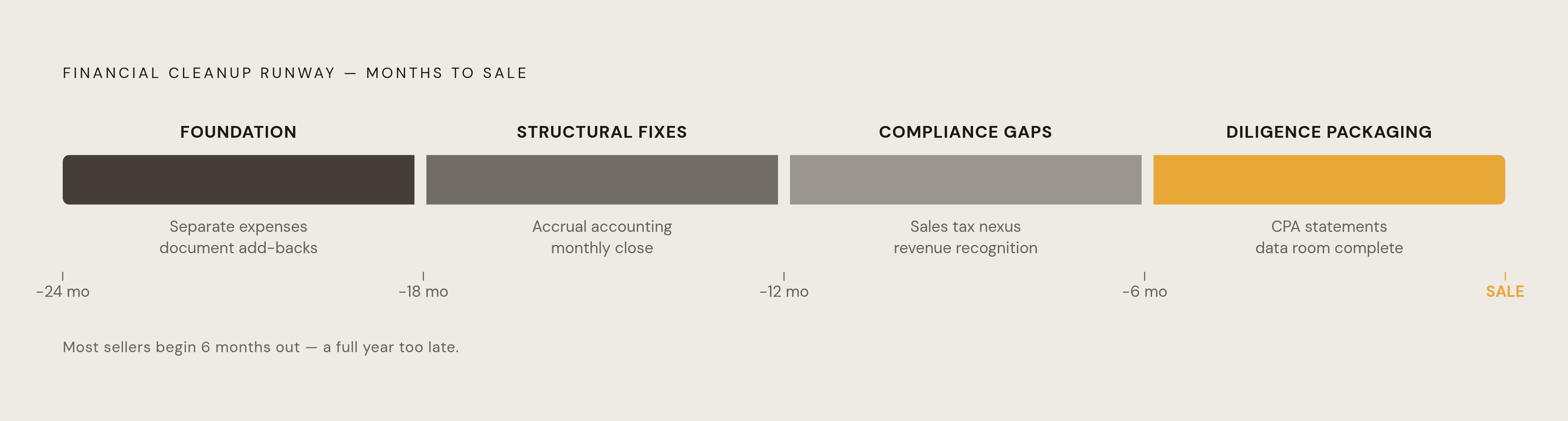
Getting financial records ready for market is not a single project with one deadline. It breaks into four distinct phases, each with its own objective, and they have to happen in sequence, because the output of an earlier phase is the raw material the next phase depends on.
Phase 1, Foundation, covers roughly months negative 24 through negative 18 before a target sale date. The work here is to separate personal and business expenses in real time rather than after the fact, to identify and document add-backs as they happen instead of trying to reconstruct them a year later, and to correctly classify capital expenditures against operating expenses from the start rather than cleaning up the distinction retroactively.
Phase 2, Structural fixes, runs from roughly negative 18 to negative 12 months. This is where a business converts from cash-basis to accrual accounting if it has not already, migrates off spreadsheets and into accounting software such as QuickBooks or Xero, and installs real monthly close discipline. Bookkeeping and Accounting Inc. describes bank and credit card reconciliation as the first line of defense and the essential quality control check on a business's finances, and this phase is where that reconciliation has to become a monthly habit completed within a defined window, not an occasional cleanup task. Pacific Business Sales recommends bringing a CPA in at this stage specifically to reconcile the internal P&L against the tax returns and to advise on what bookkeeping changes will keep the two aligned going forward.
Phase 3, Compliance gaps, covers roughly negative 12 to negative 6 months. The priority here is a sales tax nexus review, resolution of any unfiled returns or unregistered jurisdictions through voluntary disclosure where that applies, a hard look at inventory accounting methodology, and confirmation that revenue recognition is both consistent across periods and defensible under scrutiny.
Phase 4, Packaging for diligence, covers the final six months before going to market. The deliverables are a 12-month rolling P&L with monthly granularity, a clean balance sheet, financial statements that are CPA-prepared or CPA-reviewed, and a fully organized data room. East Coast Advisory specifies the core document package this phase has to produce: three years of internal statements that reconcile to three years of filed returns, monthly bank reconciliations brought current, and a documented schedule explaining every adjustment the seller intends to claim. Pacific Business Sales adds the specific components buyers and lenders will request on top of that: tax returns, P&Ls, accounts receivable aging, inventory valuation, and, for construction or manufacturing businesses, a work-in-progress report. Phase 4 is where the sell-side quality of earnings report, covered next, typically gets commissioned as the capstone of the whole process.
Sell-side quality of earnings reports
A quality of earnings report is an independent, detailed examination of a company's earnings, prepared by a transaction advisory team, and its purpose is to tell a buyer how sustainable and repeatable the reported profits actually are. Sellers increasingly commission their own version before a business ever goes to market, for a simple reason: that scrutiny is coming from the buyer's side regardless, so a seller who runs it first gets to see the findings while there is still time to fix them.
Timing is the variable that decides whether a QoE helps or hurts. A sell-side QoE commissioned six to twelve months before a listing produces findings a seller can still address: an add-back that needs better documentation, a reconciliation gap that needs explaining, a revenue recognition inconsistency that needs correcting. The same report, run by the buyer's advisors during diligence instead, produces findings the buyer uses as leverage to re-trade the price downward. It is the same analysis, performed on the same books, but whoever commissions it first gets to decide whether its findings become a repair list or a negotiating weapon. For larger transactions, a sell-side QoE paired with a confirmatory buy-side QoE is becoming the standard structure, and the two reports are expected to land close together on run-rate earnings. When they converge, diligence moves faster and the negotiated price holds. When they diverge sharply, the gap itself becomes the story of the deal.
Whether a QoE is worth commissioning depends on deal size and likely financing structure. For a lower-SDE business being sold to a single local buyer, a disciplined recast performed by a broker may be the proportionate level of spend. For any transaction that will involve SBA financing above the relevant threshold, private equity, or a search fund buyer, a sell-side QoE completed before the confidential information memorandum goes out is the more defensible choice, and that threshold is no longer just a matter of judgment. It is now a matter of federal lending policy.
The SBA rule change that makes earnings documentation non-negotiable for deals above a specified business purchase price threshold
Beginning October 1, 2026, SBA SOP 50 10 8.1 requires an independent quality of earnings analysis for SBA-financed Initial Acquisition and Business Expansion transactions above a specified business purchase price threshold. Under the revised SOP, lenders must obtain a QoE report, in addition to the business valuation already required, for any Initial Acquisition or Business Expansion transaction at or above that threshold. The practical effect reaches further than compliance paperwork: unsupported add-backs now directly reduce the maximum loan amount a buyer can obtain for a deal in that range, and since SBA-financed buyers make up a substantial share of the market for businesses sold in this price band, a reduced loan ceiling translates directly into a reduced price the seller can realistically collect.
The word doing the most work in the new rule is "independent." The QoE has to be performed by an independent, experienced financial professional, conducted for the lender's benefit, and it cannot be prepared by or for the seller's own team in a way that compromises that independence. That single requirement closes off the option some sellers might otherwise have considered, which is dressing up a broker's recast as if it carried the weight of a true third-party analysis. For any deal expected to land at or above the SBA's threshold, the earnings documentation built during the four-phase cleanup described earlier is the foundation the buyer's financing depends on, not just a nice-to-have for negotiating leverage, and books that cannot withstand an independent QoE will not just invite a lower offer under the new rule. They may prevent the buyer from securing the loan needed to make any offer.