Exit Strategy Options for Founder-Led Businesses
Founders must match their exit path to business readiness, not just to the highest price.
A founder who spent twenty years building a company by instinct, relationship, and personal credibility often discovers, at the exact moment a sale process begins, that none of those things appear on a buyer's spreadsheet. The business being sold and the person selling it are tangled together in a way that has no real equivalent in other kinds of transactions, so a wrong exit path doesn't just cost money. It can make the business unsellable outright, or quietly erase the legacy the founder spent decades building. A business that isn't ready to sell cannot be rescued by a good interest rate environment or a hot M&A cycle. Five paths account for the overwhelming majority of founder exits: strategic sale, private equity recapitalization, management buyout, family or intergenerational transfer, and ESOP, and each one produces a genuinely different outcome on price, control, tax treatment, and what happens after the deal closes. Treating these five paths as interchangeable, as if the only real decision is which one pays the most, is the single costliest mistake a founder can make in the entire process.
What every buyer evaluates before a path can even be chosen
Before a founder gets to choose between a strategic buyer, a private equity firm, the management team, a family successor, or an employee ownership structure, every one of those buyers is already running the same diagnostic. They want to know whether the business operates as a system that runs on its own, or as a set of relationships and decisions that live inside one person's head. That single variable, founder dependency, is inversely proportional to enterprise value. The more a business depends on the owner showing up every day, the narrower the pool of interested buyers becomes and the more conservative the deal structure gets, no matter which of the five paths is on the table.
Buyers have an informal but real test for this. What actually reduces founder dependency is concrete rather than abstract. So does moving customer and vendor relationships off the founder's personal cell phone and onto the organization's books, so that revenue is tied to the company rather than to one person's relationships. Documented processes that live in a shared system rather than in the founder's memory matter too, and so do financial statements clean enough that a buyer's accountant can read them without needing the founder in the room to explain the numbers.
The most common objection founders raise, that their customers stay loyal because of the relationship built over years, is in fact the clearest sign of the problem. A buyer isn't purchasing the history of that relationship. A buyer is purchasing the cash flows that relationship is expected to produce for the next five or ten years, and needs some real proof those cash flows survive the handoff. Why does this matter before any path can even be chosen? Because founder dependency doesn't just affect price. It determines which of the five paths are realistically available at all, and which ones will collapse under diligence before a term sheet is even signed.
Strategic sale: the path that produces the highest headline price and the most integration risk
Strategic sale sets the ceiling. A strategic buyer, typically a competitor or a company trying to fill a specific gap in its own platform, can often justify paying more for a business than its standalone earnings alone would suggest to any other type of buyer, because the deal is about what the business unlocks for the buyer's existing operation: a product line, a customer base, a geographic footprint, a team with specific expertise.
That premium comes at a cost many founders don't fully price in ahead of time. Strategic buyers scrutinize customer retention, the likelihood that key employees stay on, and operational dependencies with real intensity, because they are buying a platform they intend to fold into something larger. Brand identity and management autonomy are frequently the first things to change during integration, even when the letter of intent made promises about preserving both.
Deal structure reflects that risk. This path suits a founder whose main goal is maximum liquidity, whose business has already reduced founder dependency enough to survive serious diligence, and who has made peace with losing meaningful control after close. It does not suit a founder for whom legacy, employee continuity, or ongoing involvement in the business are non-negotiable, since the buyer willing to pay the most is rarely the buyer most aligned with those priorities.
Private equity recapitalization: the two-bite path for founders who want liquidity now and upside later
Private equity buyers almost always pay less than strategic buyers at the first close, and the reason has nothing to do with the quality of the business. PE firms are underwriting a financial return, not a strategic fit, so what they value is durable, predictable earnings and a management team capable of running the company without the founder in the room. They aren't paying for synergies because there typically aren't any. There's no existing platform for the target to slot into.
What they offer in exchange is a second bite at the apple. If the business grows under the new ownership and the PE firm eventually sells at a higher valuation, often in three to seven years, the founder's second payout can exceed the first. That possibility is the central appeal for founders who still believe the business has real growth ahead of it but want some liquidity now rather than waiting years for a single full exit.
A related variant, often described the same way, lets a founder sell a majority stake while keeping a meaningful minority position, which can also solve a succession problem by bringing in a partner with capital and governance discipline without giving up the business. But the trade-off here is structural, extending well beyond price. Buyers will dig into quality of earnings, how durable the customer base really is, trends in working capital, and the depth of the management bench with the same rigor used in a full sale, and the governance that comes after close, board seats, reporting requirements, defined return targets, a defined holding period, is substantial. This path fits a founder with real conviction in the business's next stage of growth, who wants significant liquidity now but isn't ready, operationally or personally, to walk away entirely, and who can work comfortably inside a structured partnership with a financially sophisticated co-owner, and the private equity market itself has its own timing pressures right now, with sponsor-to-sponsor deals facing more scrutiny and continuation vehicles becoming a more common way for funds to hold assets longer, which shapes how aggressively PE firms compete for new platform investments at any given moment.
Management buyout: the continuity path
A management buyout rarely matches what an external buyer would pay, and the reason is mechanical rather than a reflection of the business's quality. They are financing a purchase of the same cash flows the business already generates, without bringing a synergy premium or a strategic rationale to the table the way a competitor or a platform buyer would.
What makes an MBO work has less to do with price and more to do with proof. The management team needs a demonstrated track record of actually running the business, not simply supporting the founder's decisions, and needs to be credible enough in front of lenders or equity partners to get financing approved. Lenders and equity partners need real confidence that performance holds up once the founder is gone.
In exchange, the founder gets something an external sale rarely offers: cultural continuity, protection for the existing employee base, a faster and less adversarial diligence process, and a clean personal exit without months of competing bidders and shifting terms. For some founders, those outcomes are worth more than the gap in headline price. Founder preference, not financial logic, is the honest answer, and that preference is a legitimate basis for a decision. An MBO is a deliberate trade of some portion of headline price for a transition built around continuity.
Family and intergenerational transfer: the classic path
Passing the business to the next generation protects family control, culture, and legacy better than any of the other four paths, but only under two conditions: the next generation has to be genuinely prepared to run the company, and the tax planning has to happen well before the transfer, not as a scramble afterward.
This path carries a three-constraint problem that is not visible anywhere else on the list. The founder has to generate enough after-tax liquidity to fund retirement, treat children who work in the business fairly relative to children who don't, and preserve the culture and employee relationships the business built up over decades, and those three goals frequently pull against each other. Extracting enough cash to fund a comfortable retirement can starve the company of the capital it needs to keep running well under new leadership.
Family transfers tend to fail for one of two reasons: the next generation gets handed the keys without being genuinely prepared to run the business, or the estate and tax planning gets treated as a last-minute fix rather than a program that starts years in advance. One structure that frequently anchors a well-planned transfer is an installment sale to an intentionally defective grantor trust, often called an IDGT, where the owner sells the business at a value frozen as of the sale date, takes back a promissory note at the applicable federal rate, and shifts whatever appreciation happens after that point to the children while removing that future value from the taxable estate. The planning horizon here is measured in years.
No two families face the same version of this problem. Family-run businesses that have weathered multi-generational transitions tend to share a common thread: the planning for the next transition starts long before the current generation is ready to step back.
ESOP: the culture-preservation path and the honest case for and against it
An ESOP, short for employee stock ownership plan, is a qualified retirement plan that invests primarily in the stock of the company it covers. It lets a founder sell shares to employees over time, often with real tax advantages attached, while keeping the company independent and its culture largely intact. The honest trade-off sits right at the center of the decision: an ESOP cannot match the price a competitive external sale process, run against strategic buyers and PE firms bidding against each other, can generate.
The tax advantages are real and worth taking seriously, but they only partially close that gap. Partially is the right word there, not fully.
A sharper objection deserves attention before choosing this path for legacy reasons alone. Once an employee ownership group accumulates a controlling stake through an ESOP, that group can, in some cases, turn around and sell the company to a private equity firm, directly undoing the founder's original reason for choosing an ESOP. An ESOP protects culture and independence only for as long as the employee-owners choose to keep it that way.
New Belgium Brewing shows how this path can work as one chapter in a longer story rather than a final destination. The ESOP preserved the company's culture through its highest-growth years, and when the strategic sale later happened, it produced a real liquidity event for the employee-owners who had built equity in the business over that stretch. That sequence reframes what an ESOP actually is. It isn't necessarily a permanent end state, but can function as a deliberate phase that buys time, protects culture, and builds employee wealth before a later transaction. This path genuinely fits a founder whose top priority is employee and cultural continuity, whose business throws off cash flow durable enough to fund the buyout over a period of years, and who can accept a longer timeline along with real, ongoing performance expectations after the transaction begins.
The four decision variables that sort the five paths
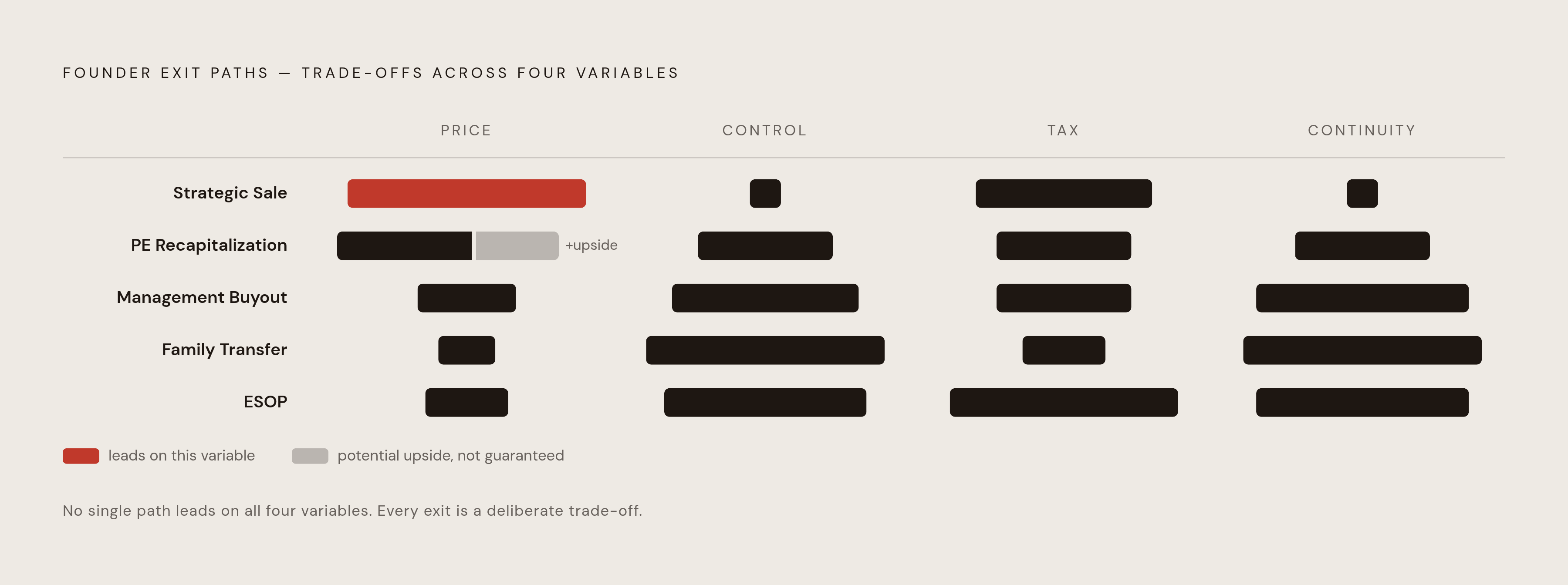
The five paths don't line up in a single ranking from best to worst. They reorder themselves depending on which of four variables, price, control, tax treatment, or what happens after close, the founder actually cares about most. The best path is a function of what the founder wants out of the transition, not whatever number happens to be largest on a term sheet.
On price, strategic sale is at the top of the range. PE recapitalization trades a lower number at first close for a shot at a larger second payout down the road. ESOPs are bounded by fair market value and structurally can't capture the synergy premium a strategic buyer might pay.
On control, intergenerational transfer and ESOP preserve the most operational and cultural continuity at the moment of close, since both keep the business inside a known group, whether family or employees. Strategic sale typically produces the most post-close change of all five, often reshaping brand, leadership, and operations within the first year or two.
On tax treatment, the picture varies by path and by jurisdiction, but for family transfer and ESOP, tax structure shapes whether the deal actually works financially, beyond just how efficiently it's executed. Strategic sales and PE deals get priced primarily on EBITDA and deal terms, with tax planning as a real but secondary layer on top. None of the five paths offers all four variables at their best simultaneously, and recognizing that trade-off early is what separates a founder who chooses deliberately from one who simply takes whichever offer arrives first.