Confidentiality Management During a Business Sale
Most deal leaks come from inside the seller's own company, not the buyer.

Selling a business means handing over, piece by piece, the most sensitive information the company holds: financials, customer lists, pricing structures, intellectual property, the operational detail that makes the business run. That information goes to people whose intentions cannot be fully verified at the point of disclosure. Most owners preparing to sell assume the danger sits on the buyer's side of the table, that a stranger with the financials might misuse them or shop the deal to a competitor. The data points somewhere else. The SS&C Intralinks/Bayes Business School M&A Deal Leaks study, now sixteen years running, recorded its highest leak rate on record in 2024, the largest share of global M&A deals leaked before official announcement since the study began. That trend line should unsettle anyone treating confidentiality as a box to check during due diligence rather than a discipline to manage for the life of the process. When leaks get traced back to their origin, the source is almost always inside the seller's own company, and usually unintentional: an offhand comment, a visible change in behavior, a document left open. That fact matters because it means a tightly worded contract with the buyer addresses a risk that is not the primary one. A buyer who signs an NDA has agreed to a legal consequence for misuse. Nothing in that signature stops a sales manager at the seller's own company from mentioning, to a friend at a supplier, that something seems to be happening. The more buyers a seller contacts and the longer a process drags on, the wider that exposure grows, so speed and buyer selection are not just measures of how well a deal is going. They are confidentiality variables in their own right, and they set up the question the rest of this piece works through: if the NDA cannot be the primary safeguard, what actually is?
What a leak costs
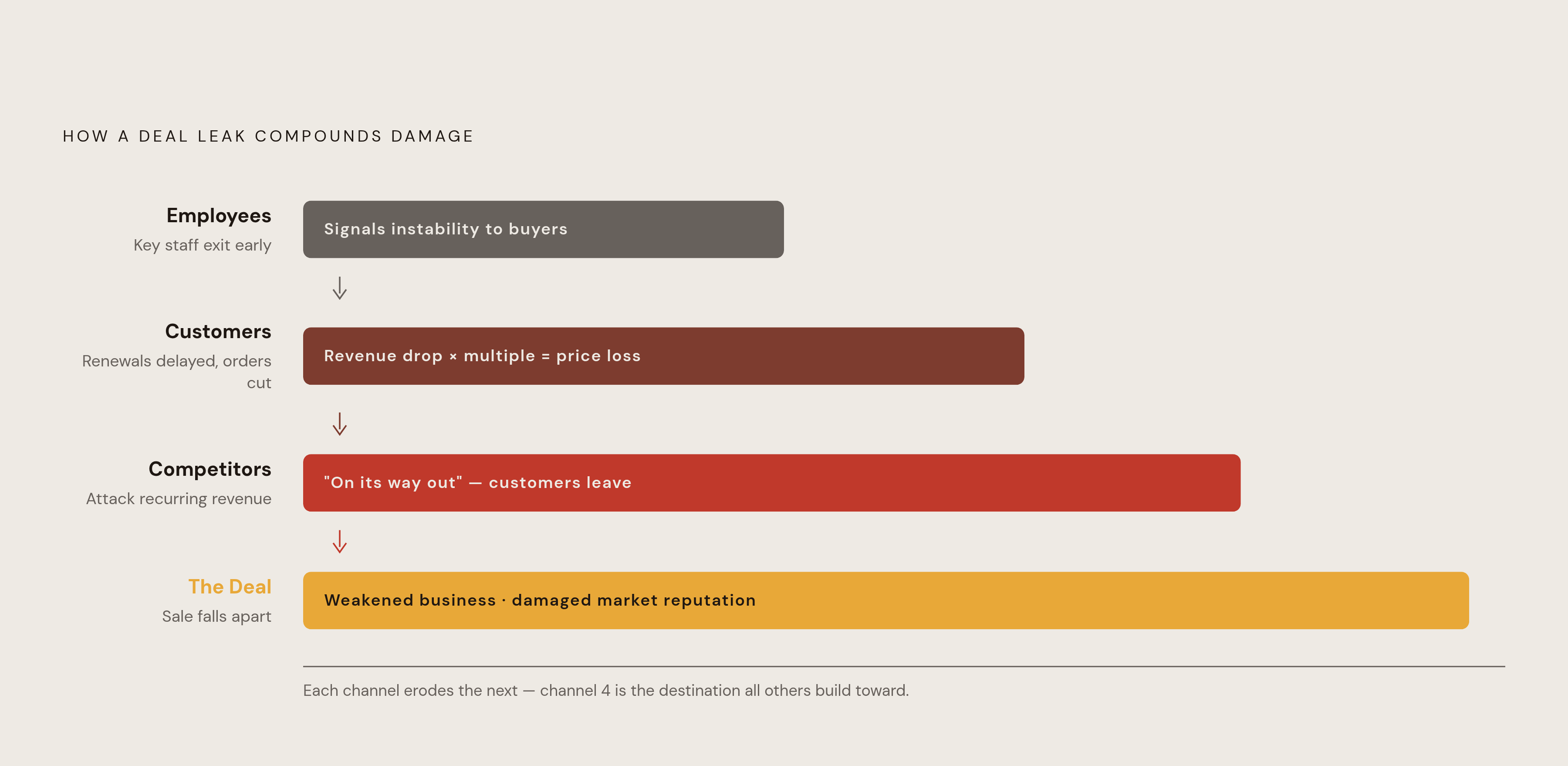
A leak rarely just creates an uncomfortable conversation and then fades. It changes the economics of the deal, because buyers price in instability the moment they sense it, through a lower offer, a bigger escrow holdback, more seller financing carried on the balance sheet, or tighter closing conditions. The damage tends to move through four channels, and each one works by a different mechanism.
Employees come first. If a key manager, a top salesperson, or a technical specialist starts eyeing the exit before any retention plan exists, that departure signals instability to a buyer in a way that is hard to explain away, and it can shave real value off the deal or introduce conditions the seller never anticipated.
Customers come next, and this channel often does the most damage per unit of rumor. A major account that catches wind of a possible sale might delay a renewal or quietly trim its orders while it waits to see what happens. Because a business is usually valued as a multiple of revenue or EBITDA, even a modest drop in revenue gets magnified several times over by the time it reaches the final price. A account worth a modest slice of revenue can cost far more than that slice once the multiple is applied.
Competitors make up the third channel, and they do not need to act maliciously to cause harm, only opportunistically. A competitor who learns a company is quietly for sale can tell that company's own customers it is on its way out the door, suggest instability where none yet exists, or move in aggressively on contracts the seller is counting on to show strong recurring revenue.
The fourth channel is the deal itself. In the worst outcome, the sale falls apart entirely, and the owner is left holding a business that has been weakened by the process, carrying a reputation in the market as a seller whose deal didn't close. That reputation follows the next attempt, whenever it comes.
Why the NDA is a necessary baseline
An NDA does one thing well: it creates legal accountability after the fact, if a buyer misuses confidential information once they have it. It does not, by itself, stop that misuse from happening. Process discipline, not the contract, carries the real weight of protecting the seller.
A well-drafted NDA, by practitioner guidance, needs to cover several things at once. It should define confidential information broadly enough to include financials, customer lists, employee information, pricing, proprietary processes, and the fact that negotiations are happening. It should restrict the buyer's use of that information strictly to evaluating the deal. It should require the buyer to return or destroy materials if talks end without a transaction. It should bind the buyer's own advisors, lenders, accountants, and attorneys to the same obligations the buyer signed up for. And it commonly, though not universally, includes non-solicitation language that keeps a buyer from poaching staff or customers if the deal never closes.
There's a tension in drafting these agreements that practitioners rarely say out loud. An NDA that reads as one-sided or excessive can scare off buyers who would otherwise have been serious, while language that is too broad or too vague becomes nearly impossible to enforce when it actually matters. The goal in drafting is precision, finding the version that is specific enough to hold up and reasonable enough that a credible buyer signs it without hesitation.
Morgan Lewis's 2026 technology M&A guidance points at where the real protection sits: post-termination handling of confidential information and clean-team protocols, both of which are process mechanics rather than contract language. The agreement sets the legal floor. The architecture built around it, who sees what, when, and under what controls, does the work the document itself cannot do.
The four-stage disclosure architecture
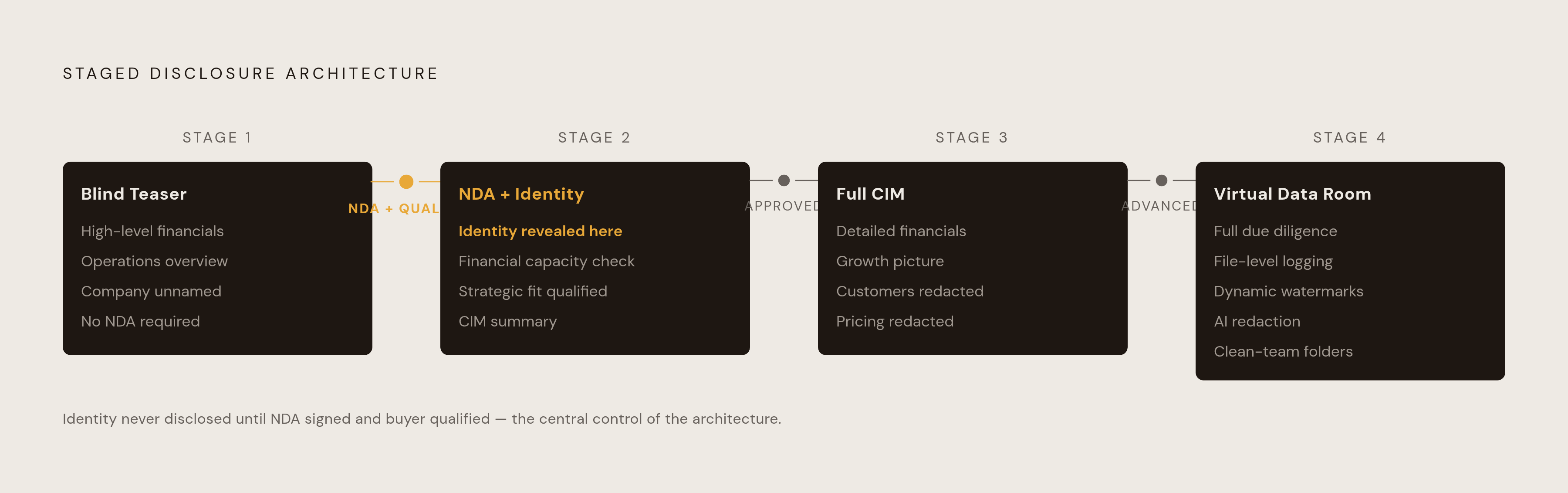
Confidentiality management, done well, looks like a staged release of information, where each new layer of detail only unlocks once the buyer has proven credible at the layer before it. Four stages make up that architecture.
The first stage is the blind teaser, a one-page summary that lays out high-level financial and operational information without naming the company. Its entire purpose is to let the seller gauge real interest before anyone learns whose business is actually for sale. A teaser can still give the game away even without a name on it, through a combination of a narrow service description, an unusual location, or a customer pattern that anyone in the industry would recognize instantly. Sellers should approve every word of a teaser before it goes out, and geographic references should stay general where specificity would be identifying ("West Coast" rather than a named city). Before any teaser leaves the building, the seller and the advisor need to agree on a no-contact list, naming direct competitors and others who should never be approached, or who can only be approached with the seller's explicit sign-off.
The second stage only opens once a buyer signs the NDA. Identity and the full Confidential Information Memorandum go only to buyers who have cleared that signature and been qualified for both financial capacity and genuine strategic fit. Using one standardized NDA template across every buyer speeds up this stage considerably and avoids the delays that crop up when a buyer tries to negotiate its own form instead; it also closes the gaps that appear when every agreement looks slightly different.
The third stage is the CIM itself. It carries detailed financials, operating information, and a picture of growth potential, but even here, specific customer names, employee names and contact details, and exact pricing can stay redacted until the buyer earns further access.
The fourth stage is the virtual data room used during due diligence. A well-run VDR logs everything: who viewed which file, when, and what they did with it, layered with dynamic watermarking, secure viewing modes, and download restrictions. Heading into 2026, the leading platforms are adding AI-powered redaction and anomaly detection on top of those older controls. A newer problem has shown up alongside that progress: employees on both sides increasingly want to use the generative AI tools they already know, and confidential deal material cannot be pasted into applications nobody is controlling. One more wrinkle applies specifically when the buyer is a competitor: antitrust "gun-jumping" rules mean customer-level pricing, forward capacity plans, and detailed sales pipeline data cannot be shared broadly with the buyer's commercial staff until it is legally permissible. Clean-team folders inside the VDR exist to put that restriction into practice, technically, not just on paper.
The circle of trust: managing internal disclosure before the deal closes
Because most leaks start inside the seller's own company, keeping internal knowledge of the sale to the smallest group that can actually function is just as important as any control placed on the buyer. The inner circle, in practice, should include the external advisors, the M&A advisor, legal counsel, the accountant, and only the internal executives whose work is strictly necessary to assemble the materials diligence requires, a narrow group assembled to do a job, not a general briefing to the management team.
There's a real disagreement among advisors here, and it deserves to be named honestly rather than smoothed over. Many counsel withholding word of the sale from employees entirely until the deal closes. Others point out that if employees find out anyway, through a supplier's offhand comment, an overheard phone call, or a data room visit they weren't supposed to notice, the anxiety that follows is harder to manage than if the seller had briefed key people directly, with a message the seller controlled and a transition plan already in hand. Employees who learn about a sale secondhand tend to react in one of two ways: they start quietly job-hunting out of fear for their own security, or they feel the betrayal of being kept in the dark and start positioning against the business they were loyal to a week earlier. The risk cuts both ways. Telling people too early, before there is a transition plan ready to hand them, creates anxiety that cannot easily be undone later. The real question an owner has to answer is not whether to tell key people, but when, and with what message already prepared before the conversation happens.
For the employees who do need to know, stay bonuses, retention incentives tied to the deal closing, are a well-established way to keep essential people focused through a process they are now aware of. Beyond that, a few operational habits do quiet work: schedule site visits outside business hours where possible, introduce buyers who must visit during the day as consultants or potential partners rather than as buyers, and keep deal-related correspondence off the company's own email system.
What the PCE Companies incident shows about buyer-side discipline
Buyers can leak information without ever intending to, acting in complete good faith, and the consequences still land on the seller. A documented incident involving PCE Companies shows how this happens. A buyer let too many of its own management employees into early diligence work. One of them mentioned the acquisition to a supplier in passing. That supplier passed the comment along to someone on the seller's own team. From there the rumor moved through the seller's organization fast enough that the seller had to speed up its own timeline and actively work to calm employees who had heard a half-formed version of the story before anyone had planned to tell them. The deal closed in the end, but it came closer to falling apart than it needed to.
The lesson here is that a seller's confidentiality process has to specify, explicitly, who on the buyer's side gets access to which materials at each stage, since NDA language binding the buyer's outside advisors does nothing if the buyer's own internal distribution runs uncontrolled. Preparedness matters as much as prevention once a process is underway. PCE's own guidance recommends drafting an internal communication memo, customer-facing talking points, and supplier scripts before the process opens, along with having an accelerated-timeline option ready to execute. None of that should wait until a leak forces the issue. Whether a leak becomes a managed speed bump or nearly derails a transaction often comes down to whether those documents already existed when the rumor started moving.
How an experienced advisor structures the process
None of the architecture described above runs itself. Blind teasers, staged NDAs, redacted CIMs, access-controlled data rooms, and a tightly managed circle of trust all require someone whose job is to control the flow of information and stand between the seller's identity and the open market until the moment that identity needs to be revealed.
An investment banker's confidentiality role covers several specific functions at once: qualifying potential buyers before any outreach happens, so the no-contact list means something in practice; using coded, non-identifying language when first gauging interest, before any NDA has been signed; acting as the intermediary so the seller's name stays out of the conversation until real interest has been confirmed; and managing the staged release of information so that each buyer earns deeper access only as their credibility is established. Process speed itself functions as a confidentiality safeguard, since every additional week a deal spends in the market and every additional buyer added to the list widens the exposure a seller is carrying. An advisor who moves a qualified process forward with discipline is not just managing deal quality. They are managing the one variable, time, that leaks feed on most.