SDE vs EBITDA for Small Business Valuation
Choosing the wrong metric can cost you millions in sale price before diligence even starts.

Confusing SDE with EBITDA does not create a rounding error in a valuation memo. It creates a deal that dies in diligence. CT Acquisitions puts the cost of the mix-up as high as 50% of sale price, which is not a footnote problem, it is a did-the-deal-happen-at-all problem. Most owners inherit whichever metric a broker mentioned first, without ever asking what the number is actually built to measure, and that single unexamined choice is the most avoidable way to leave money on the table at close.
What SDE measures and how it is calculated
Seller's Discretionary Earnings answers one question: what does this business put in the pocket of a single owner-operator who steps in and runs it themselves? It is not corporate profitability in the way a public company reports it. It measures total personal economic benefit, built for a buyer who is going to become the business, not just own a piece of paper describing it.
The International Business Brokers Association and the Institute of Business Appraisers are widely cited in setting professional standards for the calculation. Sourcing from Dew Wealth and other valuation references shows the formula starts with net income and adds back the owner's total compensation (salary, benefits, perks, for one owner only), net interest expense, depreciation and amortization, non-recurring expenses, and discretionary owner expenses that vanish under new ownership.
Why add back the owner's entire pay package? Because small business owners rarely take a clean, market-rate salary. Some pay themselves next to nothing and pull value out through personal expenses run through the business instead. Others draw far more than a hired manager would cost. SDE flattens both patterns into one number, so a business run by an owner taking a modest salary and one run by an owner taking five times that can sit on the same footing once the add-back happens.
Defensible add-backs include the owner's W-2 above what a market-rate manager would cost, personal vehicle expenses run through the business, the owner's medical insurance, family members on payroll earning above market rate for their actual role, and one-time legal or professional fees tied to a specific event. Buyers push back hard on everything else: travel and entertainment, cell phone bills, charitable donations, software subscriptions the new owner needs regardless of who sits in the chair.
Here is the test that separates a real add-back from wishful accounting. An expense that appears in the same category three years running is not one-time, no matter what the spreadsheet label says. A legal fee appearing in three consecutive years of filings is not non-recurring, it is operational, and any competent buyer's advisor flags it on the first pass. That flagging hits sale price directly, because SDE gets multiplied. Every dollar of legitimate, documented add-back runs through a multiple, typically 2x to 4x. Every dollar of unsupported add-back that gets challenged and stripped during diligence does not just disappear, it disappears multiplied. Documentation discipline is valuation work, not bookkeeping housekeeping.
What EBITDA measures and the one structural difference that changes everything
EBITDA stands for Earnings Before Interest, Taxes, Depreciation, and Amortization. It measures operating profitability with financing decisions, tax structure, and non-cash accounting choices stripped out, and it assumes professional management is already running the place. That assumption is the whole story. Everything else about the metric follows from it.
EBITDA follows GAAP, and adjusted EBITDA gets refined further through Quality of Earnings analysis, following procedures set out by the AICPA. The formula starts the same way SDE does: net income plus interest, taxes, depreciation, and amortization, plus legitimate non-recurring add-backs. But one line item gets treated completely differently. EBITDA does not add back the owner's full pay package. It adds back only the excess above what a market-rate replacement manager would cost to hire.
That is the structural difference that changes everything downstream. SDE equals EBITDA plus the owner's full compensation plus discretionary add-backs. EBITDA leaves a market-rate manager's salary sitting in the cost stack as a real, ongoing expense, because in a deal priced on that metric, somebody still has to run the business day to day, and that somebody gets paid whether or not the founder is around.
The gap this creates is not small. Sourcing from Dew Wealth shows a business generating $500,000 in net income with an owner drawing $300,000 in compensation producing roughly $800,000 in SDE, but only about $600,000 in EBITDA, once a market-rate manager's salary replaces the full owner add-back. Same business, same financial statements, two different numbers, and, as the next section on multiples shows, two very different implied valuations before a single multiple even gets applied.
What does a market-rate general manager actually cost? In the lower-middle market, that figure typically runs from the low hundreds of thousands into the high hundreds of thousands, depending on how complex the business is to operate. Get that number wrong in either direction and the entire EBITDA figure shifts under it. The replacement-manager adjustment is the single most contested line item in any owner-operator sale.
EBITDA is the standard among sophisticated buyers, not a niche preference. Pepperdine's Private Capital Markets Report shows 76% of investment bankers use adjusted EBITDA as their primary valuation method for privately held businesses, and it is the adjusted figure, not the raw reported number, that actually drives price. The gap between reported and adjusted EBITDA typically runs 20% to 30% of the EBITDA figure itself. Anything wider draws real scrutiny once diligence starts.
The revenue and earnings thresholds that determine which metric applies
No rulebook says switch metrics at exactly this dollar figure. But several 2026 sources converge on a practical band, even without a formal standard behind it.
Below the threshold, SDE governs, almost without exception. Businesses with SDE under roughly a million dollars, or revenue under a few million, get valued on SDE because the buyer pool at that size is made up of individuals planning to operate the business themselves. For that buyer, the owner's compensation is not a cost to eliminate, it is the return they are buying. Pepperdine's broker survey shows SDE accounts for 63% of the multiple types used on deals under $500,000.
CT Acquisitions places the crossover band in a range roughly double at its top end what it is at its bottom, measured in earnings. Clearly Acquired corroborates a similarly proportioned band. Dew Wealth puts the transition zone slightly higher, spanning a range more than double at its top end what it is at its bottom, measured in revenue. Inside that band, some brokers still default to SDE out of habit while private equity buyers looking at the identical deal are already underwriting it to EBITDA. A seller sitting in that zone has real room to position toward whichever metric produces a higher, defensible number, provided the financials support it either way.
Above the threshold, EBITDA takes over, for structural reasons rather than arbitrary ones. Once professional management is genuinely in place and the owner is not essential to daily operations, EBITDA becomes the honest description of what the business actually is. Private equity firms, strategics, and institutional buyers are going to install or retain professional management regardless of what the seller calls the number, so they underwrite to EBITDA because that is the input their own return models run on.
The metric switch tracks almost exactly with a buyer-pool switch, from individual buyers using outside financing to platform and PE buyers. That is two different kinds of capital asking two different questions about the same business, not a coincidence and not a bookkeeping convention. Revenue and earnings thresholds indicate where that shift tends to happen. They are not automatic triggers. Whether professional management is genuinely running the place, independent of what the revenue line says, matters most.
What drives the spread in multiples across the SDE and EBITDA ranges
Multiples in the SDE range sit meaningfully lower than multiples in the EBITDA range, and that gap is the entire reason mismatching a multiple to a metric is such a costly mistake, which the next section takes up directly.
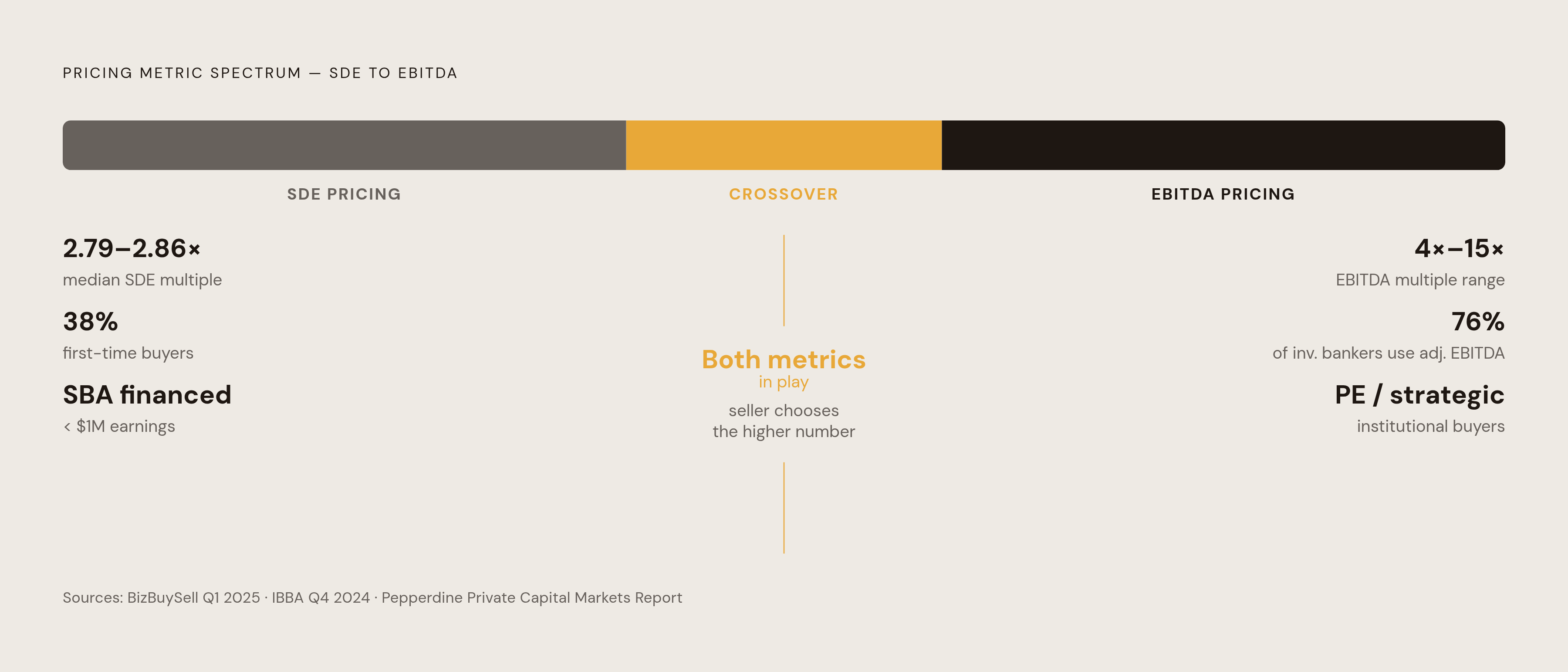
On the SDE side, IBBA's Q4 2025 data puts the median Main Street SDE multiple at 2.86x. BizBuySell's Q1 2025 dataset, covering more than 9,500 deals, shows a median asking-price-to-SDE multiple of 2.79x, with a median sale price of $345,000. That average hides real variation by industry: car washes traded at 4.7x SDE, software companies at 3.4x, coffee shops at 2.3x, restaurants anywhere from 1.5x to 2.5x, and home services businesses like HVAC, plumbing, and roofing command a notably higher 3.5x to 5x. IBBA's Q3 2025 Market Pulse pegs deals below a couple million dollars at 2.0x to 3.3x SDE.
On the EBITDA side, the numbers step up considerably. Businesses in a lower EBITDA tier generally trade at 4x to 6x, with businesses further up the range reaching 8x to 15x or higher depending on sector and scale. IBBA's Q3 2025 Market Pulse quotes deals above a couple million dollars at 4.3x to 5.3x EBITDA. By sector in the lower-middle market, home services runs 4x to 6x, manufacturing 5x to 7x, healthcare services 5x to 9x, and SaaS is at the top, with vertical, B2B, mission-critical SaaS trading at 8x to 15x EBITDA.
Trade press headlines about 8x to 10x multiples mislead more than they inform. Those eye-catching numbers usually describe larger strategic acquisitions structured with earnouts, which pull the effective, realized multiple well below the headline figure. They are not a realistic anchor for most founder-owned businesses changing hands in the lower-middle market. Treating them as one is how sellers walk into negotiations with expectations nobody in the room is going to meet.
Once the metric itself is settled, the spread within each range comes down to recurring revenue as a share of the total, how dependent the business is on the owner personally, customer concentration, growth rate, and deal structure, meaning how much of the price is cash at close versus tied up in an earnout. Two businesses with identical SDE can trade at meaningfully different multiples if one runs on a large majority of recurring contract revenue and the other is transactional and lumpy.
The fatal error: applying the wrong multiple to the wrong metric
SDE multiples and EBITDA multiples are not interchangeable. SDE multiples and EBITDA multiples apply against different-sized earnings bases as a matter of arithmetic, so changing the base means the multiple has to change with it, or the resulting number is simply wrong.
Here is where sellers most often shoot themselves in the foot. Taking an SDE figure and running it through a 5x multiple meant for EBITDA balloons the result to several times what the business is actually worth, because a 5x multiple was never built for an SDE base to begin with. That same SDE figure should sit closer to a 2.5x to 3.5x multiple, and no amount of confident presentation changes what the underlying math supports.
Buyers and their advisors catch this on first read, often before a phone call happens. And the damage runs deeper than the one number: it signals either that the seller does not understand their own financials, or that whoever prepared the valuation cut corners. Either read weakens the seller's negotiating position for the rest of the process, and it rarely recovers once that impression sets in.
The problem compounds when add-back inflation stacks on top of a mismatched multiple. Patterns from BizBuySell and aggregate deal analysis from Regalis show sellers inflating SDE by 15% to 50% through soft, hard-to-defend add-backs. Combining an inflated base with a mismatched multiple does not bring the valuation in off by a little. It unravels the moment a serious buyer's advisor opens the file.
Consider what a multiple actually does to a dollar of add-back. At 5x, every $100,000 of legitimate, well-documented add-back lifts enterprise value by $500,000. At 8x, that same $100,000 is worth $800,000. Documentation quality is leverage in the literal financial sense, and add-back disputes remain the single most common driver of post-LOI re-trades, the deals where a price agreed in principle gets cut once diligence reveals add-backs that cannot hold up.
How buyer type determines which metric they will use to price your business
The metric a buyer uses is not a matter of taste. It follows directly from who that buyer is and what they intend to do with the business the day they take it over.
Individual owner-operators, who make up the buyer pool at the SDE end of the market, price deals in SDE almost by default. Research on buyer composition shows first-time buyers making up 38% of this pool and serial small-business owners another 25%. These buyers plan to replace the seller personally, in the actual operating role, which means owner compensation is not a line item they are going to eliminate. It is part of the return they are buying into. Many finance these deals through the SBA, and SBA lenders underwrite smaller transactions to SDE as well, reinforcing the metric on both sides of the table.
Institutional and strategic buyers, meaning private equity firms, corporate strategics, family offices, and platform companies running a roll-up, price in EBITDA, full stop. They install or retain professional management regardless of who currently sits in the owner's chair, so owner compensation, in their model, is a real operating cost rather than a source of personal return. That is the replacement-manager add-back from the second section, playing out in the buyer's head before the term sheet ever gets drafted. Pepperdine's survey data showing 76% of investment bankers defaulting to adjusted EBITDA tells you exactly where the institutional center of gravity sits.
What happens when the metric and the buyer do not match? Friction, nearly every time. Present an internally built SDE valuation to a private equity buyer, and they recast the entire thing into EBITDA regardless of how the deal was pitched. Present an EBITDA valuation for a business where the owner is still doing half the operating work personally, with no real management layer underneath, and the buyer's advisor finds that gap fast and prices around it. The buyer's own underwriting model wins in the end, no matter which framing the seller walks in with. Figuring out who is realistically going to buy a given business, before the process starts, determines which metric to build toward, which financials need cleaning up first, and which add-backs are worth documenting properly rather than leaving as a guess on a spreadsheet.
Moving from SDE to EBITDA territory: what has to change operationally
Growing a business from SDE valuation into EBITDA valuation is not primarily a revenue milestone, even though revenue thresholds tend to correlate with it. It is an operational transition, and the core question is the one raised two sections back: is professional management genuinely running the business, or is the owner still the business?
That distinction is visible in checkable, concrete ways. Does the business have a general manager or operations lead who could run daily activity without the owner physically present for an extended stretch? Are customer relationships tied to the company, its systems, and its team, or tied personally to the owner's own reputation and relationships? Is there a management layer between the owner and frontline staff, or does every decision still route through one person's desk?
None of this changes overnight, and rushing it purely to chase a higher multiple tier backfires more often than it pays off. A buyer's diligence team tests exactly these questions, and an owner who installed a manager six months before listing the business, purely for optics, tends to get found out fast. A sustainable transition to the stronger metric means giving a management structure real time to prove it works without the owner's constant involvement, not staging it for a walkthrough.
That has a direct bearing on exit timing. An owner sitting just below the earnings threshold, at $800,000 in SDE, for instance, faces a real choice: sell now into the SDE buyer pool at SDE multiples, or spend the time building out management, push earnings past the crossover band, and sell later into the EBITDA buyer pool at meaningfully higher multiples. Neither path is obviously correct. It depends on how much runway the owner has, how much capital and patience it takes to build real management depth, and how the business's own growth trajectory is tracking independent of which metric applies.
What the whole comparison makes clear, in the end, is that SDE and EBITDA are not two ways of expressing the same fact about a business. They are two different questions, asked of two different kinds of business, answered by two different kinds of buyer. Getting the metric right means the number on the table is one a serious buyer recognizes as an honest description of what they are actually buying. It just means the number on the table is one a serious buyer recognizes as an honest description of what they are actually buying.
Sources
- SDE vs EBITDA in Business Valuation: Which Metric Buyers Actually Use (2026) | CT Acquisitions
- SDE vs. EBITDA: Understanding Business Valuation Metrics
- What Is SDE in Business Valuation? 2026 Guide | CT Acquisitions
- EBITDA vs. SDE: Which Method Should Home Service Owners Use for Valuation? | ClearlyAcquired
- learn.regaliscapital.com
- digitalcommons.pepperdine.edu