Three-Year Exit Roadmap for Profitable Small Businesses
Most small business owners aren't prepared for exits that buyers will actually fund.

A three-year runway is the minimum viable window for a profitable small business owner to meaningfully increase valuation, reduce risk, and reach the right buyers, and each year demands a distinct set of concrete actions to make that happen.
Why the exit most owners imagine is not the one they get
The next decade will move roughly $14 trillion of small business wealth out of founder hands, driven by a demographic reality that's already well underway: about 50% of U.S. small business owners are over age 55, and over 75% intend to exit within the next decade Top 10 Business Exit Strategies in 2025–2026. That's the scale of the thing. What's less discussed is how few of those owners are actually ready for it. Only 32% have a documented exit plan, and just 22% have taken the more basic step of aligning what they want personally, financially, and operationally before they ever talk to a buyer Top 10 Business Exit Strategies in 2025–2026.
The consequence appears in the numbers that follow. Roughly 3 in 10 small businesses that go to market actually sell, and among the owners who do get to closing, about 3 out of 4 say they profoundly regretted it within a year Top 10 Business Exit Strategies in 2025–2026. Not because selling was the wrong call. The process behind it was reactive rather than planned, and that reactive process is why the regret follows Top 10 Business Exit Strategies in 2025–2026. A business can be genuinely good and still produce a bad outcome for its owner, simply because nobody built a runway.
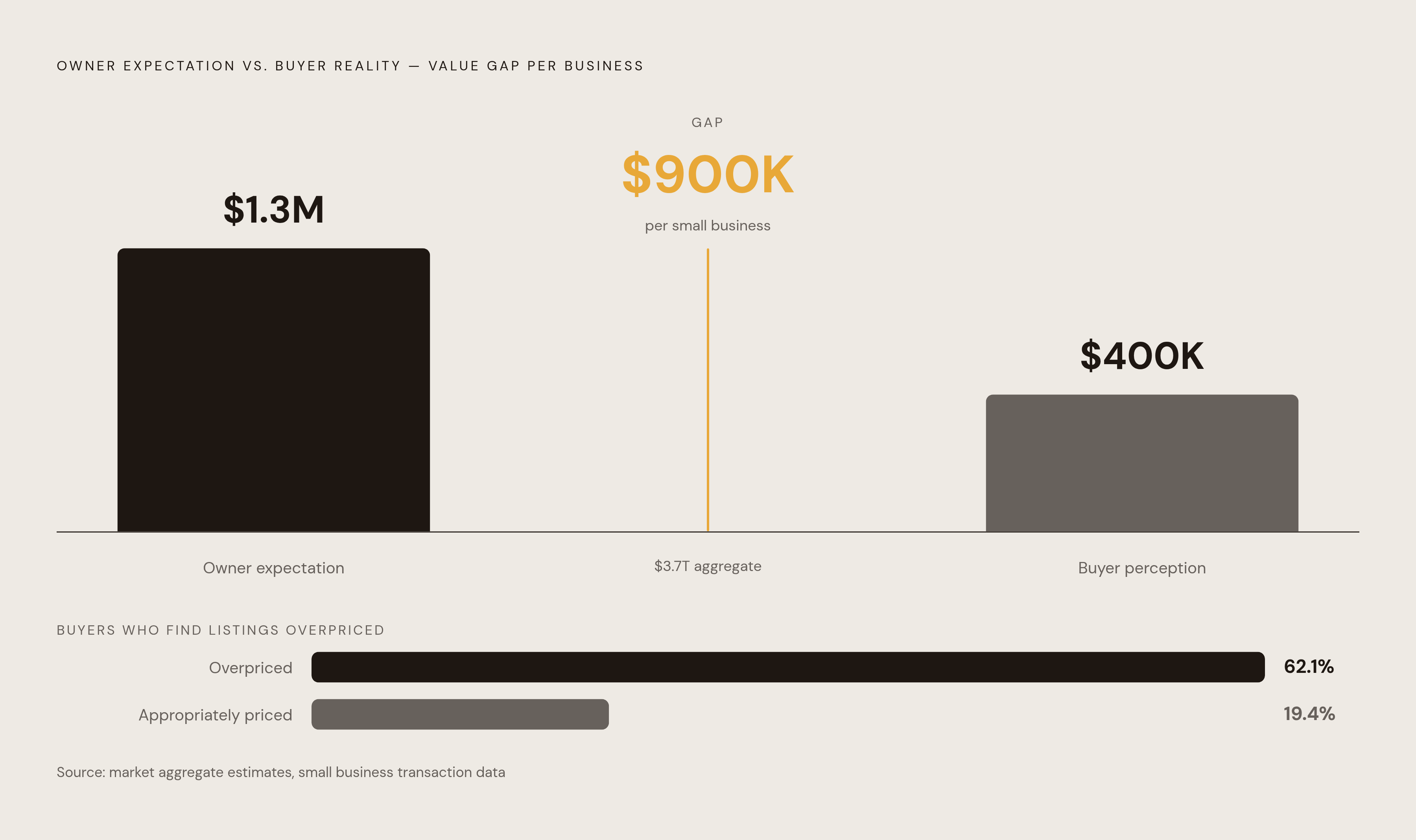
What one 2023 study called the Value Gap produces this pattern: it is the difference between what an owner believes the business is worth and what a sophisticated buyer will actually pay for it Top 10 Business Exit Strategies in 2025–2026. Aggregated across the market, that gap runs to roughly $3.7 trillion, which breaks down to about $900,000 per small business and as much as $1.3 million for a mid-market company. The average owner is walking into a negotiation with a number in their head that the buyer on the other side of the table has no intention of paying, and often good reason not to.
None of this is a case for pessimism. It's a diagnosis, and diagnoses are solvable. The Value Gap exists largely because owners treat an exit as a single event, something that happens on a closing date, rather than as a multi-year process that either builds value or leaves it unrealized. The rest of this piece is about what closing that gap actually requires, and why the answer keeps landing on a specific number of years rather than a vague sense of "eventually." The same structural dynamics apply to founder-led profitable businesses across Canada in the $500k–$50M revenue range.
What the current buyer market rewards
Deal activity itself isn't the problem. In the first quarter of 2026 alone, 2,345 small businesses changed hands, representing roughly $2 billion in enterprise value BizBuySell Q1 2026 Insight Report. Buyers are out there, capital is moving, and transactions are closing every week. Who's actually winning those deals: the market has split cleanly into two camps BizBuySell 2024 Insights Report. Strong, cash-flowing businesses with clean books draw premium offers. Flat or reactive sellers sit on the market and wait. As of April 2026, operational maturity, the kind of discipline that used to set a business apart from its competitors, has become table stakes rather than a differentiator.
That bifurcation is sharpened by a pricing disconnect that ought to give every prospective seller pause. 62.10% of buyers believe the businesses currently on the market are overpriced, and only 19.35% consider current listings appropriately priced BizBuySell Insight Report. That's not a minor gap in perception. It suggests that a large share of sellers are still operating off the same optimistic self-assessment that produces the Value Gap in the first place, and buyers, who see hundreds of these listings, have simply stopped taking sticker prices at face value.
The capital backdrop shapes how aggressive buyers can afford to be. The effective federal funds rate sat in the 3.5% to 3.75% range through the first half of 2026, following rate cuts in late 2025. That's a more predictable borrowing environment than small business buyers faced a few years earlier, though nowhere near the loose, cheap-capital conditions of the pandemic era. Buyers can finance deals. They're just not desperate to overpay for the privilege.
Who exactly is doing the buying has also shifted. MBAs running search funds, and private equity firms that used to stay above the small business tier, are all moving further down-market in search of deals. That's good news for sellers in one sense: more buyers means more competition for good businesses. But it's a double-edged sword, because these buyers tend to be more sophisticated and considerably more demanding about documentation than the individual buyer of a decade ago. What they scrutinize has become fairly standardized: financial patterns across multiple years, profit margin consistency, customer distribution, and leadership structure independent of the founder.
That point threads through everything that follows. The businesses drawing the strongest offers right now aren't simply profitable. Plenty of businesses are profitable. They're prepared, in the specific and fairly narrow sense that buyers define preparation. Everything from here forward is about what that preparation actually requires, and on what timeline.
Why three years is the minimum viable runway, not an arbitrary target
Three to five years is described as the gold standard lead time for mid-market exit planning. The answer isn't convention. It's mechanical. A handful of the levers that move valuation the most, entity structure, QSBS holding periods, ESOP formation, reducing owner dependency, maximizing retirement plan contributions, simply cannot be executed in the six months before a listing goes live. Each one has its own gestation period, and most of them are legal or structural in nature, so they can't be rushed without abandoning the tax or governance benefit that made them worth doing at all.
Skip the runway and the market has a way of making the cost visible. Reactive, forced exits routinely close at valuations well below what a prepared sale would have achieved, and buyers, who are trained to read financial statements for signs of distress, can often sense desperation and negotiate accordingly. A seller with three years of runway does.
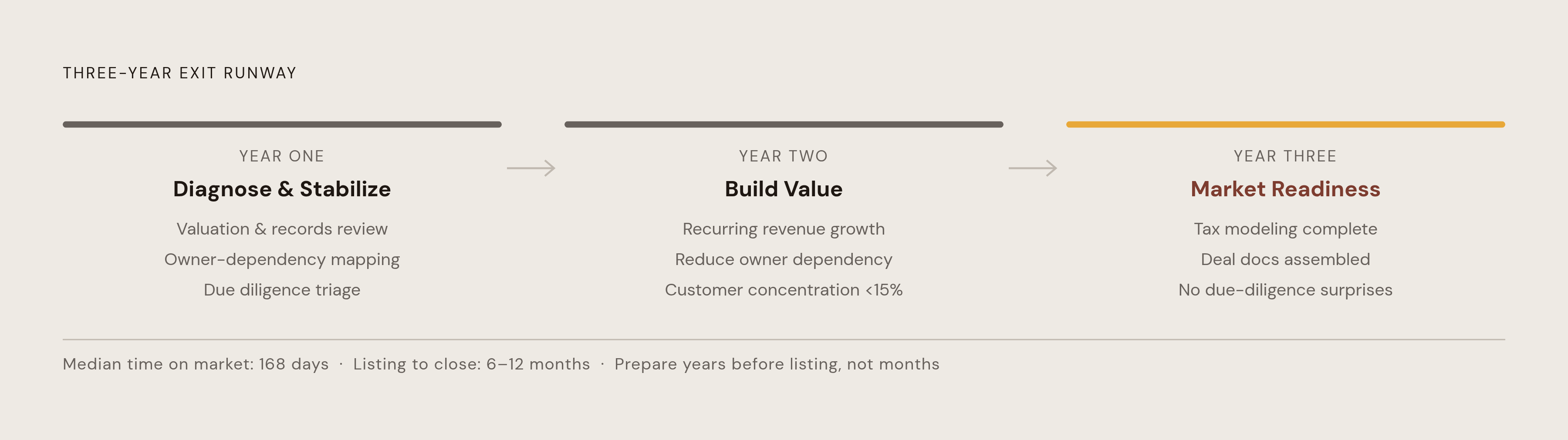
Conveniently, three years also happens to map onto three distinct kinds of work, each with its own primary objective: diagnosis and stabilization first, then value creation, then market readiness. That's not a coincidence so much as a reflection of how businesses actually change. There's a reason succession planning is broader than exit planning. Exit planning asks how to sell and minimize taxes. Succession planning asks what has to be true, financially, legally, operationally, for the exit to happen on the owner's own terms and timeline. Tax strategy is downstream of succession, and no amount of clever exit-year tax strategy fixes a business that was never restructured to be sellable in the first place.
So why do so few owners start early? Two psychological obstacles come up repeatedly: 63% say it's too early to think about, and 45% say they're simply too busy running the business to plan its eventual sale BizBuySell 2024 Insights Report. The three-year frame exists specifically to answer both objections at once, by breaking an overwhelming, abstract project into three sequential years of concrete, manageable work.
Year One: business valuation and its drivers
Year One has a single objective: diagnose and stabilize. Before anything else gets built or fixed, an owner needs an honest number, and an honest account of what's suppressing it.
That starts with a professional valuation, not a guess based on an industry rule of thumb. Businesses that get a valuation from a certified professional typically sell for 90% or more of their appraised value; those that skip it close around 70%. The methodology shifts with size. Across roughly 9,500 transactions tracked in 2025, the all-industry average landed near 2.5x SDE, a useful benchmark, though not a ceiling to aim for.
Financial records need the same scrutiny. Buyers and their lenders will ask for three years of tax returns that reconcile cleanly to internal profit and loss statements. Owner add-backs, personal expenses run through the business, one-time costs, the owner's own salary, need to be documented defensibly rather than simply asserted, because a buy-side quality-of-earnings review that disallows even a modest share of proposed add-backs multiplies that loss by the exit multiple. A single disallowed dollar of EBITDA at a 4x multiple is four dollars gone from the final price Top 10 Business Exit Strategies in 2025–2026.
Owner-dependency deserves the same honest look. A business that can't function without its founder isn't really an asset in the buyer's eyes; it's a job that happens to be for sale, and buyers respond to that by discounting hard or walking away entirely. Year One is the moment to map, with some precision, which client relationships, licenses, contracts, and daily decisions run through the owner personally rather than through the organization BizBuySell Q1 2026 Insight Report.
Due diligence, when it eventually arrives, will move through nine specific areas: financial, tax, revenue and customers, owner dependence, employees, contracts and leases, licenses and permits, legal, and assets. Using that same list in Year One, as a triage checklist rather than a future exam, tells an owner exactly where the remediation work needs to start. About 70% of business owners rely on the business's income to fund their lifestyle, so knowing the specific dollar figure needed from an eventual exit should shape which improvements get prioritized first.
Year Two: building the specific qualities buyers pay a premium for
If Year One is about seeing the business clearly, Year Two is about changing what buyers actually see BizBuySell 2024 Insights Report. Not all growth adds exit value, since plenty of owners spend a year chasing top-line revenue that never appears in the eventual multiple. The goal instead is targeting the specific factors buyers price into an offer.
Recurring, contracted revenue sits at the top of that list. It adds a meaningful premium to valuation multiples, and in B2B SaaS specifically, that premium can exceed 60%. The logic is straightforward: a buyer paying for a business is really paying for its future cash flow, and a contract or subscription base makes that future far more certain than a book of one-time transactions. Certainty gets priced in directly.
Owner-dependency reduction, mentioned as a diagnosis in Year One, becomes construction work in Year Two BizBuySell 2024 Insights Report. That means documenting every core process in writing, and pushing real decision-making authority down to a management team that can operate without the owner in the room. It also means physically shifting key client relationships away from the founder and onto the company itself, since that's the only way the owner-dependency discount actually gets removed rather than just disguised.
Customer concentration deserves its own line of attention. Once a single customer accounts for more than 15% to 20% of total revenue, that's a structural red flag that will either depress the valuation outright or force concessions in deal structure, an earn-out tied to retention, for instance. Year Two is the window to diversify that base, before the concentration turns into a negotiating weapon the buyer's side gets to use.
Every strategic decision made this year, a new hire, a capital investment, a new product line, should be run through a simple filter: does this increase how transferable and defensible the business is, or does it just bump this year's revenue. Sector matters here too. Industries with recurring revenue, licensing barriers to entry, and active private equity interest, HVAC, plumbing, dental, insurance, trade at the high end of valuation ranges, while restaurants and highly owner-dependent professional services are at the low end. Growing into the next size tier isn't just growth for its own sake. It's a valuation strategy in itself. Deal size moves multiples more than industry alone: businesses under $500K trade around 2.0x SDE, while businesses in the $5M–$50M range trade at substantially higher EBITDA multiples per IBBA Market Pulse Q3 2025 (S1), so growing into the next size tier is itself a value strategy.
Year Three: preparing the business and the owner for the actual transaction
Every issue a buyer's due diligence team uncovers on its own becomes a point of leverage against the seller. A problem the seller has already identified and priced in, or fixed outright, loses that leverage entirely.
Practically, that means organizing every piece of deal documentation before the first buyer conversation happens, financial statements, customer data, operational procedures, all assembled and ready rather than scrambled together after an offer arrives. That level of organization signals professionalism to a sophisticated buyer and keeps deal momentum from stalling, because stalled deals are where buyers start re-trading price. The three clean years of financials this depends on were the whole point of Year One's work, not something an owner can improvise in the final quarter before listing.
Timelines deserve honest expectations. Median time on market fell 3% to 168 days in 2024, though that figure covers time on market only, not the full process from preparation through close. Realistically, the period from listing to closing runs 6 to 12 months, and the complete arc including preparation stretches considerably longer than that.
What actually gets kept affects net proceeds far more than the headline sale price, since deal structure determines net proceeds far more than most owners expect going in. An asset sale and a stock sale carry different tax consequences and appeal to different buyers. Earn-outs have become common in 2026, particularly for sellers carrying customer concentration or owner-dependency issues into the deal, and understanding what triggers an earn-out payment, and what risk it creates, matters before signing rather than after. The 2025 IBBA Market Pulse found that roughly 40% of small business transactions include seller financing, averaging 30% to 40% of the purchase price.
None of this holds together, though, without a clear answer to a more personal question: what happens after the wire transfer clears? About 42% of owners plan to retire outright, 39% intend to invest in another business, and 31% plan to pursue philanthropy. Knowing which of those categories actually applies shapes which deal structures are even acceptable to consider, since a retiring owner and one planning to redeploy capital into a new venture have very different tolerances for earn-outs and seller notes. Owners who never define that post-exit purpose tend to be the ones who feel regret afterward, regardless of the price achieved.
Tax modeling belongs here too, in Year Three, because it's the last point at which meaningful planning is still possible. Tax modeling in Year Three, not the exit year, is the last window for meaningful tax planning. Once due diligence begins in earnest, they're locked. The primary objective for Year Three is to eliminate surprises (every issue discovered during due diligence becomes a downward negotiating point, and a prepared seller has already priced or fixed them).
The five exit paths and their fit with different owner situations
No single exit path is objectively best. The right one depends on the owner's goals, timeline, employees, and financial situation.
A third-party sale, to either a strategic buyer or a financial buyer such as a private equity firm, remains the most common route and typically produces the highest valuation, since strategic buyers pay for synergies a financial buyer wouldn't value the same way. From signed letter of intent to closing typically runs 2 to 6 months, though the full process from preparation to close usually spans 6 to 12 months, and deal structures increasingly layer in earn-outs and seller financing. This path suits owners after a clean break and the highest achievable price, and financial buyers specifically can offer a partial cash-out with a "second bite of the apple" later, relevant for owners willing to stay on through a transition period.
A management buyout runs 10% to 25% cheaper than a third-party sale, simply because an internal buyer can't pay the strategic premium an outside acquirer might. Financing usually blends seller notes, SBA loans, and whatever cash the buyer brings, and owners accept the lower price in exchange for preserving the business's legacy, keeping employees in place, and maintaining existing customer relationships. Timelines run roughly 6 to 12 months.
The tax mechanics differ by entity type: a C-corp ESOP allows the seller to defer capital gains under a Section 1042 rollover by reinvesting proceeds into Qualified Replacement Property, while an S-corp structured as a 100% ESOP routes future income to a tax-exempt trust, eliminating federal income tax at the entity level entirely.
Family succession is the longest path by a wide margin, typically unfolding over 5 to 10 years of gradual transfer, and it produces the lowest immediate cash proceeds. It carries its own distinct tax profile: gifted assets lose the step-up in basis a sale would preserve, installment sales to family members get priced at the applicable federal rate, and valuation discounts are available on interests in the operating entity. It fits owners with heirs already active in the business, and who have other sources of retirement income to lean on while the transfer plays out.
Which of these five an owner ends up choosing matters less, in the end, than whether the three to five years leading up to it were spent preparing for the choice at all. A business without that preparation gets to choose from whatever's left. Management buyout (MBO). ESOP (Employee Stock Ownership Plan). Many sellers begin with a partial ESOP (capturing tax savings on partial liquidity), then transition to majority and eventually full employee ownership over a multi-year period. The timeline is 6–12 months to form and fund, with complex cases possibly taking up to 24 months, making it best for owners who value employee legacy and can tolerate the formation process.