SaaS Business Valuation for Founders Selling Under $50M ARR
Four specific metrics now determine what founders actually get for their SaaS business.

Software M&A hasn't gone quiet. It's gone precise: the multiple a founder actually gets for a sub-$50M ARR business now depends less on the headline range everyone quotes (3x to 7x ARR, roughly) and more on four specific levers: growth rate, gross margin, net revenue retention, and Rule of 40 performance. The spread between a deal priced at the bottom of that range and one priced at the top has rarely been wider. This piece walks through why, lever by lever, and takes a position most sellers won't like: the metric they're proudest of is usually not the one deciding their price.
How the 2021 peak distorted founder expectations
Founders raising or selling in 2021 got used to numbers that, in hindsight, described a market anomaly rather than a baseline. Category-leading public SaaS companies traded at 15x to 20x ARR that year, and high-growth bootstrapped private businesses fetched 10x to 15x, figures that reflected the peak of a historic anomaly. Those multiples had no real precedent. It turns out they had no staying power either.
Public multiples peaked near 18.6x in late 2021 and then fell sharply, landing, by the start of 2026, close to where they sat back in 2015 and 2016. That wasn't a dip that snapped back and corrected itself. It was a correction to where fundamentals had said the market should be all along. The years in between were the aberration, not the reset. Realistic 2026 multiples across every ARR tier now run 30% to 50% below the 2021 peak, and treating that peak as a reference point is the single fastest way for a founder to misprice their own business before a conversation even starts.
So why do founders still walk into these conversations quoting 2021-era numbers? Content written during the boom is still the first thing that shows up in a search, still gets shared, still shapes expectations years after the market moved on. The public-market datasets founders lean on, aggregates like NYU Stern's that span hundreds of listed software companies including trillion-dollar names, describe the economics of a company like Microsoft far more accurately than they describe a small vertical SaaS business with modest ARR, two enterprise customers, and a five-person team. That data answers a different question than the one most founders are asking, and mistaking one for the other is where the expectation gap starts.
What private SaaS deals transact at across each ARR band from sub-$1M to $50M
Private companies carry a structural discount to public comps, generally 30% to 50%, with a an additional liquidity discount layered in at the same ARR level. That's a persistent feature of how illiquid, founder-run businesses get priced against companies with daily trading volume and audited quarterlies, not a temporary market condition waiting to correct itself.
Below $1M ARR, the business gets priced as a job, because that's how buyers actually treat it. They value it on seller discretionary earnings (SDE), not ARR: at that size, revenue without profit doesn't mean much to the individual operators and small search funds who make up the typical buyer pool in that bracket. Typical multiples run 2x to 4x SDE. Analysis of micro-SaaS deal data finds bootstrapped SaaS companies under $1M ARR averaging 2.85x profit multiples, with the top quartile, the ones with low churn and high gross margin, reaching as high as 6.13x.
Between $1M and $3M ARR, the buyer pool stays thin (mostly individual acquirers and small search funds), and multiples run around 2x to 4x ARR. The real shift happens between $3M and $5M, sometimes called the inflection zone, where growth PE firms and larger strategics start paying attention for the first time. Multiples widen meaningfully here, and the widening has a mechanical explanation: more buyers competing for the same asset is what moves price, not some magic quality the business acquires at $3M that it lacked just below that threshold.
Net revenue retention: the metric that most non-linearly separates a premium exit from an average one
Net revenue retention (NRR) measures whether existing customers spend more, the same, or less over time, stripped of any contribution from new logos. Above 100%, the existing base is growing revenue on its own. A buyer underwriting that business isn't just buying a revenue stream. They're buying a growth engine that keeps running even if new customer acquisition stalls for a quarter or two.
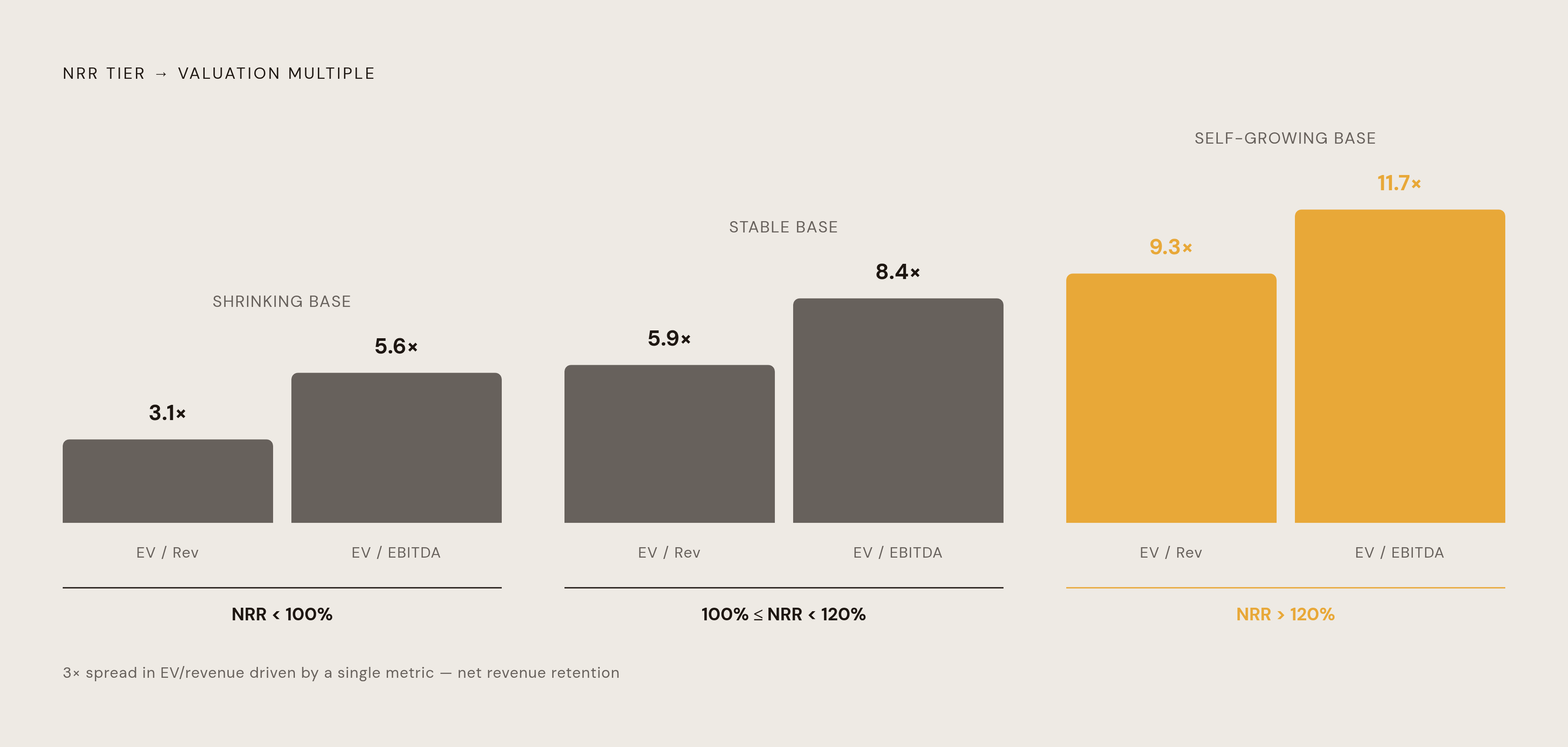
The valuation impact is a cliff. Public SaaS companies with NRR above 120% traded at a median of roughly 9.3x EV/revenue, compared to 3.1x for companies below 100%, a 3x spread attributable to a single metric. On the EBITDA side, businesses above 120% NRR commanded multiples around 11.7x versus an industry median of 5.6x, more than double. Why does one number swing valuation this hard? Growth can be bought with ad spend. Retention has to be earned, deal by deal, renewal by renewal. That's why buyers weight it so heavily: it's the one number that's hard to fake for more than a couple of quarters.
Segment context matters here too, and it argues against treating NRR as a single universal bar. Segment-level benchmarks show enterprise SaaS (deals above $100K ACV) running a median NRR of 118%, mid-market ($25K to $100K ACV) at 108%, and SMB (below $25K ACV) at 97%. That gap reflects smaller contracts and higher logo churn, a structural reality of the segment rather than a knock on the founders working in it. But it does mean a SaaS business built on SMB contracts has to lean harder on every other lever to be in the same valuation tier as an enterprise peer, since the NRR line alone won't carry it there.
Rule of 40: how the growth-profitability tradeoff is scored in 2026
Rule of 40 adds revenue growth rate to EBITDA (or free cash flow) margin, and a combined score at or above 40 signals a business balancing growth against burn rather than choosing one at the total expense of the other. By most accounts it's become the strongest single predictor of SaaS valuation multiples, outperforming either growth or profitability examined on its own.
The relationship is close to linear and directly underwritable: each meaningful improvement in Rule of 40 score corresponds to a measurable lift in EV/revenue multiple, the kind of relationship a CFO can actually plan a roadmap around. Companies consistently clearing 40 tend to land in upper single-digit revenue multiples, but the ones trading above 7x EV/revenue are concentrated among businesses scoring above 50 on a free cash flow basis, not merely brushing past the threshold.
Most founders get it backwards, and it costs them at the negotiating table. A 45 built mostly on growth (strong double-digit growth against negative 10% margin) and a 45 built mostly on profitability (15% growth against 30% margin) score identically on paper. Buyers do not treat them the same, and they're right not to. A profitability-driven 45 tells a buyer the unit economics already work at current scale, which lowers integration risk. A growth-driven 45 tells a buyer there's a bigger market opportunity still being captured, which raises the ceiling but also the execution risk. Diligence teams read the composition of the score, not just the sum, and they structure earn-outs and hold-backs differently depending on which flavor of 45 they're looking at. A founder who treats the two scores as interchangeable, because the arithmetic matches, usually finds out otherwise about six months into a process.
Growth rate and gross margin: how these two inputs set the tier your business competes in before NRR and Rule of 40 fine-tune it
Growth rate and gross margin are gatekeepers. They decide which tier of buyer even looks at the business before NRR or Rule of 40 gets a chance to move the number within that tier, and no amount of retention story fixes a business that never clears the gate.
Below roughly 15% growth, most buyers stop thinking in ARR multiples altogether and switch to EBITDA-based pricing. At that growth rate, the business reads as a cash flow asset, and the only question left is what EBITDA multiple it deserves. Higher growth rates put the business in competition for growth PE and strategic buyer attention, progressively widening the buyer universe. The relationship isn't a straight line, though: a company growing at 40% commands roughly double the multiple of one growing at 10%. Clearing that first threshold does more for the multiple than marginal gains at the high end, so early growth acceleration matters most.
Gross margin works as a gate too, just a quieter one. For ARR multiples to apply defensibly, especially in vertical B2B SaaS, buyers expect gross margin above a threshold consistent with the public SaaS benchmarks most diligence teams use as a reference. Slip below that margin threshold while CAC payback stretches into uncomfortable territory, and the business stops looking like a growth investment in a buyer's model and starts looking like a structural cash trap, one borrowing against future revenue to fund today's customer acquisition. Margin is also a proxy for something buyers can't directly observe in diligence: whether the unit economics survive as headcount and infrastructure scale up after close. A platform acquirer bolting the business onto a larger portfolio needs confidence the margin profile doesn't erode the moment the founder's personal touch disappears from onboarding and support.
Growth and margin set the basis and the buyer pool. NRR and Rule of 40 then decide where inside that range the deal actually prices. The move that appears in a term sheet, every time, is improving all four levers together well before a business goes to market, not scrambling to fix one metric in the six months before a process starts. Diligence teams can tell the difference: a metric that's been true for eight quarters carries more weight than one that's been true for two.
Vertical B2B SaaS commands a consistent premium over horizontal tooling, with the spread reflecting structurally higher switching costs and stronger NRR. Higher switching costs and stronger NRR in vertical products explain most of that gap. Positioning a business vertically doesn't just add a premium on its own, either. It amplifies the return on improving every other lever, since the same NRR gain or Rule of 40 improvement lands on a higher base multiple to begin with.
What buyers are testing in diligence when they price the multiple
The metrics get a founder into the room. What happens in diligence decides whether the deal prices at the top or the bottom of the range those metrics implied, and most founders underestimate how much of that decision has nothing to do with the numbers on the pitch deck.
Founder dependency is the first thing most buyers probe below $10M ARR, and it's arguably the single most common reason a lower-middle-market deal is at the bottom of its band regardless of how clean the numbers look on a spreadsheet. Can the business run its renewal cycle, its roadmap, its key account relationships, without the founder in the room? If the honest answer is no, buyers price that risk in immediately, no matter what the growth rate or NRR figure says.
Customer concentration is the second stress test, and it directly undercuts the NRR story built earlier in this piece. A single customer above roughly 10% of ARR draws attention from PE buyers. Crossing 20% typically triggers escrow provisions or an earn-out structure. Crossing 30% can end a private equity process outright, because a retention number built on a handful of relationships is really a bet on a few contracts renewing on schedule, dressed up as a growth metric.
The newest line of questioning in 2026 diligence concerns AI substitution risk. Buyers are now asking, explicitly, whether the workflow a SaaS product automates could be replicated by a general-purpose AI agent within two or three years. A product with clean churn numbers today still gets discounted if the underlying task looks easy to commoditize. That scrutiny has made buyers noticeably more skeptical of thinner, workflow-layer SMB tools, where defensibility was always more about switching friction than any deep technical moat, and where AI-native competitors are starting to erode that friction first.