Valuation Multiples for Engineering and Technical Services Firms
Owners can hit 12x EBITDA or fall to 3.5x—here's what actually drives the difference.

Valuation multiples for engineering and technical services firms run from the mid-3x range all the way past 12x EBITDA, and that spread is not random. A handful of operating factors, mostly things an owner can see and change years before a sale, decide where inside that band a given firm actually lands.
Start with the range itself. CT Acquisitions' 2026 guide reports that lower-middle-market engineering firms typically trade at 4x to 8x adjusted EBITDA, while premium civil, environmental, transportation, and defense specialists reach 9x to 12x. That's nearly a 3x gap within a single specialty, which raises an obvious question: what exactly is a buyer pricing when two firms in the same niche land four turns apart? The answer, worked through across this piece, comes down to backlog quality, owner dependence, licensure footprint, and contract mix, in that rough order of weight.
One mistake shows up often enough to flag early: owners benchmark their firm against headline strategic deals, the kind WSP Global, Stantec, or Kimley-Horn announce as platform acquisitions at 10x to 14x. Bolt-on acquisitions, which is what most privately held engineering firms actually sell into, close 30% to 40% below those platform numbers. A firm's real comp set is the bolt-on market, not the press release. Keep that distinction in mind, because it reframes almost everything that follows: the multiple is a compressed judgment about how durable future cash flow looks to a buyer, and durability is measurable well before a firm goes to market.
The M&A market engineering firms are selling into in 2025-2026
PSMJ data show that 447 announced AEC M&A transactions closed in 2025, essentially matching the recent pace of the sector though still short of the all-time high of 493 set in 2022. Capstone Partners' AEC update shows year-to-date 2025 volume ran at 131 deals announced or closed, against 137 in the same period the prior year, following two straight years of growth that saw sector volume climb 24.2% year-over-year in 2024.
That modest pullback has a specific cause. Tariff uncertainty through 2025 pushed private strategic buyers to slow down and wait, and Capstone Partners pegs private-side activity down roughly 10 transactions year-over-year as a result. Public buyers did the opposite. Their deal volume rose 25% year-over-year, picking up the inorganic growth private buyers backed away from. That's a bifurcated buyer pool, and it matters for anyone thinking about timing a sale: public strategics are hunting right now, private strategics are more cautious, and which camp shows up to a given firm's process depends heavily on size, specialty, and geography.
Private equity's footprint keeps growing too, whether through direct pure-play investment or through sponsoring strategic acquirers, and Westwood's 2025 M&A update notes that the largest AEC firms are increasingly PE-backed. Looking into 2026, deal activity is expected to stay steady but selective, with buyers continuing to focus on high-demand specialties. None of that changes the fundamentals covered in the sections ahead, but it does explain why the question of "what moves my multiple" carries more urgency now than it might have five years ago. Buyers are active, selective, and increasingly institutional, which means they price risk with more precision than a generalist buyer from a decade back would have.
Multiple ranges by engineering and technical services segment
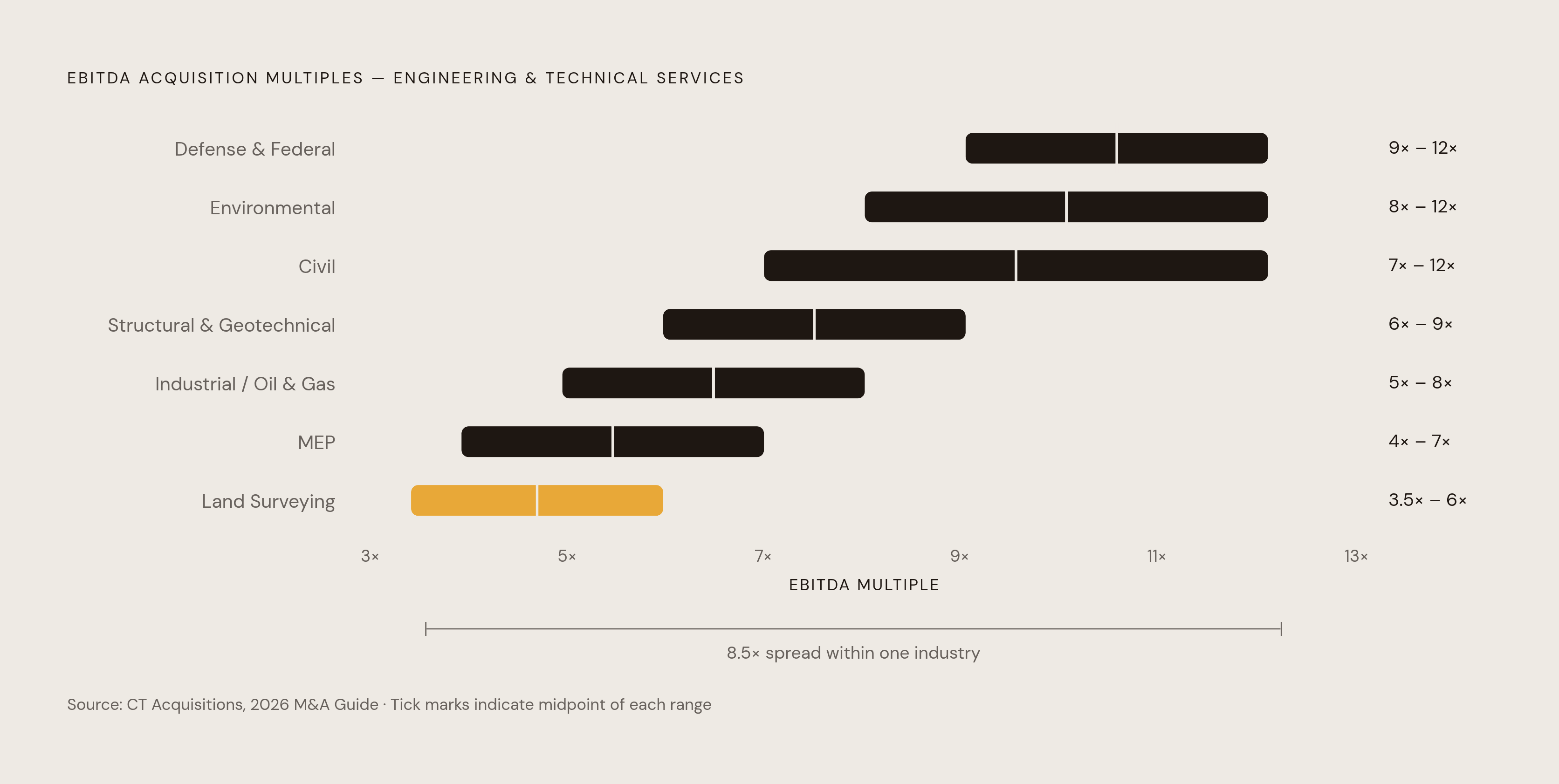
The headline 4x-to-8x band hides a lot of variation once you break the market out by specialty. CT Acquisitions' 2026 guide lays out the following ranges exactly as sourced, because the spread between segments tells its own story about what buyers are willing to pay for.
Civil (land development, transportation, water): 7x to 12x EBITDA, 0.9x to 1.5x revenue. Buyer intensity is very high, with acquirers like Kimley-Horn, WSP, and Stantec actively competing for assets.
Environmental (remediation, ESG, permitting): 8x to 12x EBITDA, 1.0x to 1.6x revenue. Also very high buyer intensity, with WSP, Tetra Tech, and ERM among the active names.
Structural and geotechnical firms trade at 6x to 9x EBITDA, 0.7x to 1.2x revenue. High buyer intensity, but a notch below civil and environmental.
MEP (mechanical, electrical, plumbing) firms trade at 4x to 7x EBITDA, 0.5x to 0.9x revenue. Buyer intensity is moderate, weighed down by commodity-style pricing risk baked into a lot of MEP contract work.
Defense and federal specialty firms trade at 9x to 12x EBITDA, 1.2x to 1.8x revenue. Very high buyer intensity from names like Leidos, Parsons, and KBR.
Industrial process, oil and gas firms trade at 5x to 8x EBITDA, 0.6x to 1.0x revenue. Moderate buyer intensity, tempered by commodity cyclicality.
Land surveying, standalone firms trade at 3.5x to 6x EBITDA, 0.4x to 0.7x revenue. Low to moderate buyer intensity, the lightest end of the whole spectrum.
Outside pure engineering, adjacent segments give useful context. IT and technical services deals carried a median EV/EBITDA of 10.4x across more than 500 transactions tracked between 2015 and the first half of 2026, and Mergermarket and Aventis Advisors data put H1 2026 EV/Revenue at a median of 1.3x across 22 deals, a partial recovery from the 2023 trough. RL Hulett's Q4 2025 update shows industrial services, which sits close to engineering on the buyer's map, actually cooled a bit: mean EV/EBITDA for strategic deals dropped to 7.0x in 2025 from 8.2x in 2024, even as deal volume climbed 17.3% quarter-over-quarter, up to 258 deals in Q4 from 220 in Q3. Aerospace and defense has historically held at elevated multiples, and for smaller suppliers in that space, regulatory and certification requirements tend to be a meaningful swing factor on price.
At the small end of the market, the picture looks completely different. BizBuySell's 2025 data puts the median architecture and engineering firm sale at $825,000, against median seller's discretionary earnings of $451,450, a different buyer universe entirely, and one that gets analyzed on SDE rather than EBITDA. For planning purposes, public-company benchmarks are a steadier anchor than headline averages, which get pulled around by outliers. Equidam's public-company data, as of July 4, 2026, places Construction & Engineering at 6.25x EBITDA and Testing Laboratories at 9.55x, useful floor-and-ceiling reference points for where the public market sits relative to private deal pricing.
How backlog quality determines where in the range a firm lands
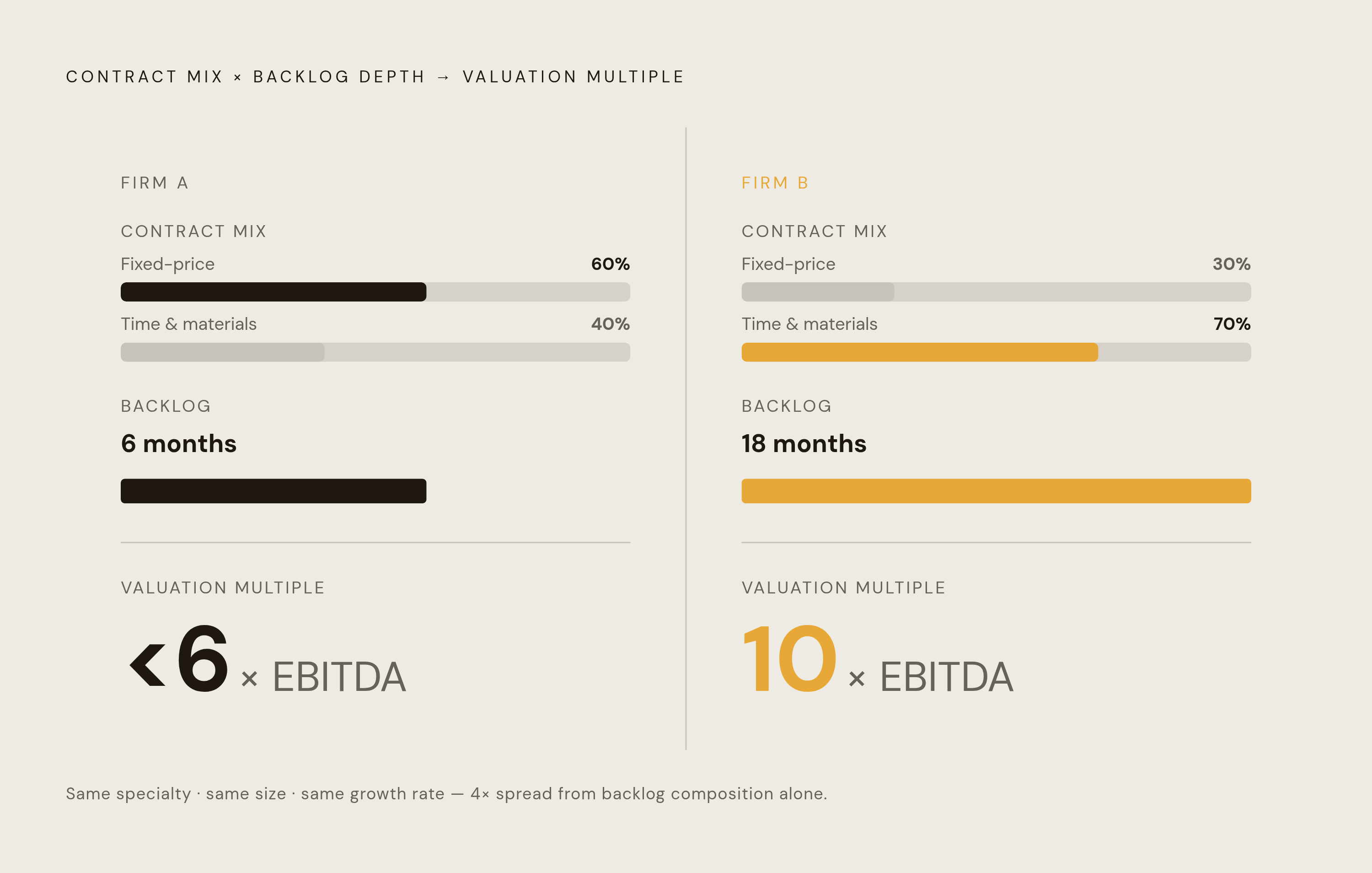
Here's the starkest example in CT Acquisitions' 2026 data: a civil engineering firm running 60% fixed-price contracts with six months of backlog will not clear 6x. The same specialty firm, running 70% time-and-materials work with 18 months of backlog, can attract 10x from a strategic acquirer. That's a 4x spread inside one specialty, driven entirely by backlog composition rather than by size or growth rate.
Why does backlog carry so much weight? Because it's the only forward-looking cash flow signal a buyer can actually underwrite with any confidence. Signed backlog under a master service agreement is about as close as an engineering firm gets to recurring revenue, and buyers price recurring revenue very differently from one-off project wins. Buyers look for contracted backlog that covers a substantial forward period of net service revenue, paired with new wins keeping pace with revenue recognized. Fall short of that and the multiple compresses, almost mechanically.
The current market gives some sense of how common strong backlog actually is right now. ACEC's 2025 data shows a meaningful share of firms reporting a workload pipeline of a year or more, suggesting that strong backlog is becoming more common across the industry rather than a rare outlier. That raises the bar for anyone still sitting on a thin pipeline heading into a sale process.
Raw backlog dollars, though, aren't the whole story. Contract type matters: time-and-materials and cost-plus arrangements preserve margin for the firm, while fixed-price work shifts risk onto the seller and compresses the multiple a buyer is willing to pay. Client type matters too, since blue-chip private clients, federal agencies, and municipalities read very differently to a buyer than a handful of speculative developer relationships. And funding certainty separates backlog that's signed and funded from backlog that's still sitting at proposal stage, which a buyer will often discount heavily or ignore outright.
Against that backdrop, ACEC's 2025 Engineering Business Outlook reported median trailing-twelve-month revenue growth of 8.4% and net operating profit margins of 12.6% across the industry. That's the baseline a firm's own backlog-to-revenue ratio should get measured against, not some abstract ideal. A firm sitting well above those medians on both growth and margin, with backlog quality to match, has a real case for landing at the top of its segment's range. Backlog answers how much future work is locked in. It doesn't answer who's actually running that work, which is where the next risk factor comes in.
Owner dependence and key-person risk as a direct multiple discount
If the owner is the one bringing in the revenue, holding the client relationships, and signing off on technical review, a buyer discounts the multiple for it, often shifting the whole valuation approach from EBITDA-based to SDE-based, which compresses proceeds substantially. CT Acquisitions' industry data shows professional services firms broadly trade at 4x to 7x EBITDA, but firms where the partners essentially are the practice, where nothing transfers without them, are 3x to 5x, and usually with heavy earnout structures attached.
Licensed engineers sit at the center of this problem in a way that's specific to the industry. A buyer will often reject the addback for a principal engineer's compensation if that engineer's stamp is load-bearing to client contracts, since the work legally can't proceed without that person's license attached to it. That seat has to get filled at replacement cost, or the revenue tied to it simply leaves when the owner does. Key-person risk isn't a footnote next to the EBITDA calculation; it sits inside the calculation itself.
This is also the mechanism behind most earnout structures. Owner dependence is one of the main reasons buyers won't pay full cash at close; instead, they tie a chunk of proceeds to whether revenue actually survives the transition, which is a direct financial consequence of walking into a sale without having solved the key-person problem beforehand. What are buyers actually looking for as evidence the problem's been addressed? A second layer of management that can run client relationships without the founder in the room. No single principal engineer responsible for more than roughly 15% of total billings, which is the threshold CT Acquisitions uses. And client relationships that live with the team and are documented somewhere, rather than sitting entirely in the founder's head and cell phone contacts.
Marketplace data tracked by ctacquisitions.com shows that profit margins for sold architecture and engineering firms climbed from 28.7% in 2021 to 38.1% in 2025. That's a meaningful jump, and it's reasonable to read it as a sign that firms successfully making it through a sale process had built enough management depth to hold margin steady once the owner stepped back, rather than watching performance erode post-close. Owner dependence is a structural risk baked into how a firm operates day to day. Licensure geography, covered next, works differently: it's a transactional friction point, but one with its own measurable bite on the multiple.
Licensure geography and contract mix as pricing friction
Every state requires engineering work to be performed under a licensed Professional Engineer, and most states also require a Certificate of Authorization, or COA, for the firm itself. That single regulatory fact creates a surprisingly large pricing gap. A firm holding active COAs across 15 states can be acquired and folded into a buyer's existing operation within weeks. CT Acquisitions' guide notes that a firm licensed in just one state can force the buyer into 6 to 18 months of reciprocity applications before that capacity is usable, and that delay lowers the price a buyer will pay.
Why does a licensing delay move the purchase price at all? Because it's an integration cost, not a reflection of how good the business is. A buyer acquiring a single-state firm can't deploy that firm's engineers into its existing multi-state project pipeline until the licensing catches up, and that 6-to-18-month gap has a present-value cost that gets subtracted straight out of the offer. Two firms with identical revenue, margin, and backlog can land at different multiples purely because one carries broader licensure and the other doesn't.
Contract mix adds a second layer of friction beyond backlog quality alone, and it centers on client concentration. A firm heavily weighted toward municipal or federal work might show a strong backlog on paper, yet still face procurement delays, political budget cycles, and margin compression that a buyer has to model in. A more diversified private-sector practice, even one growing more slowly on the surface, can command a higher multiple if client retention is stable and utilization holds steady quarter to quarter. And regardless of how strong any single client relationship looks, heavy concentration in one account is a risk factor buyers consistently price into their offers.
Auxo Capital Advisors' AEC deal trend research shows what buyers are actually evaluating under the umbrella of contract mix includes specialization in end markets that are currently active, the share of revenue coming from repeat clients, backlog reconciled against actual staffing and margin capacity (not just a dollar figure sitting on a spreadsheet), stable utilization rates, solid project controls, and clean work-in-progress and receivables. Weakness in any of those areas tends to trigger the same response as owner dependence: an earnout or rollover structure instead of cash at close, driven by a different risk but landing on the seller in the same way.
Why the quoted multiple and the actual proceeds can diverge significantly
Here's where a lot of owners get surprised. A headline multiple almost never tells the full story of what a seller actually walks away with, because earnouts, rollover equity, working capital adjustments, revenue pegs, seller notes, escrow holdbacks, employment agreements, indemnity terms, and whatever diligence uncovered rarely get disclosed next to the multiple that gets quoted around. Auxo Capital Advisors makes this point directly, and it's one of the more important things an owner can internalize before assuming a "9x deal" means nine times EBITDA is in the bank at closing.
CT Acquisitions' guide notes that deal structures commonly include earnouts and other mechanisms designed to manage transition risk can shift actual proceeds a meaningful amount away from the quoted multiple, and that movement runs against the seller almost every time the underlying risk (owner dependence, thin licensure, concentrated contracts) hasn't been dealt with ahead of the sale process.
The EBITDA figure itself is also a negotiation, not a fixed number pulled off a tax return. A properly adjusted EBITDA for a founder-run engineering firm typically comes in meaningfully higher than the reported figure once common addbacks get applied, things like resetting owner compensation to a market-rate replacement cost, adjusting related-party rent paid to an owner-controlled real estate entity back to fair market value, adding back resolved legal costs or failed acquisition expenses, and stripping out non-recurring bad debt tied to a single client's bankruptcy rather than an ongoing collections problem. But every one of those addbacks gets tested line by line during quality-of-earnings review, and not all of them survive. The one that almost never survives: compensation for a principal engineer whose stamp is load-bearing to client contracts. That role has to be replaced at full cost, so the buyer won't let the seller add it back.
Zoom out and the macro numbers put engineering firm pricing in perspective without pretending they set it. Industry valuation guide data puts a global median M&A EV/EBITDA in the double-digit range on a trailing basis, with private-equity-led deals running above that midpoint and corporate-led deals somewhat lower. Engineering firm owners aren't selling at that median, though. They're selling at whatever multiple their specific mix of backlog quality, owner dependence, licensure footprint, and contract concentration actually supports, and that number gets set well before a banker ever puts together a teaser. The levers covered across this piece, backlog composition, management depth, licensing breadth, and client diversification, are largely within an owner's control years ahead of a sale. That's the real takeaway buried inside all these ranges: the multiple isn't handed down by the market so much as built, deliberately or not, by the operating choices a firm makes long before anyone starts talking price.
Sources
- EBITDA Multiples by Industry in 2026 | Equidam
- How to Value an Engineering Firm: 2026 Multiples Guide
- Engineering Firm Valuation Multiples: 2026 Guide | Auxo
- AEC M&A Trends 2026 & Engineering Valuation Signals | Auxo
- westwoodps.com
- go.psmj.com
- Architecture and Engineering Firm Valuation: What's Your A&E Firm Worth in 2026?
- AEC Services Market Update | Capstone Partners