How to Value a Veterinary Practice Before Selling
Learn the EBITDA formula that determines what buyers will actually pay.

Selling a veterinary practice starts with one number that most owners have never actually calculated: normalized EBITDA, run through a multiple that shifts depending on size, doctor mix, and how the buyer pool is shaping up in a given year. Owners who understand how that number gets built, and what moves it, walk into negotiations with leverage. Owners who don't tend to accept whatever figure the first buyer puts on the table.
Consolidation has changed who's doing the buying and how they think about price. Corporate and private equity ownership grew from something like 8% of practices in the country clinics in 2011 to around 30% by 2025, and while independent practices still account for 93.9% of all practices, corporate groups now pull in more than half of companion animal revenue. That's not a contradiction, it's concentration: consolidation clustered around the bigger, more profitable practices rather than spreading evenly across the count. The deal pace itself has been uneven too. PE acquisition activity cooled off after late 2022, with invoice volume dropping at least 2% during that stretch, but Capstone Partners' April 2026 Pet Sector M&A Update logged 18 announced or completed transactions year-to-date, more than double the same period a year earlier. Whatever direction the market is heading, the valuation math that drives it hasn't changed.
How buyers calculate what a practice is worth: the EBITDA-multiple formula
Nearly every corporate buyer runs the same formula: Normalized EBITDA times a Purchase Price Multiple equals practice value. The Ackerman Group treats this as close to gospel in veterinary M&A, and for good reason, it's simple, it's comparable across deals, and it strips out the noise that makes revenue such a poor stand-in for value.
Revenue on its own tells a buyer almost nothing about profitability. A hospital pulling in a large annual revenue with thin margins can be worth considerably less than one doing a much smaller revenue with a clean, well-run cost structure. Buyers care about what's left over after payroll, supplies, rent, and overhead, not the top-line number a seller likes to lead with.
"Normalized" is the part sellers usually get wrong or skip. Start with operating earnings, add back interest, taxes, depreciation, and amortization (the standard EBITDA build), then layer on owner-specific adjustments that reflect how the practice would run under new ownership. The result represents the cash flow a buyer can actually count on once the current owner's personal habits are stripped out of the P&L.
Those adjustments, or add-backs, tend to fall into a familiar set of categories. Owner compensation gets reset to fair market rate for a DVM in that role, so if the owner's been taking out more than a market salary, the excess gets added back to EBITDA; if they've been underpaying themselves, that gets adjusted the other direction. Personal vehicles, family travel, or family health insurance run through the business get pulled out. So does payroll for family members earning above documented market rate, one-time legal fees or equipment repairs that won't recur, continuing education spending well above industry norms, below-market rent when the owner holds the real estate separately, and associate or relief staffing costs expected to normalize after the sale closes. Each of these, done carefully and with paperwork to back it up, raises the EBITDA base the multiple gets applied to. Done sloppily, they raise red flags with buyers who've seen every trick in the book.
The three other valuation methods buyers and appraisers use (and when each one applies)
EBITDA multiples carry the most weight in most veterinary transactions, but they're rarely the only method in the room. Lenders, credentialed appraisers, and larger PE buyers often cross-check the number using at least one other approach, so understanding the full toolkit keeps a seller from being blindsided by a method they've never heard of.
Discounted Cash Flow, or DCF, projects a practice's revenue, margins, capital spending, and working capital needs out several years and discounts that stream back to a present value. Larger PE buyers modeling a deal in real detail lean on this, and appraisers use it too, particularly in litigation or partnership disputes where the math needs to hold up under scrutiny. A modest change in the assumed growth rate can swing the resulting valuation by a wide margin for a small practice, because DCF is only as good as its assumptions. That fragility is why it's used less often for straightforward sell-side deals.
The market, or comparable sales, approach values a practice by looking at what similar clinics sold for. In theory it's the most intuitive method. In practice, it runs into a wall: most veterinary clinics are privately held, not publicly traded, and AmeriVet has pointed out that the approach depends on data from publicly-held companies, which the vast majority of veterinary practices simply are not. That leaves thin, often unreliable comparables. It can serve as a sanity check on a number derived some other way, but it rarely drives the final price.
The asset-based approach sums up tangible assets, equipment, inventory, furniture, leasehold improvements, and sometimes real estate, while goodwill gets either excluded or estimated as a separate line. For a healthy, growing, going-concern practice, this method sets a floor rather than a realistic sale price. A well-run hospital is worth a good deal more than its digital X-ray unit and waiting-room furniture. Asset-based valuation becomes more relevant when revenue is falling sharply, or when the seller is the sole DVM and is exiting the practice entirely, since goodwill tied that closely to one person doesn't transfer well to a new owner.
What the multiple is: ranges by practice type and size in 2025–2026
The multiple isn't a fixed constant, it's a range, and where a given practice lands inside that range depends on size, doctor structure, and how many buyers are competing for the deal at the moment it goes to market.
Some historical context helps calibrate expectations. Practices sold in the 5x to 6x EBITDA range back in 2016. By 2023, valuations had more than doubled: the Ackerman Group's math shows that a hospital generating $500,000 in annual profit that would have sold for a certain range in 2016 is worth roughly double that range at today's multiples. That's not inflation; it's a structural shift in how much buyers are willing to pay for the same earnings stream, driven largely by the consolidation wave described above.
Solo, single-doctor general practices with revenue below a substantial threshold typically clear in the 4x to 7x EBITDA range. Within that band, owner-dependent solo practices, where the seller is doing most of the clinical work personally, tend to land lower, around 3.5x to 6x, because the buyer pool for these deals skews toward individual buyers using small-business financing and smaller regional consolidators rather than PE platforms with deep pockets.
Multi-doctor general practices generating revenue in a solidly higher band clear meaningfully higher, typically 6x to 9x EBITDA, and usually through a more competitive sale process. At that size, the buyer pool widens to include mid-market platforms backed by private equity, and competition among buyers tends to push the multiple toward the top of the range rather than the bottom.
The practice-specific factors that push a given multiple up or down
Doctor concentration, meaning how much of total production runs through the owner personally, is the single biggest lever on where a practice lands within its multiple range. Buyers are underwriting risk as much as they're underwriting earnings, and a practice that depends entirely on one veterinarian's hands is a riskier bet than one with a real bench.
CT Acquisitions and other advisory sources lay out a rough tiering that's useful here. At the premium end, the owner produces less than 30% of total revenue, leaving the practice's earnings far less dependent on any single clinician. As owner production climbs above that threshold, buyers begin discounting the multiple to reflect the added risk. Practices where the owner accounts for less than half of total production trade meaningfully higher, because the earnings stream doesn't disappear the day the owner walks out the door.
That production question connects directly to goodwill transferability. If clients are loyal to the practice's brand, location, and systems, that goodwill moves with the sale. If they're loyal to one specific veterinarian and won't stick around for an associate, buyers discount that goodwill accordingly, and rightly so, because they're paying for a client relationship they can't actually acquire.
Wellness plan penetration and associate bench depth get cited repeatedly as the two factors that separate top-of-band trades from bottom-of-band ones. A wellness plan program locks in recurring revenue and predictable client visits, which buyers value highly because it reduces the guesswork in their own projections. Service mix matters too: practices offering specialty care, emergency services, or ancillary revenue like grooming and boarding diversify their income and widen the pool of buyers interested in the deal, since a more diversified practice looks less fragile to more types of acquirers.
Revenue trajectory and quality round out the picture. Buyers scrutinize whether growth came from more clients and more visits, or simply from raising prices year over year, because the former tells a much better long-term story than the latter. Consistent, steadily growing revenue reads as durable. Volatile or price-inflated revenue reads as a warning sign. Three years of clean financials, meaning P&L statements, tax returns, payroll summaries, and production reports that actually reconcile with each other, is the baseline buyers expect before they'll even engage seriously on price, and this baseline drives most of what follows in a deal.
How enterprise value becomes net proceeds at closing
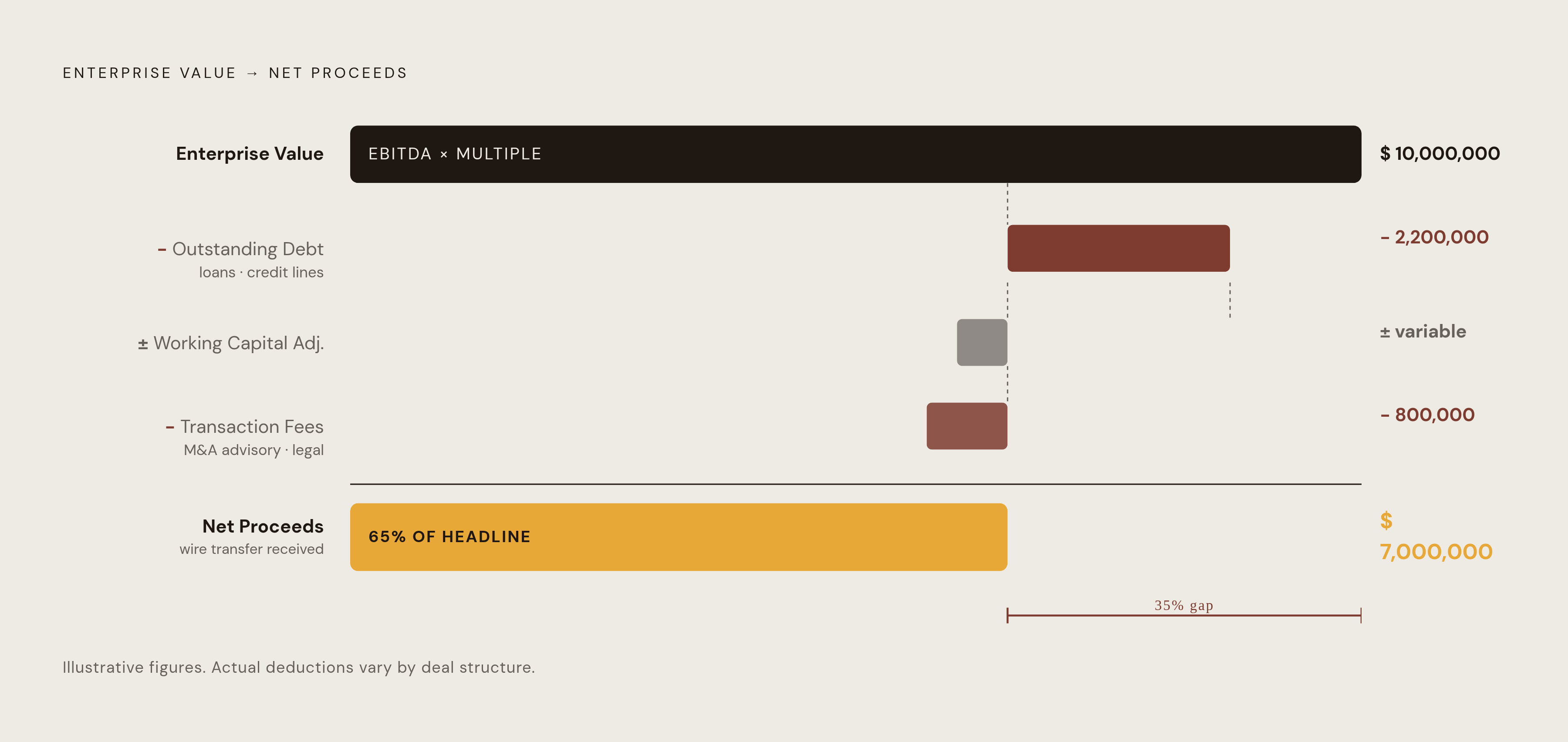
Enterprise value and the check a seller actually deposits are two very different numbers, and the gap between them catches a lot of owners off guard. The translation runs like this: take enterprise value (normalized EBITDA times the multiple), subtract outstanding debt, adjust up or down for working capital, subtract transaction fees, and what's left is net proceeds.
Debt is the most straightforward deduction. Any outstanding equipment loans, lines of credit, or other business obligations get paid off at closing directly out of the sale proceeds. A practice carrying a lot of leverage sees a bigger gap between its headline enterprise value and what the seller actually walks away with.
The working capital adjustment exists to make sure the practice hands over enough operating cash for the new owner to run day-to-day operations without a funding gap on day one. In veterinary transactions specifically, this adjustment tends to be relatively modest compared to the overall deal size, but it's still a real number that appears in the final math, and it's worth understanding well before the closing table rather than being surprised by it there.
Transaction fees, covering M&A advisory work and legal counsel, come off the top as well. None of these deductions are unusual or predatory, they're standard parts of any M&A transaction, but a seller who only ever thought about the enterprise value number is going to feel the difference sharply when the final wire transfer lands.
Common mistakes that cost sellers money before they reach the table
Most valuation damage happens long before a buyer ever shows up. Owners who wait until they're ready to sell to start cleaning up financials are already behind, since buyers expect multiple years of clean, reconciled records, and scrambling to reconstruct that history under time pressure rarely produces numbers a buyer trusts at face value.
Underestimating the add-back process is another common one. Sellers either miss legitimate normalizations they're entitled to, which understates their true EBITDA, or they push add-backs too aggressively without documentation, which makes buyers suspicious of every other number in the package. Both mistakes cost money, just in opposite directions.
Doctor concentration is often the most fixable issue and the most commonly ignored one. An owner who's still personally producing a large majority of practice revenue the year before a planned sale has had years to build out an associate bench and chose not to, and that choice lowers the multiple a buyer is willing to pay. Building bench depth, formalizing a medical director role, or growing a wellness plan program all take time measured in years, not months. This kind of planning needs to start well before a practice goes to market rather than during the sale process itself. By the time buyers are reviewing the numbers, the structural decisions that shape the multiple have already been made.