When to Start Preparing to Sell Your Business
Most business owners wait too long, then face millions in lost value.

The moment usually arrives quietly. An owner gets a call from a competitor who wants to talk, or starts doing the math on retirement, or simply gets tired after years of carrying a company on their back. They decide to sell. Then they start asking what that actually requires, and the answer lands badly: the work that moves a business from "sellable" to "commands full value" was supposed to start years ago.
Only 8% of business owners report being fully prepared to transition ownership, a 2026 survey from the Small Business & Entrepreneurship Council found. That number is not a reflection of laziness or denial. It reflects a basic misunderstanding of how long real preparation takes. Most owners assume a six-to-twelve-month runway is enough to get a business sale-ready. The work that actually moves valuation, cleaning up financials, reducing dependency on the owner, building recurring revenue, developing a management bench, takes three to five years to build properly.
This is not a matter of trying harder in the time available. It is structural. A survey cited in the broader research on this topic found that roughly half of business owners want to exit within three years, yet the preparation those exits require is largely absent from their businesses today. The math does not work. The default assumption that a short runway is enough is wrong, since the work that actually moves valuation takes three to five years to build, and half the ownership population wants out within three.
The regret is remarkably consistent after the fact. The 2025 Insights for Private Business Owners Report found that the number one regret among sellers was not starting to plan sooner, with roughly two in five wishing they had given themselves more time to complete everything that needed doing. That regret is retrospective clarity arriving at the one moment it can no longer help. Every section that follows in this piece exists to move that clarity earlier, back to where it can still change the outcome.
The valuation gap between a prepared and unprepared business
The gap between a prepared business and an unprepared one is not a rounding error on the final number. It can be the difference between a deal that closes and one that collapses at the finish line, and between two wildly different multiples applied to the exact same earnings.
Deals die more often for preparation reasons than for market reasons. In 2025, the two leading causes of broken letters of intent were findings that surfaced during quality-of-earnings diligence, responsible for 25.3% of busted deals, and EBITDA discrepancies, responsible for more than a fifth, the Axial Dead Deal Report 2025 found. Both of those causes trace back to something an owner could have fixed years before a buyer ever looked at the books. Owners who compress their preparation window below eighteen months typically leave a significant share of enterprise value on the table, based on Family Business Institute data.
Picture two companies in the same industry, generating identical EBITDA. One is owner-dependent, has three customers accounting for most of its revenue, and keeps its books in a way that requires a CPA to untangle before anyone can trust the numbers. The other runs on systems, has a diversified customer base, and hands a buyer clean, boring, reliable financials. They will not sell at the same multiple. On identical underlying earnings, a business that is owner-dependent, has customer concentration, and has messy financials will sell at a meaningfully lower EBITDA multiple than a systems-driven, diversified, well-documented business in the same sector, a difference that can amount to millions of dollars.
That gap rarely gets closed after the fact, because by the time a business is on the market, the financial history is already written. Research reported by Forbes found that only a small fraction of owners who intend to sell actually maximize the value that reaches family wealth, with the overwhelming majority either accepting a lower net outcome or leaving decisions unoptimized that could have been addressed years earlier. The stakes compound further because, for most privately held companies, the overwhelming majority of the owner's personal wealth sits inside the business itself. A compressed, discounted sale does not just shrink a transaction. It shrinks the rest of the owner's financial life. Nearly all of this is preventable, and preventing it is a matter of timing, not talent.
Why three to five years is the honest minimum
One might argue that's exactly what it is: extend the timeline, extend the billable relationship. That skepticism deserves an answer, not a dismissal, and the answer is structural rather than self-serving. The three-to-five-year runway reflects how long the most consequential value-building work actually takes to appear in the metrics buyers scrutinize.
Buyers want three years of clean, audited or reviewed financial statements showing consistent profitability and growth, and that requirement alone sets a hard floor on meaningful preparation time. If the financials only started looking clean eight months ago, three years of clean history is not something that can be produced faster by hiring a better advisor.
Practitioners do disagree at the margins. Brokers focused on getting deals done quickly tend to cite twelve to eighteen months as workable. M&A advisors push for three to five years because that is how long the work that actually moves valuation takes to build, and both sides agree that the active transaction itself, from listing to close, adds several more months on top of whatever preparation preceded it: BizBuySell's 2025 Year in Review recorded a median of 170 days to close. Compression at the front end does not disappear. It just relocates itself into the closing timeline, where it costs more.
The Exit Planning Institute's Value Acceleration Methodology organizes preparation into three gates, Discover, Prepare, and Decide, and other frameworks in the field, including Maus's, align with that same three-gate structure. Skipping the early gates does not eliminate the work they cover. It just moves the consequences of skipping them into due diligence, where buyers price them in as discounts rather than letting owners fix them on their own terms. Under the Exit Planning Institute's long-term track, spanning twelve to thirty-six months, owners who start at the Discover gate get to shape the numbers a buyer will eventually diligence. Owners who show up only at the Decide gate can only present whatever already exists, for better or worse.
The most legitimate objection to all of this is that timing is not always the owner's choice. Health changes. Unsolicited offers arrive out of nowhere. Market windows open and close on schedules nobody controls. That is a real constraint, and it does not undercut the case for early preparation, it reinforces it. Preparation work raises the value of a business whether or not a sale is imminent. Starting before the decision to sell is even final costs nothing and forecloses nothing.
The single costliest problem to fix: owner dependency
If there is one problem that explains why the timeline cannot be compressed, it is owner dependency. Roughly 80% of privately held businesses carry this problem to some degree, according to industry surveys, and it is the single most expensive issue to correct because correcting it requires the one resource nobody can buy more of: time.
FISART's analysis of closed deals across thirteen service industries between the first quarter of 2024 and the fourth quarter of 2025 found that owner-dependent businesses sell at a meaningful EBITDA multiple discount compared to management-run peers occupying the same industry tier. Put a number on what that means in practice. A business generating strong EBITDA in a sector that typically trades at healthy multiples carries real paper value on a spreadsheet, but if buyers see an owner-dependent profile (the seller working long hours and holding primary customer relationships), that same business often clears at a significantly lower multiple, a discount that can run into millions of dollars.
Why exactly does this happen? Because a buyer is not purchasing last year's revenue. They are purchasing next year's, and the year after that, and an owner-dependent business is a bet that the revenue walks out the door the day the owner does. No amount of financial engineering changes that risk profile overnight.
Fixing it is not paperwork. If the owner personally holds the primary customer relationships, someone else has to build new relationships and grow them to the point where their revenue contribution actually matters, and that kind of trust does not transfer on a spreadsheet timeline. If the owner plans to step back from daily management, a successor has to be hired, trained, and given enough tenure in the role that a buyer views the transition as stable rather than theoretical, which is itself a multi-year undertaking. Buyers also look for retention incentives locking in key employees, and installing those structures, then giving them time to prove they work, counts as preparation done well before the week before closing. None of this can be rushed by writing a bigger check to an advisor. It can only be started earlier.
What Each Phase of Preparation Accomplishes
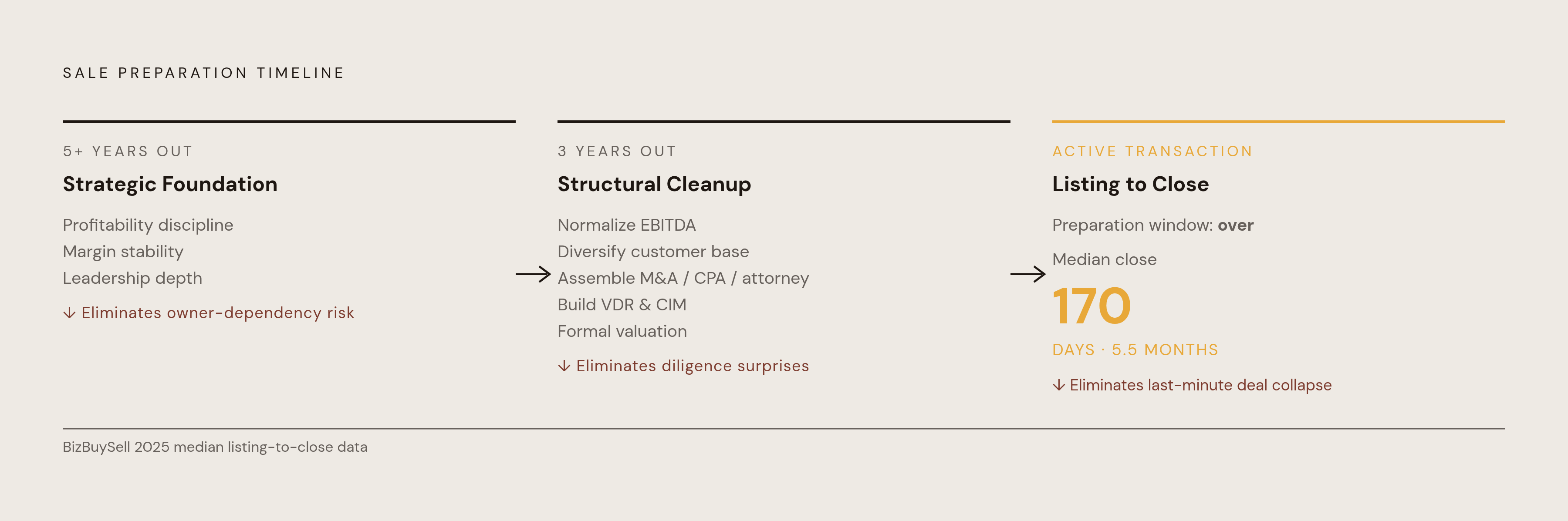
Preparation is a sequence of distinct phases rather than one undifferentiated pile of tasks to get through before a listing goes live. It is a sequence, and the sequence matters because later-phase work performed without earlier-phase groundwork does not save time. It creates gaps that buyers find during diligence and then negotiate against.
Five or more years before a sale, the priority is strategic foundation: profitability discipline, margin stability, and building real depth into the leadership team. This phase sets the ceiling on how much value the business can eventually transfer to a new owner, and it cannot be retrofitted after the fact. How profits get reported, whether a second layer of management exists beneath the owner, and how customer relationships get structured are choices made at this distance from a sale that will appear directly in the three years of financials a buyer eventually pulls apart.
Around three years out, the work shifts to structural cleanup: normalizing EBITDA, cleaning up the financials, and diversifying the customer base so no single account can sink the deal. The goal of this phase is removing every discount factor a buyer would otherwise negotiate into the price. Per Sunbelt Atlanta's preparation framework, this phase includes stopping personal add-backs, tightening accounts receivable and payable, and ensuring the trailing period looks strong.
This is also the point for a professional business valuation, a formal engagement that identifies what the business is worth today and which specific factors are driving or dragging that number. Duran Advisors' framework recommends pairing that valuation with a Value Builder Score assessment to pinpoint exactly where value is strong and where it is leaking out. This is also when the advisory team needs to get assembled: an M&A advisor or investment banker, a CPA with actual transaction experience, and an attorney who has handled M&A deals before. Waiting until the listing goes live to build that team means learning the deal process for the first time under pressure.
Building a Virtual Data Room and a Confidential Information Memorandum during this same window speeds up due diligence once a buyer is engaged, and it meaningfully reduces the risk of a retrade, a buyer coming back after signing a letter of intent to renegotiate price downward based on something diligence turned up. And once the business finally lists, the process itself is not instant. BizBuySell's 2025 Year in Review put the median time from listing to close at 170 days, roughly five and a half months. Add years of preparation before that listing date even goes live, and the honest full-cycle estimate for a well-executed sale stretches considerably beyond what most owners assume when they first start thinking about exiting.
What happens to the seller when preparation is skipped
Everything covered so far concerns the transaction. What happens to the person after the transaction closes deserves equal weight, because a low multiple is not the only cost of skipping preparation.
More than three in four business owners report profound regret within a year of selling, according to Exit Planning Institute research, and among that group, a majority trace the regret back to having no plan for what life actually looks like once the business is gone. That is a jarring number for what looks, from the outside, like a financial win. Selling a company for a fair price and then discovering there was no answer to "now what" is its own kind of failure, one that no purchase agreement can fix after the fact.
Financial regret compounds the personal kind. The 2025 Insights for Private Business Owners Report found that roughly two in five respondents wished they had engaged in estate and tax planning much earlier in the process, a gap that is entirely preventable and entirely financial rather than operational. Because most of an owner's personal wealth typically sits inside the business itself, a compressed sale at a discounted multiple does not just shrink the deal. It shrinks the pool of capital that has to fund the rest of the owner's life.
Tax and estate planning belong inside preparation, not bolted on afterward as paperwork. The One Big Beautiful Bill Act, signed July 4, 2025, permanently raised the federal estate, gift, and generation-skipping transfer tax exemption to a significantly higher level per individual and per married couple, with annual inflation indexing and no sunset date. That change alters the tax-planning math for any owner whose exit strategy was built around the prior, lower exemption level, and it rewards owners who revisit their planning assumptions rather than assuming the old numbers still apply.
None of this is inevitable. A clearly defined post-sale plan, covering what the owner intends to do next, what income they will need, and what they want to preserve for family or philanthropy, prevents emotional decision-making at the negotiating table and helps shape a deal around the owner's actual life goals rather than just the highest number on a term sheet, Preferred CFO's guide notes. Selling a business well is a life decision with a financial transaction attached to it.
Why 2026 market conditions reward prepared sellers
Market conditions do not neutralize the case for preparation. They sharpen it. In the IBBA and M&A Source Q4 2025 Market Pulse Survey, nearly three-quarters of business intermediaries expected 2026 conditions to match or exceed the 2021 peak, and the lower middle market remained a seller's environment. By mid-2026, the federal funds rate had settled at its lowest level since 2022, which eased the cost of capital for financing-dependent buyers and widened the pool of qualified purchasers actively competing for good businesses.
But favorable conditions are not uniform conditions. Average cash flow multiples reached 2.7x SDE by the second quarter of 2026, BizBuySell reported, even as the overall volume of closed deals fell. That is a market that punishes the unprepared more severely than a flat or declining one would, because buyers in a selective mood have both the leverage and the alternatives to simply pass.
Supply pressure is building on top of that selectivity. Gallup data found that nearly three-quarters of employer-business owners aged 55 or older plan to sell or transfer ownership, and the Exit Planning Institute estimates that Baby Boomers still own more than half the U.S. business market and are moving steadily toward exit. Prepared sellers are positioned to sell into genuinely strong demand. Unprepared sellers are going to find themselves competing for buyer attention against a wave of other owners who also waited too long.
The McKinsey Institute for Economic Mobility warned that without intentional action, a meaningful share of viable small businesses may close rather than successfully transfer to new ownership. The "great ownership transfer" expected to unfold by 2035 will not convert itself into successful sales automatically. It will favor the owners who treated preparation as a multi-year project rather than a pre-listing scramble.
Where You Stand Today
How many consecutive years of clean, reviewable financials exist today? Would a buyer's diligence team find EBITDA that has been carefully normalized, or would they find add-backs and inconsistencies that trigger the same disputes that kill deals in the first place? Does the business run on the owner's daily involvement, or could it survive a month without them?
A professional valuation answers these questions with more precision than instinct ever will, and it does so by identifying which specific levers, customer concentration, management depth, recurring revenue, are adding value and which are quietly subtracting from it.
From there, the sequencing matters more than the speed. An owner already inside eighteen months does not have the earlier phases available, but understanding what was skipped still shapes how a deal gets structured and where the negotiating vulnerabilities will surface.
Modern deal processes have also changed some of the mechanics involved. Buyer discovery increasingly runs through platforms that match sellers with qualified, vetted buyers rather than relying purely on broad market listings, and experienced investment banking advisors bring exactly the kind of deal-structuring and negotiation expertise that turns a good business into a well-sold one. None of that technology or expertise substitutes for the years of groundwork this piece has walked through. It simply makes better use of that groundwork once it exists.
The honest starting point is rarely comfortable. Most owners, per the data at the top of this piece, are not fully prepared, and most will not want to hear that the clock runs longer than they hoped. But the alternative, discovering the gap at the closing table instead of years before it, is the one outcome every section of this piece has tried to help a reader avoid.
Sources
- Is it Time to Sell Your Business? | Preferred CFO
- Prepare Your Business for Sale in 2026: A Step-by-Step Guide
- How to Prepare Your Business for Sale: 2026 Owner's Guide
- Your Guide to Selling Your Business in 2026 - Surfside Capital Advisors
- BizBuySell Insight Report - Market Trends
- When Should You Get Your Business Ready to Sell? The Best Time to Start Is Now — Here's Why.
- Preparing a Business for Sale in 3 Steps - Axial