Management Buyout Financing Options for Canadian Small Businesses
Banks, BDC, sellers, and mezzanine lenders each fill a different layer of the deal.

A management buyout can give a Canadian small business a credible succession path, but capable managers and a willing seller are only the starting point. This article maps the financing options and how they fit together. The central test is whether the structure funds the purchase while leaving the business enough cash to operate, repay its lenders, and sustain the transition.
Why management buyouts are becoming the default succession path for Canadian small businesses
Owners are retiring, and there are not enough buyers ready to take over. For businesses without a family successor, the management team may be the most practical successor available. Managers already understand operations, revenue drivers, customers, and growth opportunities, reducing some of the uncertainty that comes with an external sale. An internal transfer can also preserve institutional knowledge and employee stability.
Retirement is not the only trigger for a buyout. Shareholder disputes, corporate divestitures, and family transitions involving non-family managers can create the same opening. Most managers do not have the personal savings to purchase the company outright, even when the owner wants them to succeed. That leaves a structural gap between a credible succession plan and a financeable transaction.
How the purchase price is determined and why it shapes every financing decision
What, exactly, must the financing cover? The answer begins with a defensible valuation assessed independently of the seller’s preferred retirement number. The standard approaches are income, comparable market transactions, and assets, and the income approach is the one most often used for owner-operated small businesses. It can use earnings multiples or discounted cash flow.
The earnings measure needs careful interpretation. Seller’s discretionary earnings, or SDE, reflects owner-operated economics, while normalized EBITDA gives lenders a basis for assessing the business’s financing capacity. Neither removes the need to examine actual cash flow, asset quality, customer concentration, and sustainable revenue. A price supported by valuation is not automatically a price the business can service through debt. For larger transactions, an independent valuation by a Chartered Business Valuator can reduce disagreements and strengthen lender confidence, establishing a firmer starting point for financing negotiations.
Why no single lender finances an MBO and what a capital stack actually is
A capital stack is the combination of debt and equity used to fund the purchase, arranged by repayment priority. That order determines who bears losses first. Senior lenders have the first claim in a default, while subordinated lenders accept a lower priority in exchange for a higher return. Equity sits behind debt and takes the greatest risk, but participates in the business’s upside.
The layers do not operate independently of one another. A bank assesses not just its own loan payments but the burden created by the other financing. Seller debt, outside equity, and management investment therefore change the feasibility of the whole structure. Even if each instrument looks reasonable on its own, the interest and principal payments on all of them may add up to more than the available cash flow. The stack must satisfy both the purchase price and that serviceability test.
Senior bank debt: what Canadian chartered banks will and won't do in an MBO
Canadian chartered banks, including RBC, TD, BMO, and Scotiabank, provide term loans or revolving credit secured by a senior charge on business assets. This is generally the lowest-cost financing layer. Loan amounts are sized against EBITDA, interest is priced at prime plus a spread, and amortization commonly runs five to eight years.
Banks prefer businesses that make a profit and have predictable cash flow and tangible collateral. Receivables, inventory, and equipment can back a loan, but management may still need to give personal guarantees.
Loan covenants restrict what the business can do and require management to plan working capital around the lender’s conditions. Cyclical earnings or weak collateral can reduce the amount available or prevent approval. Even a bank-friendly business normally needs other capital to complete its buyout.
The Canada Small Business Financing Program as a government bridge for smaller MBOs
The Canada Small Business Financing Program, referred to here as SBL, can expand financing access where conventional collateral requirements are difficult to meet. The government backing reduces the lender’s risk. The federal department identifies eligible financing categories including real property, equipment, leasehold improvements, intangible assets, and working capital.
Those categories make the program relevant to smaller acquisitions, including SMEs and franchises with reliable cash flow but limited hard assets. Its maximum financing limit, however, prevents it from becoming a complete acquisition solution. Its usefulness depends on the eligible costs within the transaction, which must be assessed separately from the agreed purchase price. Management still needs equity and may need additional financing layers, but SBL can reduce the shortfall left for mezzanine lenders or the seller.
Mezzanine debt: filling the gap between what banks lend and what the deal requires
Mezzanine debt accepts risks that senior lenders will not. It ranks below senior debt and therefore costs more, but it can support a business with strong cash flow and limited hard assets. BDC’s Growth & Transition Capital provides mezzanine financing and quasi-equity for SME growth and transition projects, complementing other financing sources.
An interest-only period at the start can help the business keep cash during the transition before principal repayments begin. Some arrangements also include an equity kicker, such as warrants giving the lender an ownership interest. Why give away equity after borrowing to acquire it? Management accepts dilution, or a future payment obligation, in exchange for capital that makes the purchase possible. That trade-off deserves explicit evaluation, because mezzanine financing solves an immediate funding gap while adding obligations that outlast closing.
Seller financing (vendor take-back): why the owner's participation makes the deal work
With seller financing, the buyer owes part of the purchase price to the owner who is leaving. The seller receives cash at closing and the balance over agreed terms, commonly three to seven years, at a negotiated interest rate. This cuts the amount the buyer needs at closing, and the seller has no need to stay on as a shareholder.
The seller is taking a real credit risk. Security usually ranks behind bank and mezzanine debt, so underperformance can put deferred payments in jeopardy. Yet a seller who takes part can help support a higher purchase price, help the handover go smoothly, and may be able to spread capital gains recognition over several tax years.
It also gives other lenders a useful signal. An owner who knows the company well and leaves money in the transaction demonstrates confidence in both the business and its managers. That confidence is most credible when the relationship is established and the repayment terms remain affordable.
Rollover equity: when the seller retains a minority stake instead of a full exit
Rollover equity creates a different relationship from seller debt. Instead of being owed a fixed balance, the seller receives some cash and retains a minority ownership position, typically ten to forty percent. The buyer has no need to fund the retained stake at closing, which cuts the amount of capital needed then.
A shareholder participates in future value creation and shares the downside. A rollover can also be structured under Section 85 of the Income Tax Act to defer capital gains recognition on retained equity.
However, the seller remains involved as an owner. Before closing, the parties need to agree clearly on decision rights, governance arrangements, and when the seller will leave. This structure fits a seller comfortable with a phased departure.
Private equity co-investment: when the deal is too large or complex for internal capital alone
Private equity can supply capital beyond management’s resources in a larger or more growth-oriented buyout. A PE firm or search fund puts in equity to buy the business, and a PE investor usually takes majority ownership while management keeps a meaningful minority stake. Capital comes with a change in control.
Operational expertise, networks, and financial discipline can help the business grow. In return, management accepts board oversight, dilution, and pressure to meet the investor’s return expectations. Preferred returns may put the investor’s capital and minimum return ahead of management’s full participation in the upside.
The exit timetable also belongs to the partnership. A typical five-to-seven-year horizon reflects the fund’s lifecycle rather than management’s preferred ownership duration. For smaller buyouts, institutional equity is often unavailable or unsuitable, making debt, seller participation, and management equity the more relevant tools.
The Holdco structure and why management should never buy shares personally
The financing needs a legal buyer to receive it. In a Holdco structure, management establishes a holding company that purchases the target and holds the acquisition debt. This separates the acquisition vehicle from personal ownership and allows operating-company dividends to flow to Holdco under inter-corporate dividend rules without triggering personal income tax on each distribution.
Liability protection needs a careful qualification here. A corporate structure does not erase personal guarantees given to lenders.
The buyer and seller must also negotiate whether the transaction purchases shares or assets. A share purchase preserves the target’s tax history and existing contracts, while potentially supporting the seller’s capital gains exemption. An asset purchase gives the buyer a stepped-up cost base but requires contract novation and may prevent that exemption treatment. These choices belong before closing, because a later restructuring can be costly or unavailable.
Tax planning considerations that affect how the deal is structured and priced
The same headline price can produce different after-tax outcomes. The Lifetime Capital Gains Exemption can shelter eligible gains on Qualified Small Business Corporation shares, which helps explain why sellers often prefer share sales. To qualify, the business must meet rules on Canadian-controlled private corporation status, active business activity, and the mix of assets it holds.
Payment timing changes the calculation as well. Seller financing and rollover equity can defer recognition in different ways, affecting what the owner will accept in negotiations. For the buyer, acquisition interest is generally deductible, but the intended treatment needs to fit the actual financing and ownership structure rather than being assumed from the presence of a Holdco.
Family transfers require a separate comparison. Bill C-208 and subsequent changes created a framework distinct from a buyout by non-family managers. The parties need professional tax advisors to work together before the purchase agreement is signed, while there is still room to negotiate structure, price, and timing together.
Assembling the capital stack: how the financing layers fit together in a real deal
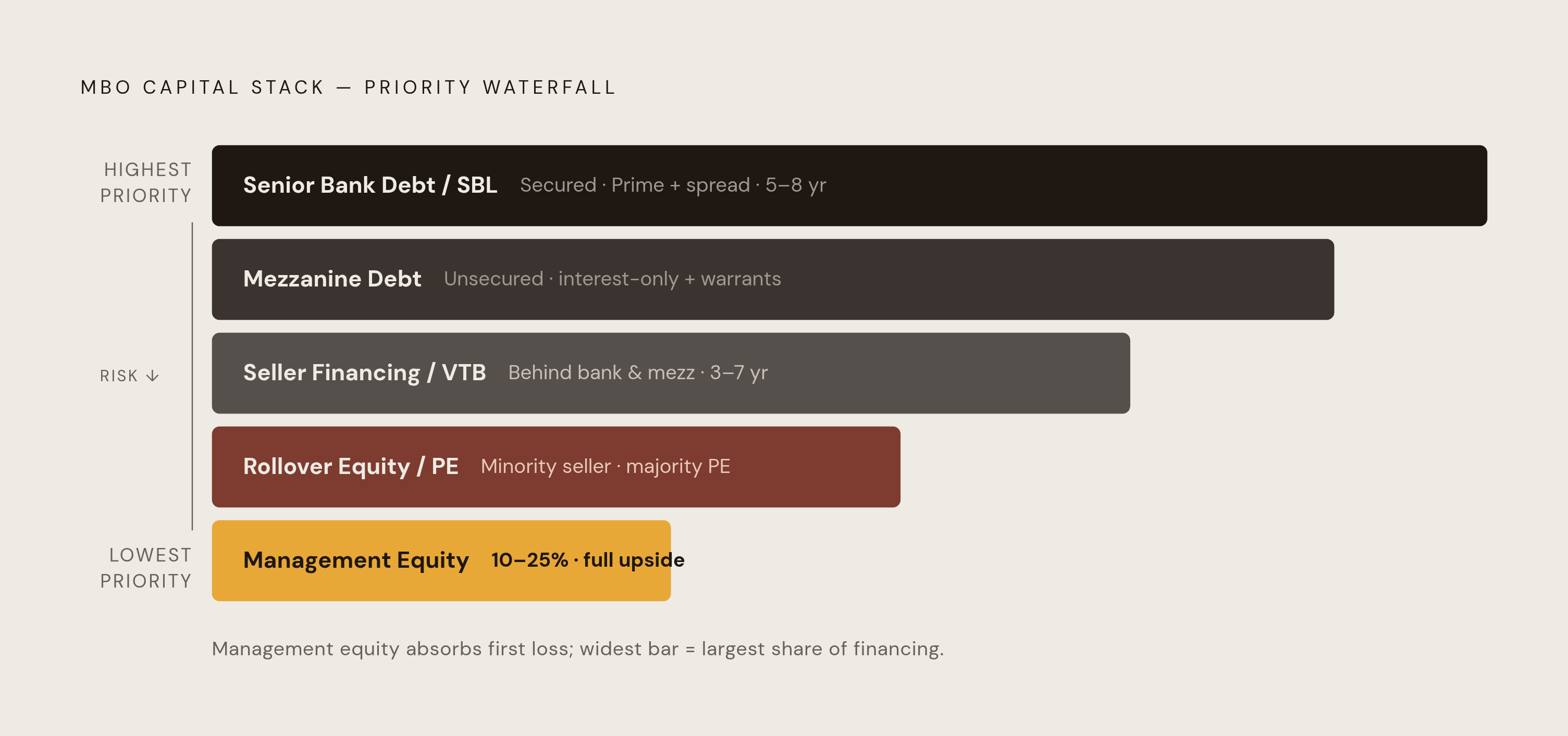
Consider an acquisition funded by senior debt, cash flow financing, mezzanine capital, seller financing, and management investment. Senior debt is the secured base of the stack, and cash flow financing depends on what the business can earn. Mezzanine capital extends financing beyond the senior lender’s limit, the seller defers part of the consideration, and management supplies equity. No single source funds the whole purchase.
The practical sequence starts with senior bank or SBL financing, then establishes the subordinated and seller layers around the remaining requirement. Management equity is usually ten to twenty-five percent of the deal’s value, which balances the confidence lenders need with the personal risk managers take. A partial buyout can cut the amount needed at the start while the seller keeps a stake.
Closing is only one cash requirement, however. The business also needs operating liquidity after debt service. Strong cash flow at closing, rather than a seasonal trough, can improve the coverage ratios lenders assess and support a more workable transition.
What due diligence looks like from the buyer's side and where MBOs most often break down
Knowing how to run the company is not the same as knowing what its legal and financial records contain. Receivables recorded as assets must be collectible, and obsolete inventory can weaken collateral despite healthy reported earnings. These findings can change financing availability after an initial agreement.
Contracts can interrupt the transaction just as quickly. Leases and customer agreements may require consent to assignment or a change of control. Intellectual property created by contractors or before incorporation may never have been formally assigned to the company.
Working capital can also lead to a dispute. Without a clear closing adjustment mechanism, buyer and seller can dispute whether the business has been delivered with adequate operating resources. These are reasons to involve legal, accounting, and M&A advisors early while continuing to pursue the buyout. Preparation can expose the gaps while there is still time to resolve them.
How professional advisors change the outcome and where to find the right team
Legal counsel checks contracts, leases, and intellectual property assignments, while valuation and accounting specialists check the price and the financial assumptions behind it. Financing specialists who know BDC, SBL, and alternative lenders can find options beyond the bank the business usually deals with.
The seller also needs an independent negotiating perspective. An experienced M&A advisor can assess whether management’s offer is competitive and whether deferred payments or retained equity adequately compensate the owner for continuing risk. Maxima is a Calgary-based business broker and M&A advisory firm providing transaction advisory services, making it a resource for owners exploring that side of a buyout.
The next step is a conversation about fit. The available tools can support different paths, but the right combination depends on the business’s cash flow, management’s resources, and the owner’s goals for leaving.