The Canadian Founder's Pre-Sale Checklist for Year Three
Fixing owner dependence and operations first makes financial cleanup more credible to buyers.

Canadian business owners should start exit planning at least three years before they aim to sell, so there is still time for tax restructuring to qualify and for operational improvements to prove their worth. A better exit depends on work completed before negotiations begin as well as on negotiating harder.
Why most Canadian founders will exit without a plan — and what that costs them
The Canadian Federation of Independent Business’s October 2026 report found that most small business owners plan to exit within the next decade, yet only a small fraction have a formal written succession plan. Roughly one in eight expects to close entirely, with the proportion higher among retailers. For an owner relying on the business to fund retirement, closure can erase the asset built over decades. The loss is personal as well as economic.
Retirement is the main reason owners expect to leave, but burnout, stress and high operating costs can accelerate that decision. Meanwhile, business exits have outpaced new entries in Canada since early 2024. Business exits outpacing new entries makes successful transfers more urgent. The CFIB report identifies finding a successor, determining value and finding time to plan as central obstacles. A three-year runway gives each problem its own place in the work.
How early should a Canadian founder start planning to sell?
Three years is the last practical starting point for completing the full preparation sequence, with later starts limiting preparation to whatever time permits. Two tax requirements explain why. For Qualified Small Business Corporation shares to qualify for the Lifetime Capital Gains Exemption, they must meet an active-business asset test throughout the preceding 24 months. Share ownership also has a 24-month condition, so restructuring just before talks begin cannot take the place of planning ahead.
The operational clock runs nearly as long. Building independent management, renewing contracts and documenting systems can take 12 to 24 months to produce results buyers will pay for. Starting with exactly two years remaining leaves little room to diagnose problems before the qualifying period begins. The three-year schedule therefore reserves its first two years for structural and operational work, and its final year for professional preparation and controlled market entry. Starting later can remove particular ways to improve the outcome.
Getting a baseline valuation before anything else on the checklist
The first action is to commission a baseline valuation. What is the business worth now, and which weaknesses separate that figure from the founder’s desired outcome? Without that starting number, there is no shared basis for decisions on tax planning and spending to improve the business. A full CBV opinion establishes the baseline, while a lighter “calculation of value” engagement can provide an interim check. The appropriate level of rigor depends on the situation.
For smaller owner-operated businesses, Seller’s Discretionary Earnings shows the economic benefit that is available to a single full-time owner-operator. It adds back owner compensation, interest, depreciation, amortization and qualifying discretionary or non-recurring expenses to pre-tax net income. Larger businesses tend to use EBITDA multiples, though the industry, growth and risk all affect which metric is used and what the multiple is. Owner dependence and customer concentration deserve particular scrutiny because they depress what buyers will offer.
Structuring the corporation to qualify for the Lifetime Capital Gains Exemption
With a baseline established, the next question is how much value the founder can retain after tax. The Lifetime Capital Gains Exemption, or LCGE, is a powerful shelter for qualifying share sales. Eligibility is not automatic. At sale, all or substantially all corporate assets must be used principally in an active business carried on primarily in Canada. Throughout the preceding 24 months, more than half must meet the active-business test, and the shares must satisfy the ownership condition involving the seller or a related person.
Passive investments, excess cash and rental properties can obstruct qualification. Removing them through asset purification requires tax advice because mistakes can trigger immediate tax or disqualify the shares. This belongs at the beginning of the runway.
Buyers usually want asset purchases for tax depreciation, while sellers usually want to sell shares for capital gains treatment and the LCGE. A share deal may therefore require a negotiated price adjustment. The proposed increase in the capital gains inclusion rate was cancelled on March 21, 2025, but the founder’s final tax position still needs review before signing.
Multiplying the LCGE through family shareholding and estate freeze structures
The exemption is not necessarily limited to one claim per family. Where appropriate shareholding and eligibility conditions are met, spouses or adult children may each claim their own exemption. Consider a couple with qualifying gains allocated to each spouse’s shares. Two eligible claims can shelter more than one, although the result depends on ownership, allocation and each person’s eligibility.
The founder exchanges common shares for fixed-value preferred shares equal to the business’s current fair market value, while new common shares go to the next generation or a family trust. Future growth then accrues to those new shares. Crystallization and family restructuring also belong in the tax-advisor discussion, with CRA anti-avoidance rules constraining execution.
The 24-month ownership condition makes timing central. For a family succession, Bill C-208 and subsequent amendments effective January 1, 2024 also permit qualifying sales to corporations controlled by children or grandchildren to receive capital gains treatment, subject to conditions.
Whether to consider an Employee Ownership Trust as an exit path
An Employee Ownership Trust offers a different route. The founder sells to a trust holding shares for employees, without requiring employees to fund the purchase out of pocket. Sales that qualify get a large capital gains exemption. Bill C-30, enacted June 18, 2026, made that exemption permanent rather than temporarily available for the 2024 to 2026 tax years.
Does the founder want employees to become the successor, and can the proposed transaction meet the conditions? The transaction must be conducted on an arm’s-length basis, and the former owner cannot retain control after sale. It takes time to structure the deal, so eligibility needs to be checked in the first planning year, before the deal reaches closing. The CFIB report found that more than a quarter of owners intend to sell to employees, yet awareness of this route remains limited.
Reducing owner dependence — the operational change that moves the multiple most
Owner dependence leads to the biggest cut in valuation. When revenue, relationships and institutional knowledge reside in the person about to leave, buyers may pay less or withdraw. A management team able to operate independently gives buyers something transferable to acquire.
For a founder preparing to sell, promoting or hiring a strong number-two is therefore the highest-ROI operational step in the notes’ preparation sequence. That person needs time to demonstrate independent day-to-day control. Standard operating procedures, employee handbooks and customer onboarding workflows then turn tacit knowledge into documented systems a buyer can assess. Missing documentation gives buyers another risk to negotiate against. The practical test is demanding but clear. Can the founder take a two-month sabbatical without the business degrading? If not, operational preparation remains unfinished.
Cleaning up financials and contracts so buyers have nothing to negotiate against
Undisclosed liabilities and discrepancies between reported and verified performance are frequent causes of discounted or failed transactions. Preparation means exposing those weaknesses before the buyer does. Financial normalization adjusts for personal expenses, one-time costs and non-market-rate owner compensation to establish defensible adjusted EBITDA. An independent accounting firm’s sell-side Quality of Earnings report tests that figure before negotiations turn into an argument about earnings.
Contracts need the same advance attention. Renewed customer agreements, an extended lease and secured supplier agreements reduce uncertainties buyers would otherwise price into their offers. Each helps protect a different part of the business, including its revenue continuity, occupancy and supply.
However, cleaner paperwork cannot cure customer concentration. If one customer supplies a disproportionate share of revenue, a renewed contract does not create a diversified customer base. Revenue diversification is a multi-year effort. The valuation must surface this risk early enough for the founder to act.
Understanding which buyers exist and why going to market with only one is a mistake
The CFIB report found that most owners planning an exit expect to sell to an unrelated buyer. That requires finding and vetting people the founder may not know. The Canadian Venture Capital and Private Equity Association reports that over 65% of Canadian private equity transactions occur in the small and medium enterprise space. Strategic acquirers, private equity platforms, management buyout candidates and individual operators therefore belong in the buyer assessment.
A sole buyer can slow proceedings, press for reductions after diligence and propose terms protective of its own interests. A controlled process builds interest among several qualified buyers while keeping the sale confidential, because news that gets out too soon can unsettle employees, customers and suppliers.
AI-driven buyer matching can widen that search beyond the founder’s personal network. Its purpose is to make a competitive process accessible without depending solely on existing buyer relationships. Advisors still need to manage qualification, confidentiality and negotiation.
What the formal sale process looks like and how deal structure determines what the founder actually receives
The formal process begins with an exit readiness review and preparation of a Confidential Information Memorandum, or CIM. Controlled outreach leads to management presentations and Letters of Intent, followed by due diligence, the purchase agreement and closing. Buyers examine financial records, contracts, tax filings, employment agreements, intellectual property, environmental compliance and pending litigation through a virtual data room. Advance preparation makes that examination more navigable.
The headline price is not the closing proceeds. Cash at close is typically the largest component in lower-middle-market transactions, but a seller note may defer part of payment for three to seven years with interest. That makes the founder a creditor exposed to repayment risk. Working capital adjustments can also change the final amount because buyers expect a normal level of working capital at closing.
The earlier work now has specific uses. A defensible valuation anchors price discussions, independent management supports presentations, and documented earnings and contracts reduce diligence disputes. Understanding payment terms before signing reduces the chance of accepting an attractive price with an unsuitable risk profile.
A sequenced checklist — what to do in each of the three years
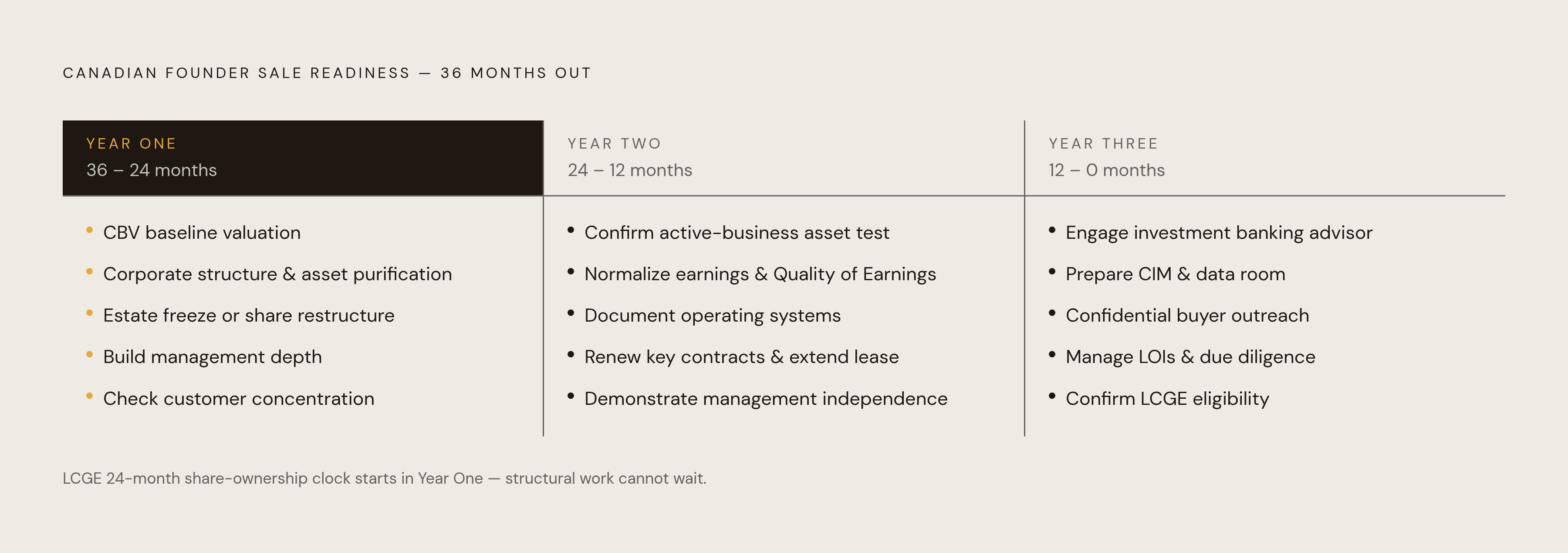
For founders putting this sequence to work, Year One means 36–24 months before target close. Commission the CBV baseline first, then review corporate structure with a tax advisor and begin any required purification. Decide whether family share restructuring, an estate freeze or employee ownership fits the planned exit, and make changes that depend on timing early enough to meet the conditions that apply. In parallel, identify the management gap and begin building a number-two. Check customer concentration and start diversification where it is needed.
Year Two covers 24–12 months before close. Review whether the corporation is on track to satisfy the active-business asset test at the intended sale date. Normalize earnings and commission or prepare for a sell-side Quality of Earnings report. Write down how the operating systems work, renew key customer contracts, extend the lease and secure agreements with the suppliers the business depends on. Update or establish a shareholder agreement, and review any actions needed for a qualifying intergenerational transfer. This is also the period in which management independence must become demonstrated performance.
Year Three covers the final 12 months. Engage an investment banking advisor for the readiness review, prepare the CIM and data room, and begin controlled, confidential outreach across the qualified buyer pool. Manage Letters of Intent, diligence and negotiations with advisors while keeping options open with multiple interested parties. Work through the numbers for working capital adjustments and seller-note terms before agreeing to them, and check which cross-border tax requirements apply. Before signing, have the tax advisor review LCGE eligibility, the inclusion rate and alignment between the intended tax treatment and the agreed deal structure.
What founders who wait past the three-year window can still do
A founder who starts 18 months before sale still has useful work to do. If the corporation already has a relatively clean asset structure, LCGE qualification may remain achievable. A Quality of Earnings report and CIM can be prepared, and management development can begin despite the shorter runway. New share restructuring still has to meet the 24-month condition. Its feasibility must be assessed against the actual transaction date.
Within 12 months, tax options narrow further, but operational preparation and professional marketing remain available. Owners then need to focus on the weaknesses they still have time to fix and accept that some planning benefits are out of reach. An advisor can help distinguish those tasks, while AI-assisted buyer matching can address the search for qualified successors regardless of when preparation starts. The next constructive step is a plan grounded in the business as it stands and the time still available.