Why BizBuySell and Canadian Listing Sites Attract the Wrong Buyers for Your Business
Public listings pull in inquiries, but few come from qualified buyers.

For a smaller Canadian business sale, a confidential, targeted buyer search is an alternative to a public listing or a conventional broker-led sale. BizBuySell and listing sites built around public exposure can generate inquiries, but identifying buyers with the funds, intent, and strategic reason to close requires preparation, screening, and outreach.
What BizBuySell is and what it was built to do
It is a legitimate, long-running classifieds marketplace where sellers can advertise businesses and buyers can browse them. There is no advisor assigned to a transaction. Sellers pay to be seen, but the service does not include preparing, negotiating, or completing a sale.
Those fees purchase time on the platform. There is no commission or success fee, so payment does not depend on whether an inquiry becomes an offer or a completed transaction.
How the fee model shapes who shows up in a seller's inbox
A marketplace benefits from attracting people who browse and contact advertisers, even when those people are not ready to buy. Buyers can sign up and send inquiries for free without showing that they have the funds, stating their intent, or proving who they are before making contact. Interest therefore arrives before evidence of purchasing ability. The seller must establish whether the two coincide.
BizBuySell leaves screening to the seller. Through its paid Edge program, buyers can choose to share profiles with financial information that can help sellers judge whether they qualify. A profile gives an owner more information about some contacts while leaving qualification optional for entry.
A broker or advisor can qualify buyers before they take up the seller’s time, while a listing platform passes inquiries through for the seller to check. Owners must arrange confidentiality agreements, request evidence of funds, and assess intent themselves. A busy inbox can therefore represent a growing workload.
The three categories of contact that dominate a BizBuySell seller's inbox
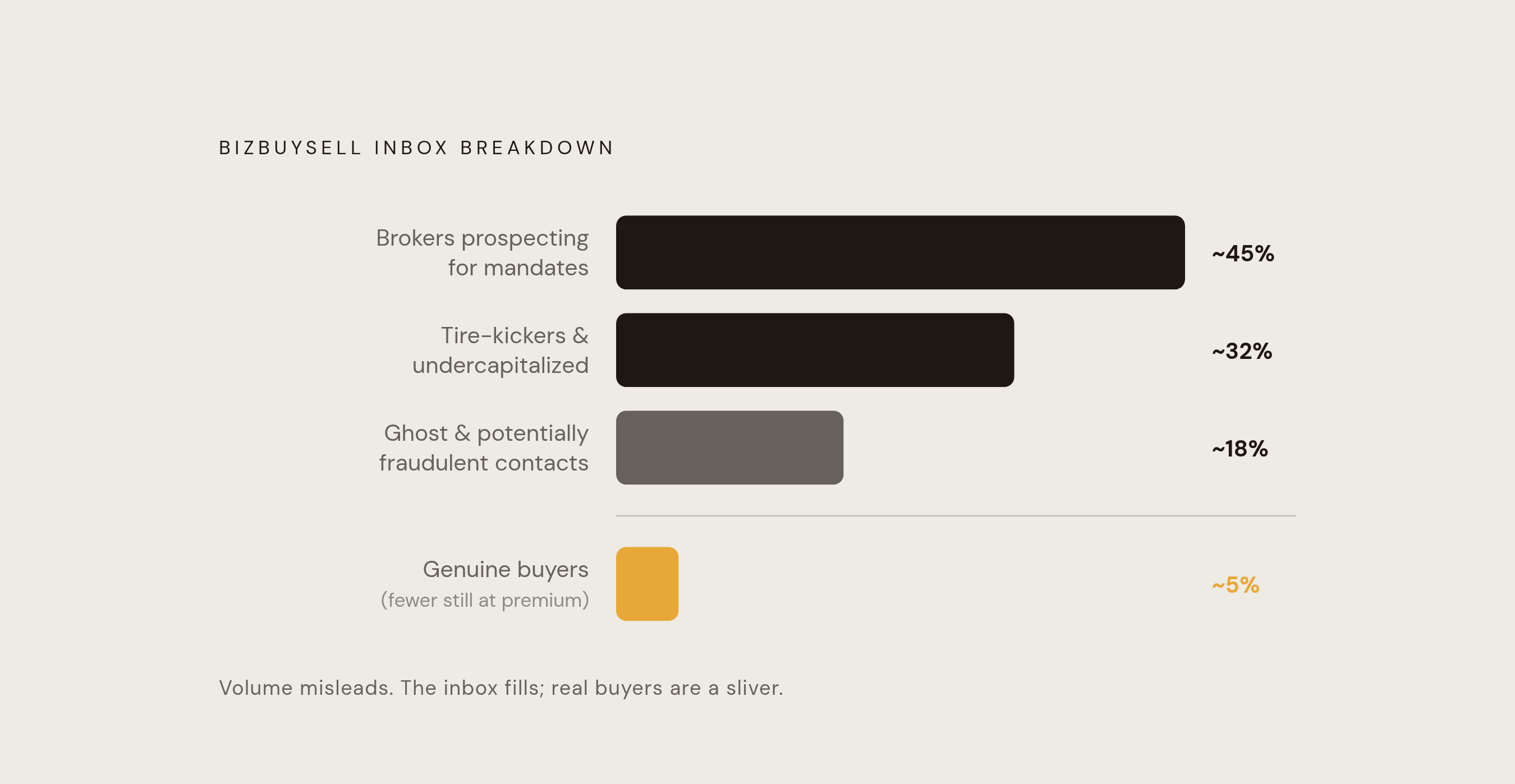
The first category is brokers prospecting for mandates. Sellers who list without a representative say advisors contact them within days of the listing going live and offer to manage the sale. An owner expecting buyer conversations instead has to distinguish people interested in purchasing the business from people interested in representing it. Both kinds of contact may be legitimate.
The second category consists of tire-kickers and undercapitalized searchers. Their inquiries may begin with apparent enthusiasm, then stall after a first exchange or a scheduled call. Some ask questions already answered in the listing. Others reveal that they have no financing when the seller presses for specifics. Because contacting the owner requires no prior demonstration of readiness, the owner discovers these limitations only after investing time.
The third category includes ghost leads and contacts that seem to be fraudulent. Seller accounts describe duplicate inquiry forms, unusable contact details, and messages that appear templated or automated, although appearance alone does not establish fraud. Each ambiguous contact still needs attention. For an owner running the business during the sale, sorting this traffic competes with the operations needed to sustain its value. Yet removing the noise does not solve the entire problem, because a genuine buyer is not necessarily the buyer best positioned to pay a premium.
Why even the "real" buyers on public listings are rarely the ones who pay the most
Public marketplaces primarily attract individual searchers and first-time owner-operators. The audience includes purchasers seeking a job replacement and investors looking for underpriced assets. These buyers can complete legitimate transactions. Their interest, however, generally rests on what the business earns on its own.
Competitors, roll-up operators, and private equity-backed platforms may value a company for its fit with an existing business, including synergies and market position. They typically work through proprietary networks, investment bankers, and targeted outreach. That difference can support a higher price than standalone cash flow would justify. A seller who relies only on public listings may never reach the buyer who would get that extra value from the business.
The distinction is visible in the browsing experience itself. Someone comparing a food business, a dry-cleaning operation, and a manufacturing company is searching broadly and may have no clear acquisition thesis. Horizontal reach does not establish strategic fit. Public exposure also creates a confidentiality risk, since employees, customers, and competitors can discover that a sale is underway before the owner controls the explanation.
What the skepticism loop costs sellers who do have a strong business
A searcher who has encountered exaggerated SDE, stale information, or incomplete financials may approach the next listing expecting similar weaknesses. The next business may be entirely sound. Nevertheless, its owner inherits doubts formed elsewhere, because the marketplace does not reliably distinguish strong evidence from an attractive claim before the conversation begins.
That caution can appear as extensive demands for proof upfront, low opening offers that build in a “platform discount,” or silence when a buyer assumes the financials will not withstand scrutiny. None of these reactions proves that the seller lacks credibility. They reflect the uncertainty surrounding the listing. For an owner who has spent years building a profitable business, the cost is having to establish trust before the business’s actual strengths receive serious consideration.
Better financials help answer scrutiny but leave open which buyers arrive and what assumptions those buyers bring. A strong company can still be poorly matched. The sale process must make its quality legible to people equipped to recognize and finance it.
Why the stakes for Canadian sellers are especially high right now
CFIB’s October 2026 report, Passing the Torch, says a large majority of Canadian small business owners expect to exit within the next decade, while only a small share have a formal succession plan. Trillions in business assets could change hands. For nearly half of owners, finding a buyer or suitable successor is the biggest obstacle. That makes the distinction between generating interest and finding a qualified successor economically significant.
The same research states that business exits have outpaced new entries in Canada since early 2024. A failed sale can thus disrupt an owner’s retirement plans and lead to the closure of a company that could keep running under a new owner. Owners may instead postpone retirement. Using a listing site need not lead to either outcome, but both show why owners need more of a plan for their exit than placing an advertisement and waiting.
Tax and financial preparation add another layer. Canada’s Lifetime Capital Gains Exemption can shelter gains up to $1,016,836 in 2026 for qualifying Qualified Small Business Corporation share sales, but owners can lose access if they do not plan the structure correctly in time. Preparation affects what the owner keeps, too. Meanwhile, financials optimized for tax minimization can obscure earnings and weaken the valuation presented to buyers. Finding the right purchaser cannot repair every problem left unresolved before the search.
How can a Canadian owner find qualified buyers without a public listing?
A confidential search uses preparation, screening, and targeted outreach in place of letting anyone browse. For a smaller Canadian sale, that can mean an off-market or semi-private process supported by investment banking advisory rather than a public advertisement or conventional brokerage mandate. The alternative is a process that identifies likely buyers, establishes their capacity and intent, and controls what they receive.
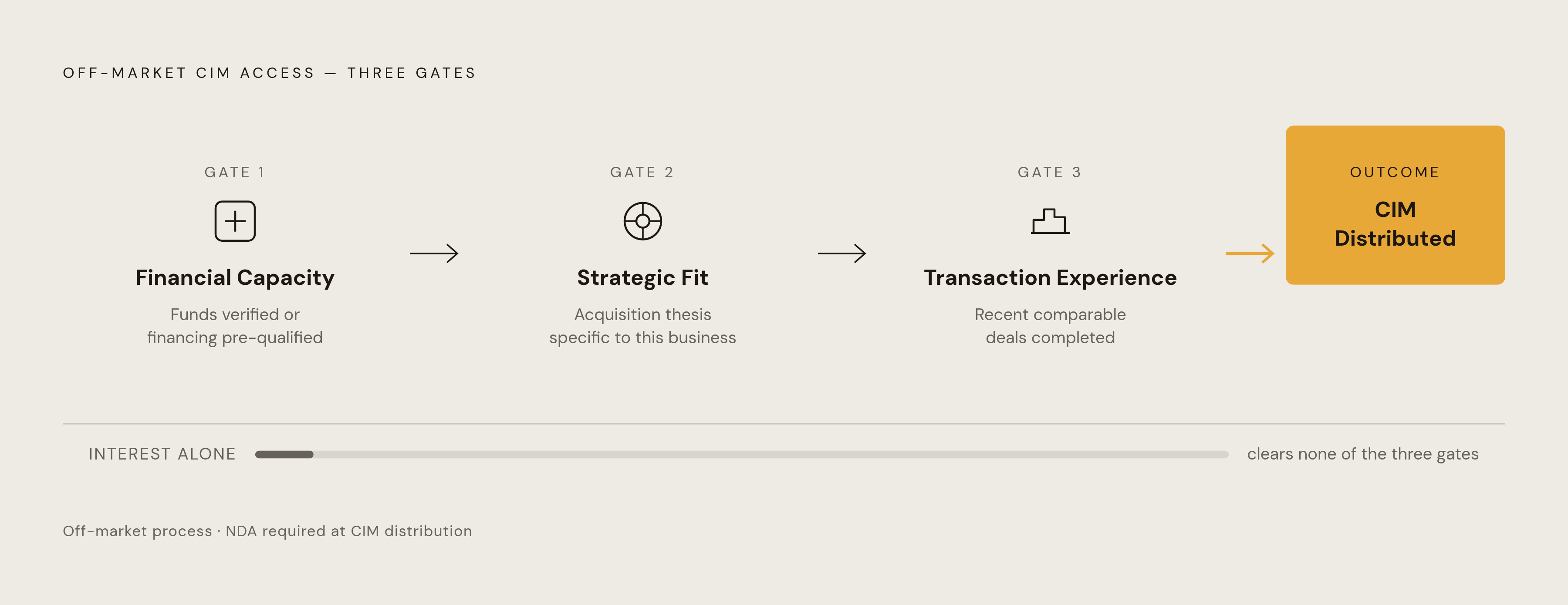
The first confidentiality gate is a legally binding Non-Disclosure Agreement before confidential information is disclosed. The central marketing document is then a Confidential Information Memorandum, or CIM, covering business history, operations, market position, financial performance, and growth opportunities. It is not a public listing. Before distributing it, advisors screen buyers for financial capacity through funds verification or financing pre-qualification, strategic fit through an articulated acquisition thesis, and transaction experience through recent completed deals of comparable size.
These criteria answer different questions. Does the buyer have a credible route to funding, a reason to acquire this particular business, and evidence of an ability to complete a comparable transaction? Interest alone answers none of them. Experienced advisors may already have networks of pre-qualified buyers, so they can find a match before a business ever goes on the public market. Targeted outreach then begins with a reason for the conversation.
Manifesto uses AI-driven buyer matching and investment banking advisory to find buyers who fit the business within a pre-vetted network. A public listing still has a legitimate role. A seller with clean financials, a realistic price, and the capacity to manage inquiries may need exposure as one component of an otherwise prepared process. The limitation arises when that component is expected to supply the preparation, qualification, and transaction support it was never designed to provide.
What sellers should do before choosing any channel — listing site or otherwise
Owners should prepare the business before deciding how to advertise or approach buyers. Valuation comes first, because the price needed for retirement is not necessarily the price a buyer will pay. Personal need does not set market value. EBITDA-based multiples vary sharply with company size, industry, and owner dependency, so a credible asking price must reflect the business a purchaser will actually inherit.
Owners need to look closely at owner dependency because a business that cannot run without its owner will struggle to draw a strategic premium. Reducing that dependency is one of the highest-return preparation steps available before a sale. Financial presentation needs similar discipline. Normalizing earnings through legitimate owner-expense add-backs and the treatment of one-time items gives the CIM a basis the seller can defend and helps buyers make sense of tax-minimized accounts.
Preparation should begin well before the planned exit. Reducing customer concentration, documenting systems, and building management depth take time to become visible in the financial record a buyer will assess. Industry changes the work required, too. Food and restaurant businesses tend to draw first-time owner-operators, while manufacturing needs buyer pipelines for the sector because what buyers know about supply-chain and regulatory issues affects the risk of the deal. Before a sale, professional services businesses with high customer concentration need to deal with the valuation discount that comes from relying on so few customers.
The useful channel question follows from that preparation. Which buyers can close at a price that reflects this business’s value, and how can they be reached specifically? Traffic is only one possible input to that answer. Owners who establish a realistic valuation, reduce dependence on themselves, and prepare credible financials can choose a channel for its fit with the sale they want to achieve, rather than asking an unprepared listing to create their options.