How Qualified Buyers Are Vetted in a Private Business Sale
Sellers must separate serious buyers from competitors and dreamers before sharing sensitive details.

A seller who lists a business for sale and watches the first few inquiries land usually feels something close to relief. Someone is interested, the years of work behind the business have a market after all, but that feeling fades fast once the inquiries pile up, because most of the people writing in are not buyers in any meaningful sense. Some are curious about what a business like this sells for. Some are undercapitalized dreamers who like the idea of owning a company more than they have the means to buy one. A smaller number are worse: competitors who know how to dress up an email so it reads like acquisition interest, when the actual goal is a look at pricing, a client list, or the names of the people who hold the business together.
That last group is the reason vetting exists at all, not as a bureaucratic hurdle but as self-defense. A private business sale runs on an uncomfortable trade: buyers cannot evaluate a company without seeing inside it, and sellers cannot protect the company without keeping outsiders from seeing inside it. A competitor who gets a look at margins, key accounts, or staff relationships has gained something valuable the moment that information changes hands, whether or not an offer ever follows. No signature, no deposit, no term sheet needs to exist for the damage to be done.
The scale of the problem appears in the numbers from a single deal handled by MidStreet: more than 170 interested buyers made contact, and the firm separately built a target list of over 50 potential acquirers. Out of that combined pool, only a small fraction ever received confidential marketing materials, because only a small fraction passed screening. That ratio reflects what an unfiltered buyer pool looks like in a business sale, and it is why the rest of this piece exists.
The volume problem is getting worse, as clients working with Exit Equity now report inboxes clogged with outreach from AI agents representing search funders, SBA-backed individual buyers, strategic acquirers, and private equity firms, adding a layer of automated noise on top of the usual mix of genuine and hollow interest. More inbound contact does not mean more real buyers, because the filtering step that separates the two groups matters more than it used to, not less.
The three things that make a buyer qualified
Interest is cheap. Anyone can reply to a listing, ask a few questions, and request a call. Qualification is a different and much narrower standard, and a buyer only earns it by clearing three separate tests at the same time: financial capability, genuine intent, and relevant experience. Fail any one of the three and the other two stop mattering: a deal that cannot be financed, is not wanted, or cannot be run after closing is not a deal.
Financial capability goes well beyond the question of whether someone has cash sitting in a bank account. The buyers worth taking seriously are often the ones doing the groundwork before they ever find a specific business to buy: lining up SBA pre-approval, lining up a bank commitment, or putting together an equity partnership in advance. That kind of preparation says more about seriousness than any amount of enthusiasm in a first email.
Intent is harder to document but just as disqualifying when it is missing. A buyer with real intent can explain, specifically, why this type of business fits a plan, whether that plan is expansion into a new market, diversification away from a single industry, or simply the desire to run something independently after years of working for someone else. Urgency, or the lack of it, is information in itself.
Experience rounds out the three, and it does not require a buyer to have run an identical business before. What it requires is a credible plan: transferable management skill, and a clear, specific answer for how any gaps in direct industry knowledge will get filled, whether through hiring, a partnership, or some other structure. For individual buyers financing a purchase through the SBA, management and industry experience become a financing question, since lenders underwriting those loans weigh them heavily in their decision. A seller transition period, a retained key employee, or an experienced operating partner can offset a gap, but the lender still wants to see the gap addressed, not ignored.
These three criteria carry equal weight, and none of them substitutes for the others. Every stage that follows in the vetting process exists to test these same three things, first at a distance and then up close, with more documentation required at each step.
Stage one: blind marketing and first-contact screening before any confidential detail is shared
Vetting does not start when a buyer signs an NDA. Vetting starts earlier, at the moment the business first appears in the market, and that sequencing shapes how much protection the seller has at every later stage.
The first layer of protection is how the business gets described to the world. Professional advisors market a business using a blind teaser: industry, revenue range, geography, and a few defining financial characteristics, enough detail to catch the attention of a genuinely interested buyer but not enough for anyone to identify the specific company. That anonymity does real work. It keeps a competitor from recognizing the business from its description and inserting themselves into the inquiry pool under false pretenses, since there is nothing yet to recognize.
Once an inquiry comes in, the next filter is a conversation, not a document. MidStreet's brokers run an initial interview with every prospective buyer before any NDA or questionnaire goes out, and that interview decides whether the buyer advances. The NDA is something a buyer earns by clearing this first conversation, not something handed out automatically to anyone who asks. Brokers watch closely for a specific pattern at this stage: buyers who push for identifying details, such as the business's exact location, employee count, or facility specifics, without agreeing to sign anything first. That is a recognizable tactic, an attempt to get enough information to identify or evaluate the business without ever making a commitment, and an experienced broker's job is to recognize it and decline to answer until the NDA is actually signed.
Screening inbound interest is only half the job, and serious advisors do not sit back and wait for the phone to ring. MidStreet's approach on one deal combined active inbound management with a proactively built list of more than 50 potential acquirers, a mix of private equity groups and strategic buyers. That combination gives a seller leverage two different ways: it widens the field of genuinely capable buyers, and it creates the kind of competitive tension among real contenders that tends to push a final price higher.
None of this involves an NDA yet. That comes next, and the sequencing is the point: a business can be protected by what it does not reveal just as much as by what a buyer eventually promises not to disclose.
Stage two: the NDA as a vetting instrument, not just a legal formality
Once a buyer clears the first interview, the NDA becomes the next test, and how a buyer responds to it reveals almost as much as what it legally protects. A buyer who balks, stalls, or tries to negotiate away the substance of a standard confidentiality agreement is showing a seller what the rest of the deal will look like if it goes forward.
Benjamin Ross Group treats a signed NDA as standard practice in every legitimate business sale. A refusal to sign carries real weight as a warning sign. Signing also establishes something about the buyer's standing: they are acting as a principal, or as someone authorized to act on a principal's behalf, rather than quietly gathering intelligence for an undisclosed party.
Leading brokers do not let the NDA stand alone as a formality. They pair it with a buyer questionnaire, and that pairing turns the moment of signature into active vetting. The questions themselves map directly onto the three qualification criteria from the previous section: what kind of business the buyer is looking for, how long they have been searching, whether they have made offers before and why those fell through, how much liquid capital they can bring, how ready their financing is, and what relevant business experience they carry.
A buyer's reaction to this stage sorts the field quickly. Objecting to the NDA itself is a hard stop, full confidentiality or nothing, and no business detail moves forward past that point. A buyer who drags their feet on returning the questionnaire is sending a softer signal, but it still says something: buyers who are serious about closing tend to treat each step with a sense of urgency, because delay works against them too. What matters here is simpler: the NDA functions as a behavioral test, a point in the process where a buyer either demonstrates they are operating in good faith or shows, through resistance, that they are not.
Stage three: verifying financial capacity with documents by buyer type
Behavioral signals narrow the field, but they cannot substitute for documentation. At some point a seller needs proof, not impressions, that a buyer can actually fund the purchase, and what counts as proof depends heavily on what kind of buyer is sitting across the table. Treating an individual buyer and a private equity firm the same way at this stage misses the risks specific to each.
For an individual buyer, Benjamin Ross Group's standard requires a personal financial statement, a recent credit score, and a written summary of relevant business or industry experience. For individual buyers financing a deal through the SBA, pre-qualification acts as a parallel financial screen that runs alongside the seller's own process: a lender reviews the buyer's personal credit, liquidity, relevant experience, and ability to fund the required equity injection, then issues a written prequalification letter. Brokers and sellers treat that letter as a meaningful, independently verified signal of financing readiness.
Corporate and private equity buyers get evaluated on different terms. Exit Equity verifies this type of buyer through a balance sheet or an official letter confirming both the ability and the intent to fund the transaction at the scale the deal requires. Private equity firms face an additional layer of scrutiny on top of that: their track record on comparable deal sizes, and their demonstrated history of closing the transactions they sign up for during diligence.
Credit history serves as a check that runs in parallel to both of these paths, particularly for individual buyers. The specific thresholds lenders use to judge that ratio vary by lender and by deal, but the underlying principle holds across the board: financial vetting runs on documents, not declarations, and the right documents depend entirely on who is sitting on the other side of the table.
Stage four: phased disclosure paced to qualification depth
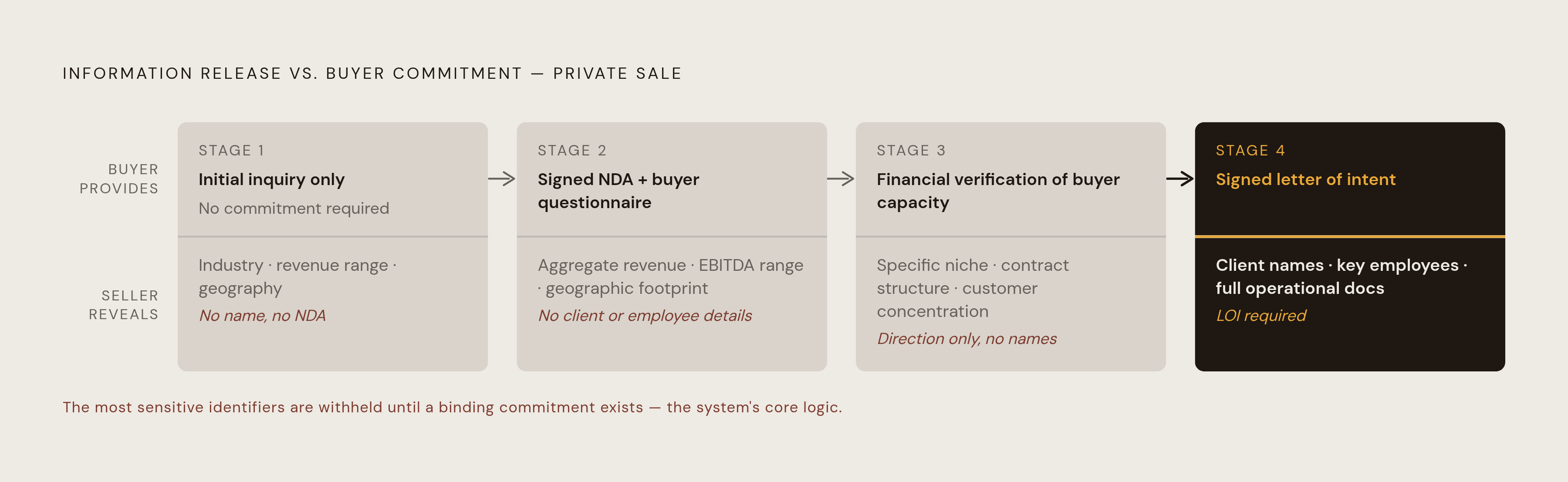
Clearing the NDA and the financial screen does not open every file in the data room at once. Access to the business's confidential detail is tiered, and each additional layer unlocks only after the buyer clears the verification step that corresponds to it. Vetting, in other words, keeps operating well past the signature on the NDA. It runs continuously, through every stage of the deal, right up to closing.
The first tier of disclosure, after the NDA is signed but before a full confidential information memorandum goes out, covers only a high-level summary: aggregate revenue, a range for EBITDA, the general industry, and the geographic footprint. No client names, no employee details, and no proprietary process information appear at this stage, regardless of how qualified the buyer has looked so far. A second tier opens once the buyer clears initial screening: the specific industry niche, an overview of how contracts are structured, and customer concentration described directionally (what share of revenue the top clients represent, without naming them). That level of detail gives a serious buyer enough to build a credible thesis for an offer, without handing over the specific relationships a competitor could exploit. The third tier, the most sensitive, opens only after a letter of intent is signed and the buyer has been fully vetted against all three qualification criteria: specific client names, the identities of key employees, and detailed operational documentation.
Why does this staged approach work rather than simply frustrate buyers and slow the deal down? Serious buyers tend to accept phased disclosure without complaint, because they understand that a seller's confidentiality obligations are not optional and that the sequence protects a business they themselves may soon own. A buyer who pushes hard for more detail than the current stage justifies is either inexperienced in how these deals normally run, or is testing how much information can be extracted before any real commitment gets made. Exit Equity has flagged a specific version of that second pattern: buyers who use due diligence to pull as much operational detail as possible and then try to renegotiate price downward on minor pretexts once they have what they wanted. Phased disclosure does not eliminate that risk entirely, but it puts a ceiling on how much a buyer like that can extract before they have made a binding commitment, which is exactly the point of rationing information against proof at every step along the way.