AI Buyer Matching Platforms for Sub-$50M Business Sales
Three tiers of AI platforms exist for smaller business sales—understand which one fits your deal.
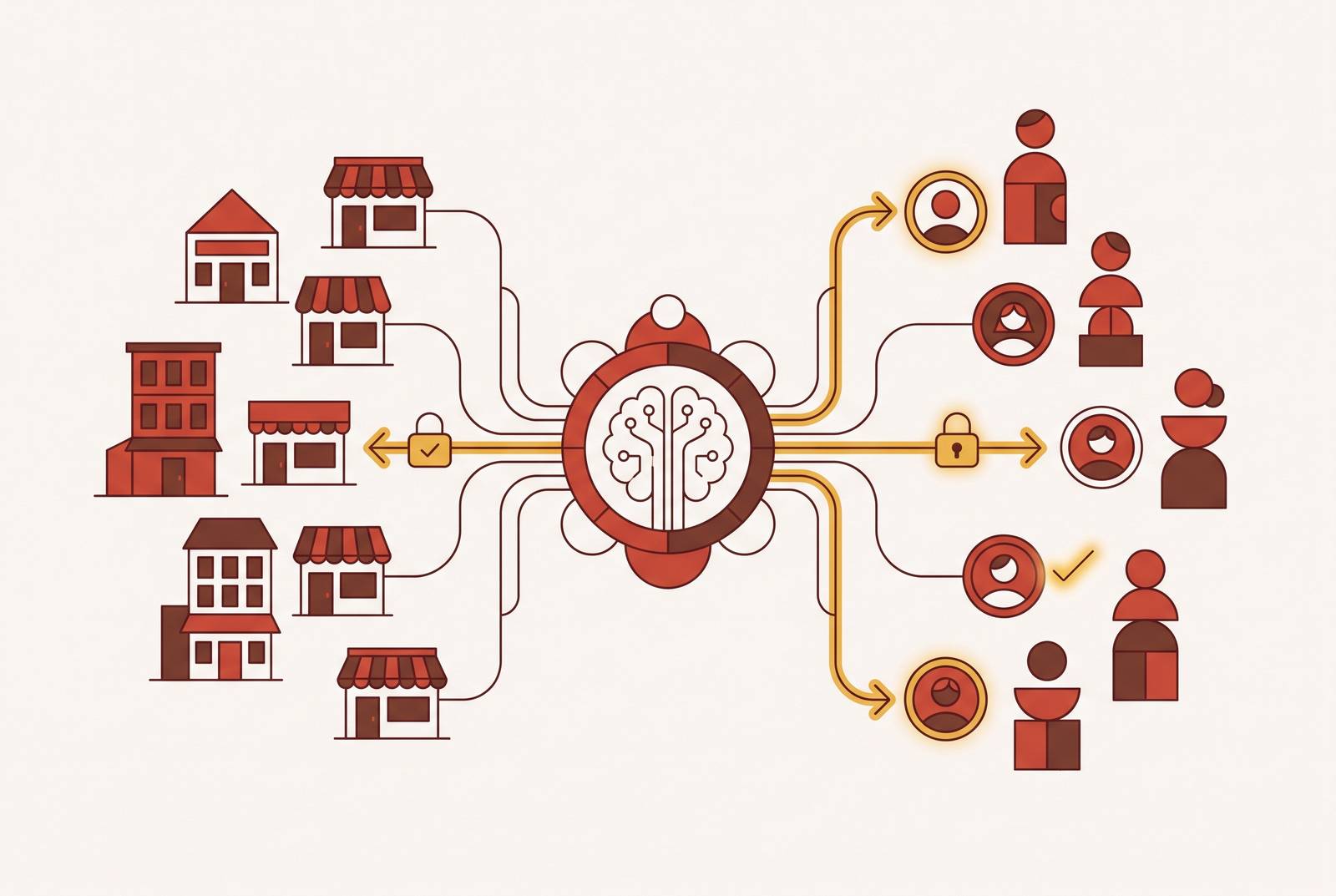
Owners selling a smaller business face a market where the right buyer almost certainly exists, but has no reliable way to find them, or be found by them. People call the lower middle market buy-side environment one of the most active in recent memory, but most of that activity happens inside deal networks and advisor relationships, so a seller without institutional access never sees it. At the same time, a growing wave of aging owners is finally bringing businesses to market after years of delayed succession planning. More sellers are now competing for attention in the same opaque channels. Global deal value keeps concentrating in large transactions, while deal volume at the smaller end stays flat and clustered in a handful of sectors and regions; this pattern in the data means a seller at the lower end of the market cannot count on rising activity to surface a buyer on its own. AI-driven matching has emerged as the structural answer to this gap: it scans buyer criteria and deal data across far more sources than any single advisor's personal network could cover, raising the question of what kind of AI is doing the scanning, and whether the platform behind it was actually built for a deal this size.
What separates the three platform tiers structurally
Every platform claiming to use AI for buyer matching falls into one of three tiers, and the tier matters far more than whatever language a platform uses to describe its algorithm. The first tier is the public listing marketplace, where sellers build a browsable profile that gets indexed and searched, sometimes on the open web, trading confidentiality for volume and speed. The second tier is the deal network, a private database where M&A advisors, private equity firms, and strategic acquirers go to find deals. These listings are not publicly indexed, and the buyers inside them are institutional and pre-screened, which makes the pool smaller but far more serious. The third tier is the advisor matching service, which works differently from the first two in a basic way: it does not connect a seller directly to a buyer. It connects the seller to a vetted sell-side advisor, who then runs a confidential process through whatever channels fit the business; the platform's job is matching the seller to the right advisor, not running the sale itself.
What changes between tiers is not just who the buyers are, but what the AI is actually doing. In Tier 1, AI mostly recommends listings and matches buyer profiles to them, much like the recommendation engine a shopping site runs. In Tier 2, AI does heavier lifting: powering deal origination, matching buyer mandates to seller profiles, and in some cases running diligence tools. In Tier 3, AI routes a seller's intake information to the advisor best suited to their industry, size, and goals, functioning less like a marketplace algorithm and more like an intelligent referral system. A seller who understands which tier they are standing in, and what the AI is actually built to do inside it, can tell quickly whether a platform fits their deal or just fits its own marketing copy.
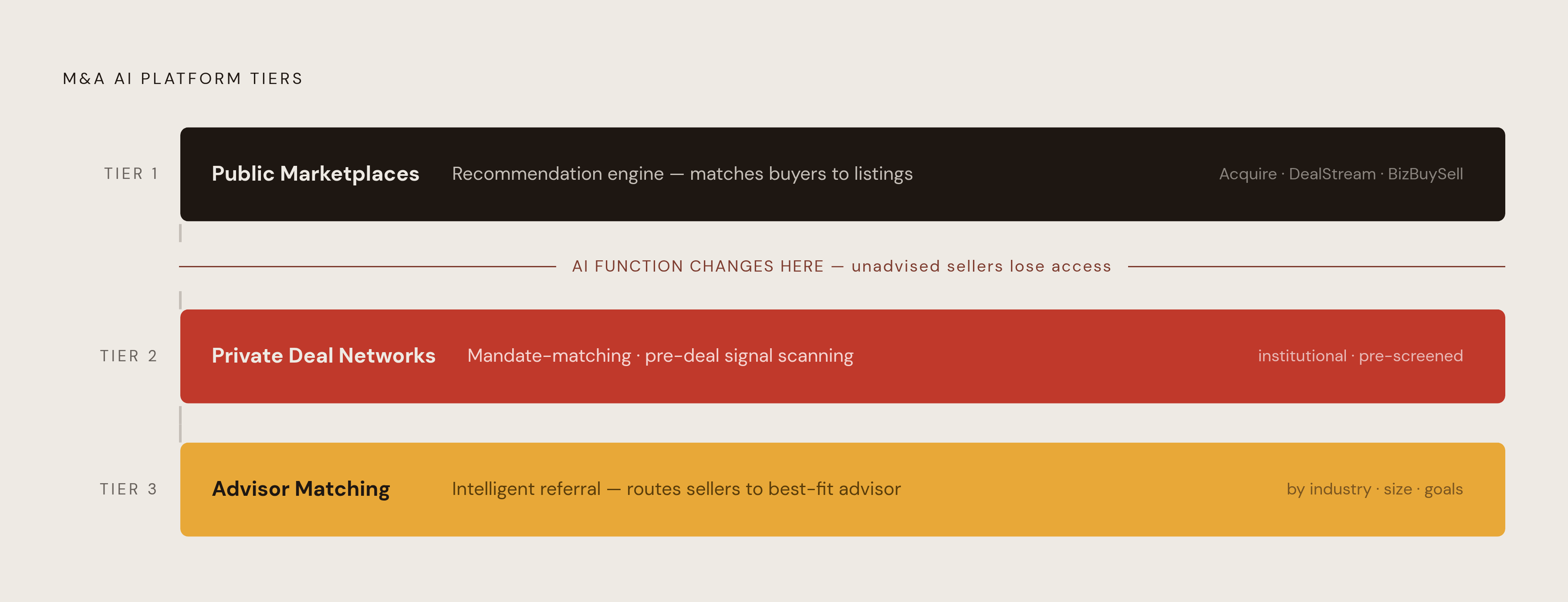
What Tier 1 public marketplaces (Acquire.com, DealStream, BizBuySell) use AI for and where each fits
Tier 1 platforms use AI mainly so buyers and sellers can find each other faster, but they don't run or manage the transaction once a conversation starts. That distinction matters more as deal size grows, because discovery is only the first few steps of a sale, and a platform built purely for discovery has little to offer once diligence, structuring, and negotiation begin.
Acquire.com, formerly MicroAcquire before its 2023 rebrand, has facilitated more than $500 million in cumulative deal volume. AI businesses now make up a meaningfully larger share of submissions on the platform than they did over the prior twelve months, reflecting how many AI-native tools are now entering the acquisition market generally. The platform fits technology businesses, SaaS products, and AI-native tools at the smaller end best, since its buyer pool skews heavily toward individual buyers and search fund operators, not institutional acquirers.
DealStream, formerly MergerNetwork and headquartered in Cambridge, Massachusetts, targets the lower middle market and lets sellers list for free. Its matching runs on straightforward criteria: sector, deal size, geography, EBITDA range, and buyer type, an approach less about machine learning sophistication and more about filtering a large buyer pool down to a relevant subset efficiently.
BizBuySell, owned by CoStar Group, is the largest public marketplace in the category by listing volume, and more buyers visit it each year than any of its peers. Its value comes from sheer reach and broad adoption among brokers rather than from any particular AI capability, which places it closer to a high-traffic listing service than a matching engine in the Tier 2 sense.
FE International is built for technology businesses, and that includes AI-native tools, SaaS products, and automation platforms you find at the lower end of the mid-market. It connects sellers to buyers who are hunting for AI acquisition targets, and even smaller AI-native tools built around one vertical workflow, some with fairly modest annual recurring revenue, are finding buyers there.
What unites all four is a structural ceiling built into the Tier 1 model itself: every public marketplace broadcasts that a business is for sale, whether through a searchable listing, open-web indexing, or both. At the micro-deal level, individual buyers and search funds dominate, and when speed matters more than discretion, that trade-off is the right one. But above a certain deal value, that same visibility creates reputational risk, risk of employee defection, and risk that a competitor or key customer notices before a deal ever closes. That risk is exactly what pushes larger sellers toward Tier 2.
What Tier 2 deal networks match, and the disadvantage sellers without advisors face in them
The most capable buyer-matching AI in the lower middle market lives off the public web, inside private channels. It lives inside private deal networks built for M&A advisors, private equity firms, and strategic acquirers to source deal flow, where listings are never publicly indexed and buyers are institutional and screened before they ever see a profile.
AI inside this tier does more than recommend listings. It processes funding rounds, patent filings, hiring patterns, and online mentions to flag potential deals before they ever reach the open market, and it maps buyer mandates against seller profiles with a level of specificity no public marketplace attempts. But Tier 2 is solving a genuinely harder matching problem than Tier 1. Active private equity buyers rarely publish their acquisition mandates in any structured, searchable way, so the AI has to aim at a target that keeps moving and mostly stays hidden. The quality of any given match depends heavily on how broad and current the platform's buyer mandate database actually is, something a seller browsing from outside has no real way to verify.
That opacity is also what makes Tier 2 a structurally harder place for an unadvised seller to operate. These networks exist primarily to serve professionals: advisors running processes for clients, PE firms screening for mandates, strategic buyers scouting for tuck-in acquisitions. A seller entering without an advisor is navigating a system built around a language and a set of relationships they were never meant to access directly. The access itself only compounds in value once a skilled advisor is behind it, running a competitive process across multiple qualified buyers at once. For deals above a certain size, that competitive tension is what actually moves price, not the existence of the database. A platform can surface the right names. An advisor is what turns those names into competing offers.
Above a certain deal value, broadcasting that a business is for sale carries real reputational downside. Public marketplace exposure at that size can hand competitors information they were never supposed to have, unsettle employees who discover the listing before they are told directly, and prompt key customers to start quietly shopping for alternatives before a deal is even signed.
The confidentiality risk extends beyond the listing itself. It extends into how deal documents get handled once diligence begins. Pasting financial statements, contracts, or cap tables into consumer-grade AI tools can expose confidential seller information and, in many cases, breach existing NDAs. Anything beyond an early-stage teaser belongs in enterprise-tier AI tools with a signed data processing agreement, not in a free chatbot a founder happens to already use for other work.
Buyers, meanwhile, are raising the bar on their own side of diligence. AI now lets buyers analyze contracts, challenge add-backs, and build diligence requests far more systematically than they could even a few years ago, so sellers who have not kept pace with this shift walk into negotiations without fully understanding what the other side already knows. Quality-of-earnings reports are becoming close to standard practice on larger deals partly because AI tools make it so much easier for buyers to surface inconsistencies buried in seller financials. A seller choosing a sales channel at this size is also choosing how much diligence firepower they will be facing on the other side of the table, which makes channel choice and advisor choice two parts of the same decision.
How AI now evaluates the target business, not just finds buyers for it
The role AI plays in a sale has started to shift in a direction that matters more than which platform a seller picks. AI is no longer only the tool buyers use to find a target. It is increasingly the lens buyers use to decide whether to proceed with a deal at all, and at what price.
A meaningful share of strategic M&A dealmakers walked away from a deal in a recent year specifically because of AI-related concerns about the target business. A company's AI profile now affects whether it can sell at all, not just how attractive it looks on paper. Unaddressed regulatory, privacy, or technical risk tied to AI use can produce real valuation discounts, and those discounts stack on top of each other. A business that has never audited its own AI exposure carries a negotiating liability into the sale process, one a buyer's AI-powered diligence exposes quickly, often faster than the seller's own team can explain it away.
What buyers weight has also shifted alongside this. Deal teams increasingly look at signals that point toward future performance, such as product scalability, customer behavior patterns, data quality, and operating leverage, rather than anchoring almost entirely on past growth and historical margins. AI tools make it faster for buyers to interrogate all of these signals at once. The diligence process itself has sped up even as its depth has increased. For a founder preparing to go to market in 2025 or 2026, the practical question is no longer just which platform to list on. It is how the business will hold up once it passes through an AI-powered diligence lens, and whether there is time to fix the weak spots before a buyer finds them first.
The limits of AI matching and where human judgment remains decisive
AI matching is good at finding correlations, buyers who have historically acquired similar businesses in similar sectors at similar financial profiles. What it cannot do is judge whether a specific buyer and a specific seller actually belong together.
Leadership credibility, cultural alignment, and strategic fit are judgments that depend on context and experience, the kind of understanding that comes from actually knowing how a business operates day to day, not how it appears in a spreadsheet. AI can flag an anomaly sitting inside a data room, a discrepancy in reported margins, an inconsistent growth pattern, a gap in documentation. What it cannot explain is intent: why a particular buyer might be willing to pay above market, a decision that usually reflects strategic conviction no algorithm currently captures. That gap is where the strongest case for advisor involvement lives. The platform, however good its matching engine, is an input into a competitive process. The advisor is who creates the tension across multiple buyers that moves price upward, and on larger deals that tension decides the final number far more than the initial list of names ever does.
AI adoption among M&A professionals has accelerated sharply in a short window, and that acceleration is happening on both sides of the table at once, buyers and sellers, advisors and principals alike. As tools proliferate everywhere, the advantage that comes purely from having AI starts to compress, since nearly everyone has access to some version of it. What increasingly separates one process from another is not whether AI shows up somewhere in the workflow, but how well an advisor actually deploys it inside a disciplined, well-run process.
Matching deal size, confidentiality needs, and readiness to the right platform tier
The right tier for a given seller is the one that fits deal size, confidentiality requirements, and how ready the seller actually is to run a process versus still planning one, not the one with the most impressive AI pitch.
A founder with a smaller technology business, comfortable with public visibility and looking mainly for speed, is well served by Tier 1 platforms like Acquire.com, DealStream, BizBuySell, or FE International, particularly where the buyer pool of individuals and search funds matches the kind of buyer likely to be interested. If a seller's business is worth several million dollars or more, and a competitor finding out early could cause real damage, they need to weigh that exposure seriously before they list anywhere public. For businesses at that size, Tier 2 deal networks hold the better-qualified, institutional buyers, but those networks work best with an experienced advisor running the process behind the scenes, with the founder not navigating alone. And for sellers who are not yet sure which channel fits, who still need help figuring out valuation, timing, or even whether the business is ready to go to market at all, Tier 3 advisor matching services solve a different problem entirely: finding the right advisor first, so that whoever eventually runs the sale knows the business, the buyer landscape, and the diligence risks well enough to defend the asking price.