Why Most AI Buyer Matching Platforms Miss the Canadian Lower Middle Market
Canadian owner-operators need private buyer data and human judgment, not US-trained algorithms.
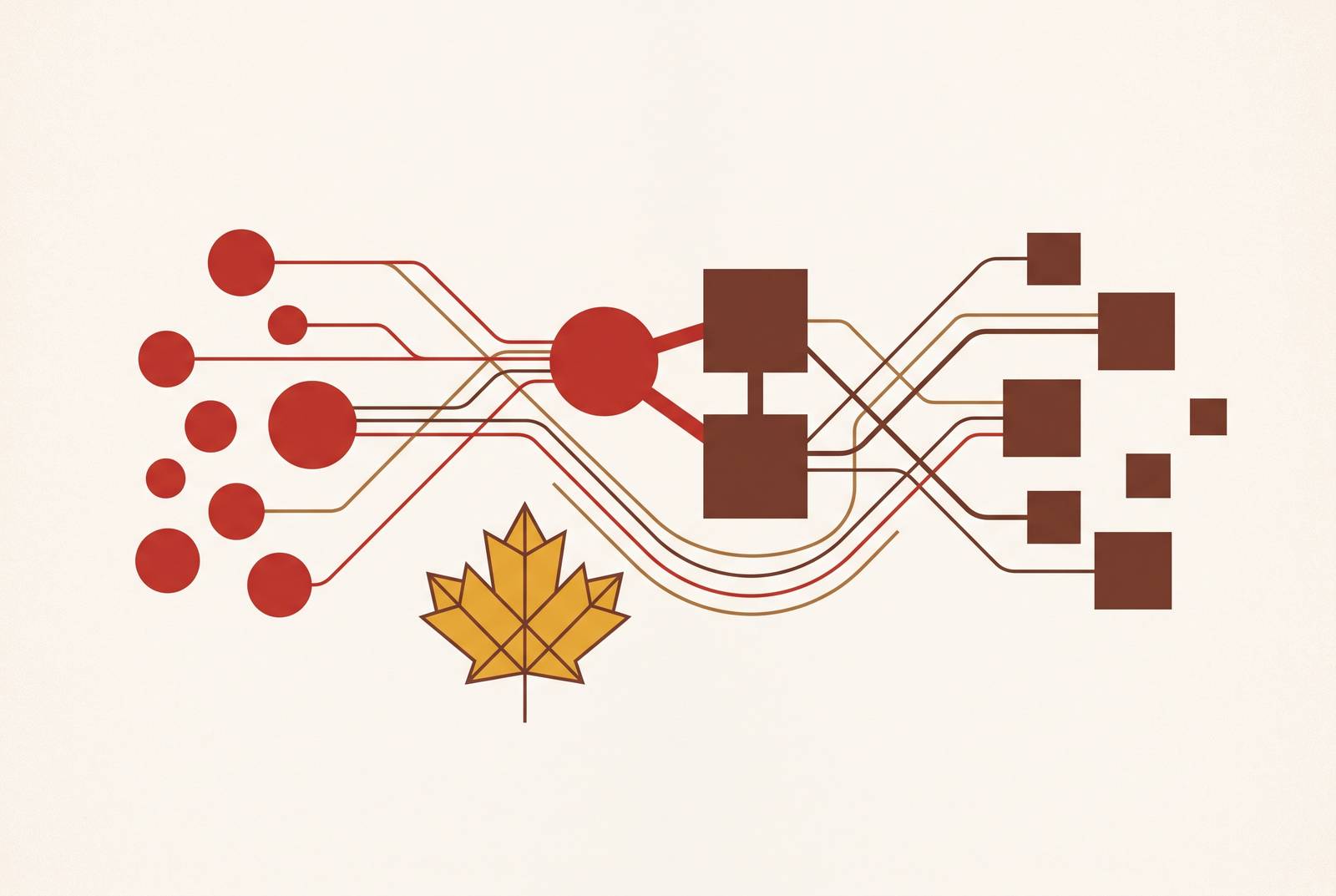
For smaller Canadian founder-led businesses, AI-powered buyer matching needs Canadian private-company data, confidential outreach, and human advisors who can assess more than financial fit. Most platforms miss this market because their US-centric data and institutional matching logic overlook regional buyers and owners’ succession priorities. Selling without a public listing calls for private outreach to qualified, pre-screened buyers, with confidentiality built into the process.
Why Canada's lower middle market is heading into a succession crisis that the broader M&A boom is not solving
CFIB’s succession research finds that most small business owners plan to exit within the next decade, yet only a small fraction have a formal succession plan. That gap is demographic. Boomer ownership concentration means exits will outpace new business formation for years, while CFIB data already show business exits exceeding starts for multiple consecutive quarters. The businesses at risk include food processors, contract manufacturers, and regional service firms that local economies depend on.
Norton Rose Fulbright’s 2026 outlook says nine mega-deals drove the average deal size, though the vast majority of deals were below that threshold. Kroll’s Summer 2025 Canadian M&A report shows a similar pattern, with fewer deals in H1 2025 but higher disclosed enterprise value because the deals were larger. Capital gravitates toward scale, and advisory attention follows. A healthy aggregate value therefore says little about an individual founder’s access to qualified buyers.
MNP’s Q2 2026 M&A update reports declining quarter-over-quarter activity as trade tensions, inflationary pressures, and geopolitical uncertainty weighed on deal-making. Smaller sellers face a thinner market just as more owners need to leave. The resulting pressure includes both a shortage of succession plans and an undersupply of qualified advisory and matching capacity where those plans must become transactions.
What AI buyer matching platforms were built to do, and why that design does not fit this market
Most AI buyer matching platforms began with institutional deal flow in mind. Their users were buyers and intermediaries, including private equity firms sourcing targets and banks screening pipelines. Their inputs reflect those users’ needs, including revenue, EBITDA, sector codes, and broad geography. These are useful financial filters for an initial search. They are not a complete account of what makes a buyer suitable for an owner-operated business.
That distinction becomes sharper when the underlying data are considered. Most platforms were built on US deal data, where institutional M&A disclosure is deeper and more standardized, then extended to Canada without rebuilding the data layer. Tools based on an advisor’s existing buyer database also inherit its limited coverage of the global acquirer universe. Faster searching does not remove that boundary. A platform may process its records efficiently while still overlooking the buyers most relevant to a Canadian seller.
Canada’s lower middle market combines three difficult conditions, namely thin public data, qualitative sale criteria, and regional fragmentation. A manufacturer in Cambridge, Ontario and a food processor in Lethbridge, Alberta operate within different labour markets, customer networks, and regulatory environments. Broad financial and sector filters cannot capture those distinctions. A platform needs to include the right buyers and criteria as well as rank buyers well.
The data desert at the core of the matching failure
Commercial databases rarely have enough detail on owner-operated businesses in secondary Canadian markets to match them with buyers who fit. Many have no meaningful public filings, disclosed transactions, or analyst coverage. The information needed to understand these businesses is held privately, outside the channels on which institutional datasets depend.
Businesses with disclosure histories are easier for a platform to surface, so results lean toward larger, more institutionalized companies. Regional manufacturers, trade contractors, and food producers are harder to represent. An incomplete record also gives a matching system less basis for distinguishing a strong fit from a superficial resemblance. Iterating faster on the same dataset cannot supply facts that were never collected.
MNP’s quarterly sector reports cover Agriculture, Food & Beverage, Manufacturing, Oilfield Services, and Engineering & Construction, showing that these industries are active parts of the transaction market. Its Q2 2026 data identify Industrials as the leading sector, with 72 transactions. Yet owner-operated businesses in these industries often lack the clean financial disclosures that AI platforms require. Regional bolt-on acquisitions, the dominant transaction type in the lower middle market, typically originate through relationships and local knowledge.
What AI cannot read about the non-financial criteria that drive Canadian lower-middle-market deals
CFIB’s succession research finds that owners strongly prioritize protecting employees, preserving how their business operates, maintaining its legacy, and keeping ownership in Canadian hands. These priorities are absent from standard buyer-matching datasets. Better financial data would not close that gap. A system can know more about revenue and still know nothing about whether a buyer will retain a long-tenured team.
Consider a buyer whose financial profile fits but whose plans include centralizing operations in the US, removing local management, and rebranding the business. For an owner committed to employees, Canadian ownership, and family legacy, that buyer could be unacceptable. A financial matching score could nevertheless rank it highly. The score uses the wrong definition of a successful match. What exactly is the system optimizing for?
Seller preferences can be recorded and used as filters, but judging whether a buyer will honour them requires more than a field in a database. Cultural compatibility, family dynamics, and trust need contextual judgment. In this market, a buyer’s time in the facility and understanding of the local community can help establish the confidence needed to close. Relationships are part of the transaction’s working structure. AI can find patterns and buyers, but human advisors must talk through what the owner wants to keep to judge whether a buyer still looks like a good fit.
How regional fragmentation makes a US-trained platform structurally blind to most of Canada
A food manufacturer in British Columbia, a manufacturer in southern Ontario, and an oilfield services firm in Alberta face different buyer pools, provincial tax implications, and succession dynamics. Treating Canada as one geography obscures those differences. A buyer’s national presence does not establish its relevance to each regional business. The useful unit of matching is often closer to a local industry network than a country label.
Norton Rose Fulbright’s outlook says Quebec’s EV battery corridor is drawing large cap foreign direct investment and consolidation. That example concerns larger transactions, but it illustrates the provincial concentration of investment patterns. At the lower end of the market, regional buyer networks and deal norms are also consequential. A national sector match can therefore remain theoretical. The gap is particularly acute for owner-operated businesses outside the markets where institutional data are deepest.
CASL and provincial privacy laws govern aspects of how information is collected, used, and communicated, so Canadian compliance needs to shape data collection and outreach from the start. Confidentiality cannot be treated as a final check. If private business information circulates without proper consent, employees, customers, or competitors may learn of a potential sale prematurely. That exposure can end a transaction before a suitable buyer has been established.
What happens to owners when the matching fails — and the exit does not close
For many owners, the business is their retirement. It is typically their largest financial asset, so a failed sale is not simply an unsuccessful deal. A poor price or an unsuitable buyer can put the owner’s financial future at risk. BDC’s Rachel Chong, Director, Growth & Transition Capital, explains that unrealistic expectations can prevent transactions or lead owners to sell for less than the business is worth. A matching process that does not address those expectations leaves a central obstacle untouched.
Finding buyers cannot solve owner dependency. When every important decision and relationship runs through the founder, the buyer faces a business whose performance may not survive the handover. That dependency discounts value, while businesses that can perform after the founder leaves attract premiums. Technical know-how concentrated in one person is particularly difficult to transfer quickly.
The consequences become harsher if an owner dies or becomes incapacitated without a plan. A spouse or family inherits operating decisions, employee questions, and customer uncertainty under time pressure and grief. They may have to run an unfamiliar business, sell hurriedly at a discount, or wind it down. Preparation protects the family from having to solve succession at the moment it is least equipped to do so.
What a platform built for this market actually has to do differently
The lesson for platform selection is to examine the underlying design. Canadian private-company deal data must include regional bolt-ons and trade-buyer activity that commercial databases often miss. Matching must also use employee protection, ownership preferences, and legacy to set limits on which buyers are chosen. Human assessment then has to test whether the buyer’s intentions and operating approach fit those constraints.
Confidentiality requires equally deliberate design across outreach and buyer vetting. An owner should be able to explore the market without publicly listing the business or alerting employees, customers, and competitors. That requires a process for private outreach to qualified buyers. Canadian regulatory fluency must inform how information is collected and used.
Within that structure, AI has useful work to do. It can expand the buyer universe beyond an advisor’s contact list, surface non-obvious strategic acquirers, and process deal documents quickly. Human advisors can then assess qualitative fit, manage expectations, navigate family dynamics, and build trust. The division of labour is the advantage.
One model that reflects this design pairs AI-powered buyer matching with institutional investment banking advisory, built specifically for owner-operated businesses across Canada and the US. Its relevance to a Canadian owner depends on Canadian deal data, regulatory fluency, and advisors who understand regional transactions. The combination offers the most value when work begins three years before a planned exit, while there is still time to close the gap between current and potential value.
How should Canadian owners prepare before engaging a platform or advisor?
Before engaging a platform or advisor, owners should establish what the business is worth, how dependent it is on them, and which succession priorities are non-negotiable. A baseline valuation should distinguish market value from the amount needed for retirement. The distinction can be uncomfortable but is useful. It reveals the gap between present value and financial goals while there is time to address it. An owner-dependency assessment then identifies the relationships, decisions, and capabilities that need to be distributed before a sale.
Employee protection, Canadian ownership, and legacy preservation are more useful as explicit filters than as concerns raised late in negotiations. Owners should ask how each priority enters the matching process. They should also ask whether the buyer database is built from Canadian private-company transactions or adapted from US-centric data. A platform’s answer should explain its fit for the business.
Confidentiality deserves a specific question before any agreement is signed. How does the process prevent premature disclosure to employees, customers, or competitors? Owners should also find out whether human advisors have worked directly on Canadian lower-middle-market transactions or whether the service is mostly self-serve. The final question concerns timing. What changes in the process for an owner three years from exit compared with one ready to sell now?
Starting early gives owners time to make the business less dependent on the founder, agree on expectations, and use succession priorities to choose buyers. Waiting narrows the work that remains possible. An owner who waits until they are ready to exit has already lost the years in which preparation can create the most value.