Running a Confidential Off-Market Sale Process for a Profitable Canadian Business
Staged disclosure protects your business's value and stability during a private sale.

Selling a profitable Canadian business without a public listing requires a confidential off-market process built around vetted buyers and staged disclosure. The sequence runs from an anonymous teaser through a signed NDA to controlled document access and exclusive due diligence. Confidentiality is an actively managed system, and its purpose is to protect both the business and the seller’s negotiating leverage.
Why confidentiality is the highest-stakes operational risk in a Canadian business sale
A key account manager gets wind of the sale and updates their professional networking profile. Then a buyer’s first due-diligence question is “who are your three top people and are they staying?” The owner now faces a retention problem during valuation. If the strongest employees leave, the buyer is no longer evaluating the same business.
The uncertainty can spread beyond the team. Customers may hedge their dependence, competitors may poach accounts, and suppliers or lenders may tighten terms. A searchable public listing that reveals the business name, address, revenue and Seller’s Discretionary Earnings gives sensitive information to people the seller cannot afford to inform early.
How do you sell a Canadian business without publicly listing it?
In an off-market sale, the business stays unnamed on public marketplaces and listing sites. Instead of accepting inquiries from a marketplace audience, the advisor approaches a curated, pre-qualified buyer list and controls what each recipient learns. Private does not mean informal or exclusive. Several qualified buyers can compete while the company’s name stays private.
The distinction therefore lies in the process’s structure as well as its advertising channel. Buyers earn access one gate at a time, and details that could identify the business stay out of searchable profiles. When the seller talks to just one buyer, there is no competition to help the seller negotiate price and protections in the contract. Confidentiality and price maximization need not conflict when controlled exposure creates genuine alternatives.
The preparation work that must happen before any buyer hears a word
Preparation gives the seller time to resolve weaknesses before buyers turn them into negotiating leverage. Financial readiness begins with three to five years of accrual-based income statements, balance sheets and cash flow statements. Every earnings adjustment needs a defensible record. Normalized EBITDA should account for what the owner is paid, one-time expenses and non-recurring items, including personal expenses run through the business that have records to back them up. For smaller owner-operated businesses, SDE typically provides the more relevant measure of the economic benefit available to one full-time owner-operator.
Legal readiness requires a complete corporate minute book, including incorporation documents, bylaws, resolutions, share records and relevant shareholders agreements. Provincial registry filings also belong in the preparation work. Clearview Counsel’s legal checklist recommends a pre-sale legal audit on the seller’s timeline. That work should identify change-of-control provisions in customer contracts, leases, licences and financing arrangements, establish corporate ownership of intellectual property, and address unresolved liabilities or compliance gaps.
Operational readiness asks a different question. Can the business function without the owner holding every important relationship and decision? Delegation, cross-training, documented workflows and broader customer relationships reduce that dependency, while renewed contracts can strengthen revenue stability. A professional valuation identifies risks such as customer concentration and separates evidence from the owner’s expectations. Only a deliberately chosen, small internal circle needs to know why this work is happening.
Stage one of the process: the blind teaser and what it must and must not reveal
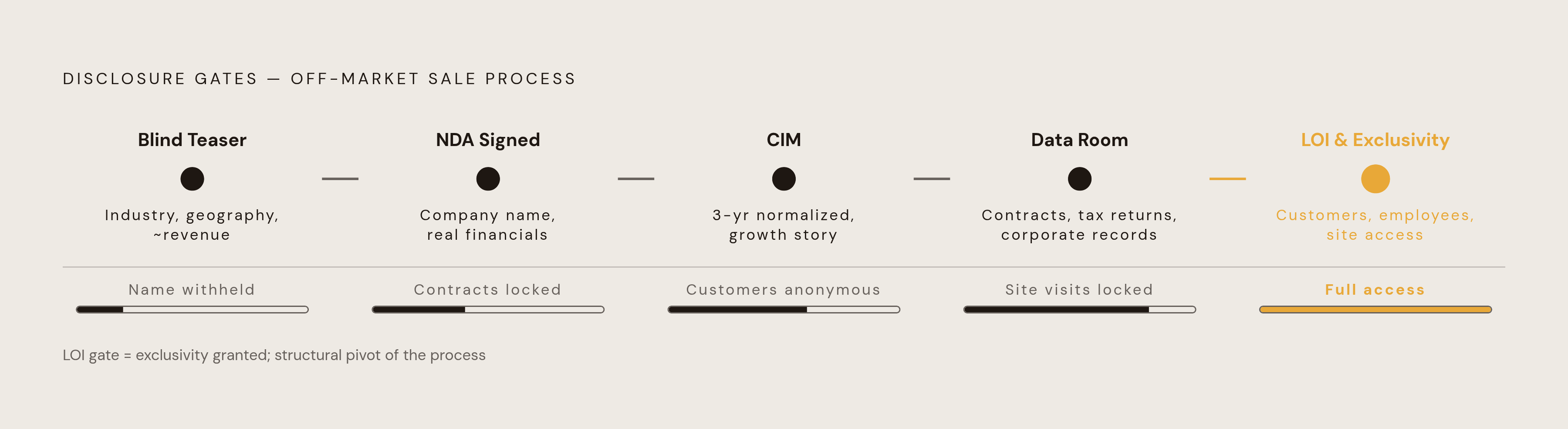
The blind teaser draws buyers’ interest without naming the company. Typically one to two pages, it describes the industry, broad geography, approximate revenue and earnings, and nature of the opportunity. A profitable recurring-revenue commercial services business in Western Canada gives a buyer a basis for assessing fit. It does not need a company name.
Determining whether the details collectively identify the seller is harder. A precise location, named customer, exact employee count or distinctive organizational detail may reveal what the omitted name conceals. Those details should stay out, and the teaser should go only to the curated buyer list, with no public broadcast. The teaser’s only job is to generate enough qualified interest for a signed NDA, the threshold to substantive disclosure.
Stage two: building and approaching the curated buyer list
Curation begins before anyone receives the teaser. Buyers should be screened for capital sufficient to fund the transaction, a mandate that fits the acquisition, and seriousness demonstrated through their transaction record. Buyers could include strategic acquirers, private equity-backed platforms, family offices and individual owner-operators who qualify. Each category brings a different acquisition rationale, so a long contact list is not the same thing as a qualified network.
Outreach timing then balances exposure against competition. One-at-a-time approaches limit how many parties are involved, while small, managed waves preserve more competitive tension. The choice depends on business size, buyer depth and urgency. Canada’s lower-middle market has fewer domestic buyers than its U.S. counterpart, making cross-border reach consequential. AI-powered buyer matching can broaden candidate identification beyond an advisor’s existing contacts, while human advisory judgment assesses which candidates belong in the process.
Stage three: the NDA as the legal architecture of the entire process
The NDA gate comes before the company name, real financials or identifying details. Its definition of confidential information should cover financial records, customer and employee information, and the fact that a sale process exists. A non-solicitation provision addresses approaches to employees and customers, including after a failed deal. Obligations should survive that failure for a meaningful period.
Suppose a buyer calls a top customer to assess relationship health “as part of research.” Without a no-contact clause, the agreement lacks the explicit consent gate intended to prevent that approach. Written seller consent should therefore be required before contact with employees, customers, suppliers or the landlord. Financial qualification may accompany signing, while numbered documents and logged recipients make later distribution traceable.
Stage four: the Confidential Information Memorandum and what it contains
The Confidential Information Memorandum is where buyers first evaluate the identified business in depth. It explains the opportunity, history, ownership, products or services, market position and staffing. Its financial core includes three years of normalized results, documented add-backs and revenue breakdowns by customer, service line and geography. Customer information can remain anonymized or grouped at this stage. It also shows where the business could grow and how a buyer might add value.
An organized, consistent CIM signals a well-run business, while gaps invite a risk discount. The document should also describe assets and the proposed share or asset sale structure, because that distinction affects Canadian tax outcomes. The advisor typically prepares it, but the owner must review its accuracy before tracked distribution. At this stage, buyers do not get detailed customer names, employee-level information or site access.
Stage five: management meetings, the data room, and controlling site access
Management meetings introduce a form of exposure that documents do not. A virtual presentation or a meeting at an advisor’s office at 6pm creates a different confidentiality risk from a buyer walking through the facility during business hours. The seller chooses which managers take part, with no assumption that the whole team must attend. For essential employees told about the sale early, retention agreements with stay bonuses help reduce the risk that they will leave because they are worried.
The virtual data room controls documentary access through a permission-based repository containing financials, contracts, tax returns, corporate records, leases and intellectual property registrations. Access logs record which buyer viewed which document and when, also revealing areas of buyer interest. Disclosure remains staged within the room itself. Core financials precede contracts, while customer and employee details wait for the later gate. Physical site visits come after a signed LOI, and informal customer or supplier checks remain subject to written consent.
The Letter of Intent and what changes after it is signed
The Letter of Intent normally sets out proposed price, asset or share structure, exclusivity, key conditions and the expected closing timeline. Exclusivity changes the seller’s position because negotiations with other buyers stop during the agreed period. Earlier competition provides the foundation for this trade. The seller accepts a temporary loss of alternatives in return for a credible commitment that supports deeper disclosure.
Detailed records, customer names and employee-level information can now support due diligence, and controlled site visits can be scheduled. Essential employees may join the inner circle, but retention agreements should be in place before those talks. This is not the broad announcement stage. Wider employee and customer communication belongs at or after signing the definitive purchase agreement. Where foreign buyers are involved, potential Investment Canada Act review and approval requirements should have been identified early because they can affect the timeline.
Canadian tax structures that affect how the deal is designed from the start
The highest offer does not necessarily produce the most money after tax. The Lifetime Capital Gains Exemption can shelter a substantial amount of eligible shareholder gains on qualifying shares of a Qualified Small Business Corporation. Eligibility depends on asset, holding-period and corporate-structure tests that take time to satisfy. A share sale is typically needed to access the exemption, while buyers often prefer an asset sale for liability reasons. That tension belongs in early deal design.
Other structures require their own eligibility analysis. The Canadian Entrepreneurs’ Incentive applies to qualifying sectors rather than every industry, so its availability cannot be assumed. Employee Ownership Trusts provide another succession route. Grantbook states that it became majority-owned by Canada’s first EOT on January 1, 2025, while Taproot Community Support Services announced its transition in September 2025. The Government of Canada’s Spring Economic Update 2026 proposes making the eligible EOT capital gains exemption permanent, but sellers should treat it as a proposal and avoid assuming it is already law.
These choices affect corporate structure, share-versus-asset preferences and holding-company arrangements before outreach begins. After-tax modelling may favour a lower offer with a better structure over a higher headline amount. This information is limited to transaction design. Canadian tax rules call for a tax advisor who has worked on business sales, ideally brought in while the seller is getting ready.
The advisory team that makes the process work — and what each role actually does
The M&A advisor or investment banker coordinates the sequence, prepares the teaser and CIM, approaches buyers, manages the data room and negotiates terms. This role also controls disclosure gates. Canadian mandates require particular attention to network breadth. Combining AI-driven buyer identification with institutional investment banking advisory addresses the need for cross-border reach without treating an algorithmic match as completed buyer vetting.
Other advisors own distinct parts of the work. The accountant or tax advisor normalizes financials, supports defensible CIM representations and models tax-efficient structures. The lawyer for the business sale takes care of the NDA, change-of-control provisions, corporate records, purchase agreement and closing. The financial advisor connects acceptable deal structures to the owner’s retirement income, investment and estate goals. A gap in one role cannot reliably be covered by expertise in another, particularly when missed contractual or tax issues emerge during negotiations.
The mistakes that break confidentiality — and the ones that reduce the final price
An unsigned or generic NDA allows disclosure without the intended protections, while an untracked CIM removes the ability to trace its distribution. Too many early insiders widen the leak risk. Unauthorized channel checks and premature site visits then expose the sale through direct contact, even when the documents themselves remain private.
Price failures follow a related but distinct pattern. Waiting until revenue declines or the owner is visibly burned out gives buyers a weaker business narrative, while negotiating with one buyer removes alternatives. Unresolved customer concentration and contradictions between the CIM and diligence findings create grounds for discounts or withdrawal. Ignoring after-tax proceeds can further erode an apparently strong result. An off-market sale is a system rather than a hope, and owners who understand its gates are better placed to preserve the business long enough to close on their terms.