How Founders Engineer a Higher Sale Price Four Years Before Listing
Start delegating and documenting now to command a premium when you sell.

Canadian business owners planning to sell in three to five years should begin exit preparation now, with four years allowing time to build the financial history and management track record buyers examine. A higher sale price comes from improving two inputs, normalized earnings and the confidence multiple applied to them. The sequence is to reduce structural risk first, strengthen revenue quality next, then document sustainable earnings and growth before listing.
Why the sale price is set long before the listing
Founders often think the market sets what their company is worth when they decide to sell. Yet buyers assess profitability, founder independence, and transferability that already exist by then. Those qualities take years to establish. Two businesses with identical revenue can therefore receive very different offers because one produces more dependable earnings without its owner.
Negotiation starts with the business presented to the buyer. It cannot supply missing management experience or turn recent improvements into a long financial record. Preparation changes what the buyer can underwrite, while negotiation works within that evidence.
The two inputs buyers actually pay for — normalized earnings and the risk multiple
First Turn Capital expresses valuation as (Normalized EBITDA × Multiple) minus Risk Discount plus Synergy Value. The formula distinguishes the earnings base from the multiple, while recognizing separate adjustments for risk and buyer-specific synergy. Revenue alone does not determine what a business is worth. Founders can improve sustainable profit, reduce the risks attached to it, and clarify the value available to a particular acquirer.
The appropriate earnings measure depends on the business. For smaller owner-operated companies, Seller’s Discretionary Earnings, or SDE, adds owner salary, benefits, and personal discretionary expenses back to reported profit. For businesses that need professional management after acquisition, EBITDA counts the pay those managers need as a real cost. Tabber Benedict stresses that adjustments must be reasonable and documented, because buyers discount unclear or aggressive add-backs.
The multiple expresses confidence that earnings will continue under new ownership. Founder dependency, customer concentration, undocumented processes, and non-transferable contracts weaken that confidence. Melissa Houston CPA notes that founder-dependent businesses can receive valuation discounts of thirty to fifty percent compared with businesses with transferable systems and leadership. History gives buyers grounds for a different assessment. A sustainable earnings improvement supported by two years of statements is more credible than one introduced two months before listing.
What should a Canadian business owner do four and three years before selling?
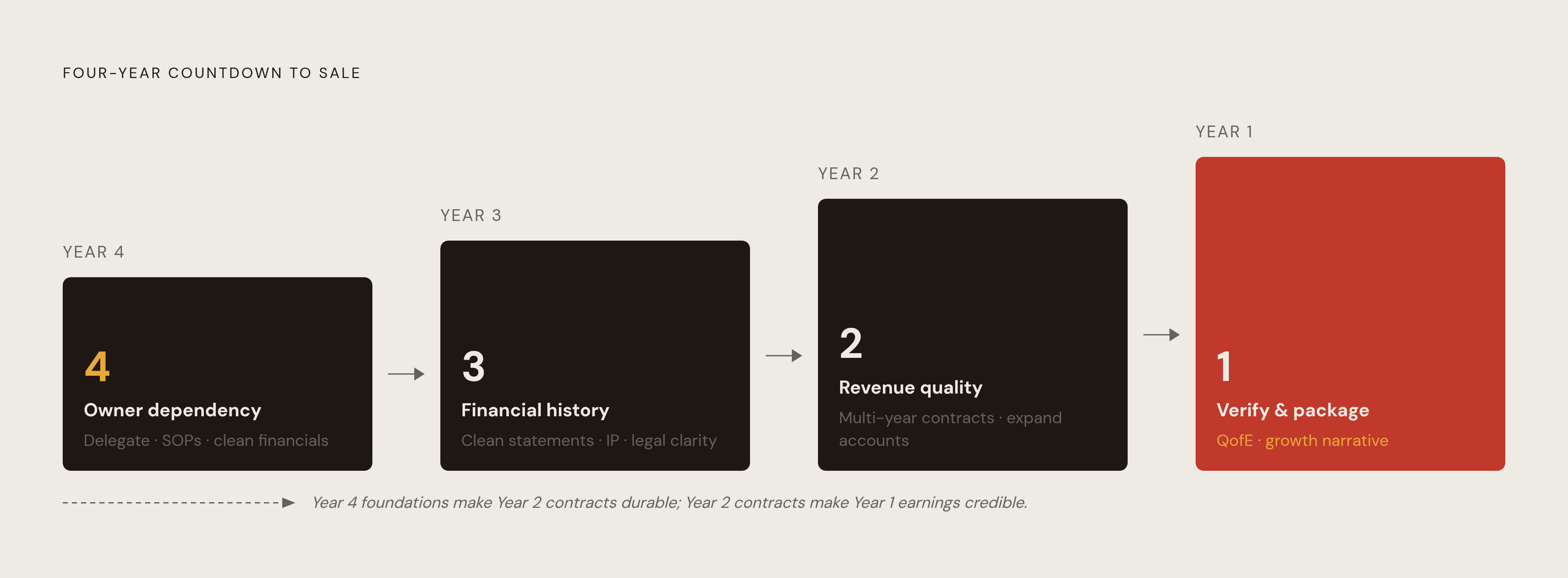
The earliest work must have time to prove itself. Novelty Hill Capital identifies owner reliance as one of the largest valuation discounts in founder-led transactions, particularly when the founder controls key accounts, daily decisions, or undocumented knowledge. The practical response begins with delegating decision authority to department managers and transferring major customer and vendor relationships to named leaders. KPIs and clear limits on who can decide what then let those leaders act without having to ask for approval each time. Starting in year four creates time to document that independence.
Plans to keep managers in place also need attention well before a sale. Retention incentives, including phantom stock or transaction bonuses tied to closing, can keep executives aligned through the sale. Buyers will ask about those arrangements. Standard operating procedures support the same transition by moving knowledge out of the founder’s head and into the company. A management title is less persuasive than a record of decisions made and relationships maintained without the owner.
Financial reporting needs a similarly long runway. The same framework calls for statements aligned with accepted accounting standards, reconciled and updated monthly, with personal and non-operational expenses separated from core costs. Tax filings and accounts receivable must reconcile to internal reporting, and potential EBITDA add-backs need early documentation. The objective is the monthly discipline that produces three years of consistent historical statements before marketing begins.
Legal clarity belongs in this early phase too. Shareholder agreements, equity records, and board approvals need to be organized, while intellectual property ownership held personally by the founder must be formally assigned to the company. Unclear ownership can reduce valuation or require remediation before closing. Addressing it now keeps that work on the seller’s timetable. It also leaves subsequent years available for improving the business rather than resolving uncertainty about what can be sold.
Year two before listing — attacking customer concentration and revenue quality
Once the structural foundation is in place, preparation turns toward the durability of revenue. Why year two rather than the final year? Diversification and new contract structures need multiple quarters to appear in the financial record buyers examine. Beginning after management and reporting improvements also gives the business a stronger basis for managing those changes. The aim is to improve revenue quality without damaging the earnings base.
Novelty Hill identifies high customer concentration as a primary deal-breaker during diligence. Its recommended sequence is not to shrink the dominant account, but to freeze its growth while expanding adjacent accounts and new verticals. Diversification can include new geographic markets and cross-selling to existing clients. Converting transactional buyers into multi-year contracts can also improve predictability. The relevant test is whether the largest customer’s share falls.
Predictability strengthens the multiple for a separate reason. First Turn explains that businesses with identical profit can receive different multiples when one has materially more recurring revenue. Depending on the industry, that may mean subscriptions, retainers, maintenance and aftermarket contracts, or long-term service agreements. New products are not always necessary for this transition. Existing relationships can move from project billings to retainers or from informal repeat business to contracts with renewal terms.
However, contracted revenue is not automatically transferable revenue. Benedict says assignability can affect valuation because customer or vendor agreements that cannot be transferred put the sale at risk. Standardizing terms also reduces the complexity buyers must examine. Revenue quality therefore depends on both payment predictability and the agreement supporting it.
Year one before listing — making EBITDA improvements credible and building the sale narrative
The final year is primarily for verification and packaging. Its credibility depends on changes made in the preceding years. First Turn states that buyers discount aggressive cost cuts made three to six months before a sale because they expect costs to return after closing. Buyers are more likely to see improvements made twelve to eighteen months earlier as lasting changes when they are visible across multiple statements.
Legitimate margin work can still include supplier renegotiation, correcting pricing leaks, and addressing labor inefficiencies identified by product or service-line analysis. Such improvements need evidence of sustainability. One-time cost eliminations, revenue pull-forwards, and expense deferrals instead draw a closer look from quality-of-earnings teams. If discovered after a letter of intent is signed, they can prompt a re-trade that reduces the buyer’s offer. A stronger reported number is not necessarily a stronger normalized number.
Owner compensation, personal expenses, one-time legal fees, and unusual repairs require invoices, general ledger detail, or payroll records, with their treatment suited to the earnings measure being used. For larger lower-middle-market businesses, a quality of earnings review that the seller commissions can uncover problems before buyer diligence. The growth narrative requires comparable discipline. Tested pricing strategies, new markets being entered, and operational improvements with early financial results are more credible than unsupported projections, while earlier systems work supplies evidence of scalability.
What the compounding looks like across all four years
A management team established in year four makes customer relationships transferred in year two more durable because named, retained executives now hold those relationships. Recurring contracts then support earnings with a history of payments and renewals. Clean monthly reporting makes that history visible in the final evidence package. Each improvement helps the buyer judge another.
This interaction explains why earnings growth and risk reduction belong in the same plan. Higher sustainable EBITDA increases the base to which the multiple applies, while stronger transferability supports confidence in that base. Neither works as well without the other. A company with improved margins but unresolved owner reliance may still face a discounted multiple, while a well-managed company cannot substitute organizational quality for earnings.
A short time spent preparing cannot produce the operating history buyers need, even when the changes themselves make sense. The consequences can extend beyond a lower multiple to fewer qualified offers and weaker negotiating leverage. Recent improvements may also remain open to challenge during diligence. The constraint is not simply how much work can be completed, but how much evidence can exist before buyers arrive.
How the sale process itself rewards a prepared business
Clean financials, documented systems, and credible management support competing Indications of Interest. Competition gives the seller more negotiating room. Before approaching that buyer universe, however, the seller should review the list and exclude competitors whose involvement could compromise confidentiality before NDAs are signed. A broad process still needs boundaries.
After the letter of intent introduces exclusivity, the evidence faces closer examination. The quality of earnings review examines financial records, add-backs, and revenue composition that the preparation period should already have organized. Surprises at this stage give buyers reasons to reduce their offers. Prepared records instead help preserve the agreed economics and move diligence forward faster. The practical value of preparation is therefore measured not only by the initial offer, but by how well that offer survives scrutiny.
Where founders typically have blind spots and how to find them before buyers do
Blind spots are normal in owner-operated businesses. The founder’s close knowledge helps the company function, but can obscure how much still depends on that knowledge. Customers may call the owner’s personal phone even though an account manager is in charge on paper. Vendors may negotiate only with the founder, while managers wait for approval on decisions they nominally control. Buyers see those patterns as dependency, whatever the organization chart says.
Growth can conceal a similar weakness in revenue. If sales to the largest customer grow faster than sales for the business as a whole, concentration is rising even while sales look healthy. An expense that seems clearly personal to the founder still needs records that link it to a specific general ledger entry. Likewise, an agreement assumed to be transferable may contain a change-of-control provision requiring counterparty consent at closing.
A formal valuation before preparation begins can identify which drivers support value and which risks depress it. For businesses undertaking a sell-side quality of earnings review, commissioning it twelve to eighteen months before listing leaves time to address findings. An M&A advisor who helps with preparation brings the buyer’s perspective to decisions on what to improve. That perspective helps prioritize weaknesses by their likely effect on a transaction.
Starting the roadmap — what to do in the next ninety days if exit is four years out
The first ninety days should establish the baseline. Commissioning an independent valuation can identify owner dependency, concentration, reporting quality, and transferability risks that are compressing the current multiple. The next step is to map every customer relationship, vendor negotiation, and internal decision that still runs through the founder. Each can then be assessed for transfer to a named team member within a year.
The financial baseline needs just as much attention from the start. Pulling three years of statements and listing every add-back planned for the sale shows which claims already have support and which need more records to back them up. This tests what would survive a quality-of-earnings review. Together, these starting actions show whether the main constraint is earnings, buyer confidence, or both.
Knowing the likely buyer universe can then sharpen the plan. A private equity firm assessing a platform acquisition has different risk priorities from a strategic acquirer in the same industry. AI-assisted buyer matching combined with human investment banking advisory can help align preparation with those buyer profiles before marketing begins. Businesses that make a profit but are below institutional scale can also get that help well before listing. Advisory work should focus first on which improvements would give a qualified buyer stronger reasons to pay more four years from now, before considering who might buy the company today.