What a Private Sale Advisor Actually Does for Canadian SMB Founders Before a Buyer Ever Appears
A private sale advisor prepares your business for sale long before any buyer appears.

A Canadian SMB founder can sell without publicly listing the business by engaging a private sale advisor to run confidential outreach to screened buyers, with NDAs required before sensitive information is shared. But access to buyers is only part of the work. The advisor’s most consequential contribution comes before outreach, when valuation, preparation, and positioning establish what a buyer can reasonably pay, and whether the business can actually transfer.
Why most Canadian SMB founders reach the market unprepared — and what that costs them
Business exits have outpaced new business entries in Canada since early 2024. Against that backdrop, most small business owners intend to exit within the next decade, but only a small fraction have a formal succession plan. Retirement dominates those intentions. Burnout and rising costs, including tariffs, labour, financing, and compliance, are also shortening the time owners have to prepare.
The gap is not simply reluctance to plan. Finding a qualified buyer or successor is the most commonly cited barrier, with accurate valuation close behind. Among owners struggling with valuation, most do not know what their business is worth or which professional to approach.
An illness, burnout, or unsolicited offer can turn that uncertainty into a rushed sale, with a lower price and fewer opportunities to use tax exemptions. Planning changes the founder’s confidence as well as the available choices. Owners with written plans expect successful exits much more often than those without them, while very few unplanned sellers report high confidence.
What a private sale advisor actually is — and what distinguishes the role from the other professionals in the room
A private sale advisor manages the sell-side transaction from strategy through closing, coordinating the people and decisions needed to protect the seller’s interests. The accountant prepares financial statements and works out how to keep taxes down, while the lawyer writes and reviews contracts and handles closing. The advisor organizes preparation, identifies buyers, negotiates terms, and keeps the process moving.
AIM Group Canada distinguishes this specialization from the owner’s existing legal and accounting relationships, emphasizing business-sale expertise without a conflict of interest. Fort Capital describes its mandate as designing and executing the sale process and guiding the client through each step.
The typical transaction timeline — and why the advisor's most consequential work happens in the first two months
The preparation phase typically takes roughly two months and includes valuation, the Confidential Information Memorandum, the buyer list, and the virtual data room. Active marketing comes next, and negotiation, due diligence, and closing work begin after buyers get involved. Preparation establishes the financial narrative and supporting evidence buyers will use to assess the opportunity.
The basis for negotiating the final price is already taking shape before outreach. Every earnings adjustment, missing contract, or unresolved dependency affects what the advisor can credibly present. If preparation reveals changes that require longer than two months, the founder’s readiness takes precedence over the desire to launch in determining the timing.
How advisors establish what a business is actually worth — and why the number on the tax return is almost never the right starting point
What earnings would remain under a new owner? That question separates a working sale valuation from the earnings reflected in a Canadian owner-operated business’s T2 corporate return. Owner compensation, personal expenses, one-time items, and related-party transactions can distort the picture. Normalization adjusts those items to show the business’s sustainable earnings capacity.
The earnings measure also depends on who will operate the company. Seller’s Discretionary Earnings, or SDE, adds back the owner’s wage and personal expenses and suits owner-operator businesses where the buyer expects to work. EBITDA assumes professional management at market pay. The advisor needs to separate pay that ends when the seller leaves from the management costs a buyer must keep paying.
Valuation then applies an income approach, a market approach using comparable transactions, or an asset approach based on net asset value. Earnings multiples dominate most Canadian SMB valuations. Multiples above 7× are uncommon and typically require scale, recurring revenue, and a competitive process. Technology and SaaS businesses can command higher multiples than construction or retail because recurring revenue and scalability reduce buyer risk.
AIM Group recommends cleaning up personal expenses one to two years before a sale, arguing that the earnings multiple can more than offset the additional tax paid. Cleaner evidence reduces negotiation friction. A formal Chartered Business Valuator report is a separate, more involved engagement than an advisor’s working estimate. In either case, normalization must produce an earnings figure a buyer will accept.
The Canadian tax architecture every advisor must work around — and why deal structure is a tax decision as much as a price decision
A headline price does not establish what the founder keeps. Buyers generally prefer asset deals because of the tax depreciation benefits, while sellers generally prefer share deals for capital gains treatment and the chance to qualify for the Lifetime Capital Gains Exemption. The tension belongs in early strategy discussions. Otherwise, negotiations can advance around a structure that undermines the seller’s after-tax goals.
The LCGE is available to eligible individual shareholders of qualifying Canadian-controlled private corporations, with the 2026 limit set through federal indexing. AIM Group describes family trusts as a way to multiply access across eligible beneficiaries, while emphasizing the two-year shareholding requirement. That lead time cannot be recovered at signing. The advisor brings in the CPA early to look at qualifying small business corporation status and plan for the exemption before reaching out to buyers.
Other exit routes introduce different conditions. BCCPA explains that intergenerational transfers failing the relevant conditions under Bill C-208 can have capital gains recharacterized as taxable dividends, eliminating LCGE access. The federal government’s Spring Economic Update 2026 proposed keeping a large capital gains exemption in place permanently for Employee Ownership Trust sales that qualify. These alternatives require tax expertise, but the advisor must recognize them early enough for the CPA to assess their relevance.
The eight preparation tasks advisors work through before a buyer is ever contacted
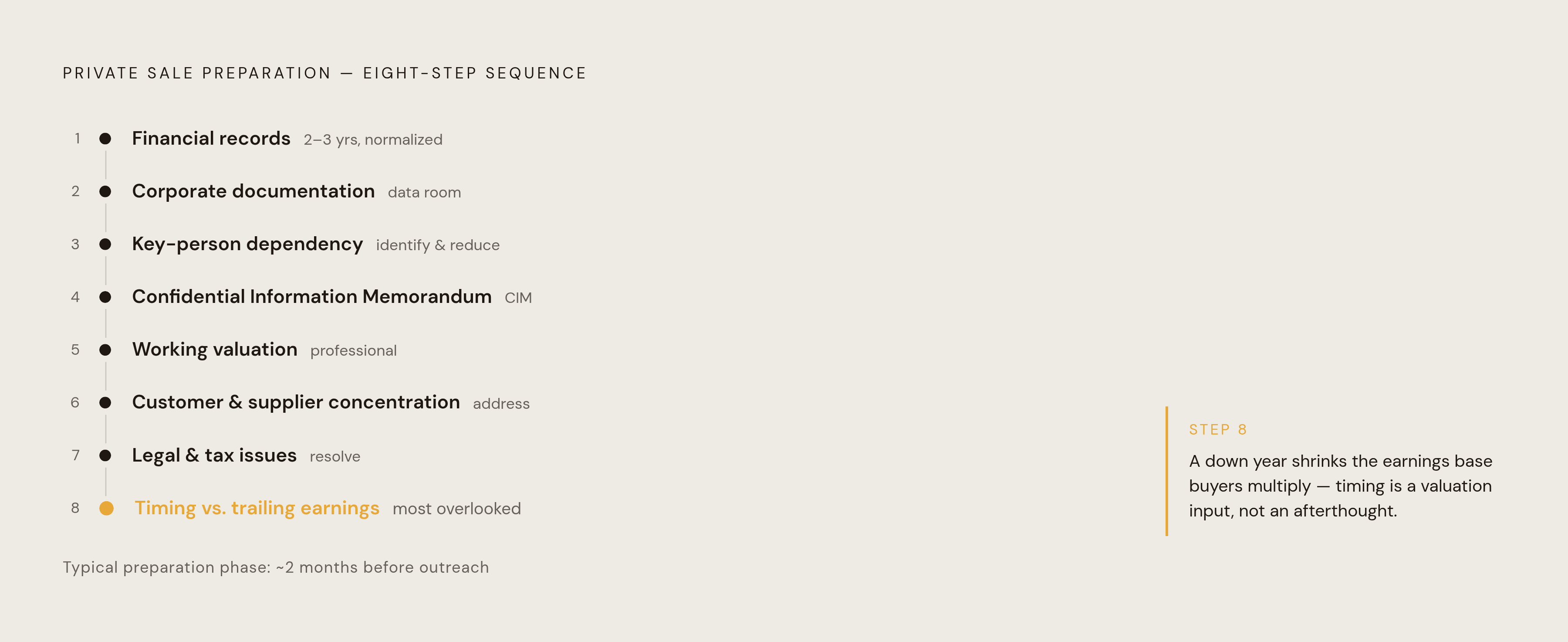
The advisor first organizes financial records and normalization, usually starting with two to three years of compiled or reviewed statements. Audited statements strengthen larger transactions. Buyers and lenders need this evidence to judge earnings, risk, and financing, so they can negotiate with books they can trust.
Second, the advisor helps assemble corporate documentation in a data room, including incorporation records, shareholder agreements, minute books, resolutions, tax returns, contracts, and permits. Missing records are a sign of weak governance and slow down diligence. Organizing them before engagement avoids making the buyer’s investigation the first serious review of the company’s files.
Third, the advisor helps identify and reduce key-person dependency through delegated decisions, cross-training, documented workflows, and shared client relationships. Can the management team sustain the business without the founder, or does too much value depend on personal goodwill that cannot transfer?
Fourth, the advisor assembles the Confidential Information Memorandum, or CIM, from the prepared evidence. This is the main marketing document for qualified buyers. It sets out how the company runs, how it performs financially, and what it is worth before buyers form their own views.
Fifth, the advisor establishes a professional valuation to align expectations with cash flow and market evidence. This is where optimism meets supportable pricing. Early guidance also identifies the transaction’s need for a working estimate or the additional formality of a CBV report.
Sixth, the advisor looks at customer and supplier concentration and helps put stronger contracts in place. Concentration can alter terms as well as price. Where possible, preparation includes renewed key contracts, revenue diversification, and documented supplier agreements, while franchise transfers require early discussion of franchisor approval criteria and fees.
Seventh, the advisor coordinates the resolution of legal and tax issues with the appropriate professionals. Unfiled returns, CRA disputes, outstanding HST/GST assessments, and undisclosed liabilities can stall or terminate a deal. Checking what the landlord requires for consent to lease assignment also keeps that issue from blocking the transfer near closing.
Eighth, the advisor discusses when to sell in light of how the business is doing, because buyers apply multiples to trailing earnings. A down year weakens that earnings base. Starting to prepare three years before a planned exit gives the founder more control over when to go to market and helps avoid being forced to launch when trading is weaker.
The three conditions that most reliably cause a deal to fail — and how the pre-market phase neutralizes them
Owner dependency is the first predictable threat. A buyer taking over a business as its main operator leaves must keep the business running as well as fill the job. The earlier delegation and documentation work addresses that problem, but it takes months. The company must demonstrate that it can operate independently.
Unrealistic valuation expectations are the second threat. A founder’s required retirement proceeds do not establish what normalized cash flow can support. An honest working valuation exposes that mismatch before the seller commits publicly to an asking price. AIM Group also emphasizes settling normalization adjustments before marketing, because arguments over earnings mid-transaction destroy momentum.
Unresolved assignments, liabilities, corporate records, or tax disputes can stop a transaction regardless of the agreed price. Dependence on one buyer adds a different vulnerability, particularly when concentration concerns create leverage to renegotiate after a letter of intent. Preparation addresses the transfer obstacles, while a competitive process reduces reliance on one counterparty.
How can a founder find qualified buyers without word getting out—and choose more than the highest bidder?
The buyer list begins with the business’s industry, size, structure, and the founder’s post-close goals. Price is only one selection criterion. A strategic acquirer may pay for synergies but restructure aggressively, while private equity buyers emphasize cash flow and management continuity and may retain the founder during transition. For individual owner-operators, financing capacity can shape terms as much as their intentions.
Sell Side Advisers describes a custom scorecard that screens buyers for their ability to pay and their fit with what the seller wants for employees, legacy, and transition. Fort Capital emphasizes its buyer network across Canada and abroad. Cross-border reach broadens a relatively small domestic pool, but foreign acquisitions also introduce Investment Canada Act notification or review requirements. Relevant thresholds determine when pre-closing net benefit review is required.
The advisor checks potential buyers before sharing material information, and buyers sign NDAs before they get sensitive details. That discipline allows a private process to reach qualified candidates without publicly listing the business. Competition among those candidates then creates negotiating tension without making confidentiality an afterthought.
Industry-specific preparation considerations for food, beverage, and manufacturing exits
FCC’s mid-year update reports that Canadian food and beverage manufacturing sales rose in the first half of 2026 compared with the first half of 2025. Subsector results differed sharply, however, and geopolitical risks and trade measures made the second-half outlook more challenging. Preparation therefore needs food safety certifications, regulatory documentation, stable supplier contracts, product-line margin analysis, and evidence that key accounts do not depend on the owner.
In Statistics Canada’s Q3 2026 Canadian Survey on Business Conditions, manufacturing is tied for second in plans to exit, behind accommodation and food services. Manufacturing EBITDA multiples typically range from 4×–7×, with proprietary products, long-term contracts, and independent operations supporting value. Physical condition also shapes buyer scrutiny. Equipment condition, deferred maintenance, and environmental compliance need early attention, while founder-led technical expertise must become demonstrably transferable through operating systems and processes.
What to look for when choosing an advisor — and what the pre-market phase should feel like if the right one is engaged
Relevant criteria include business-sale specialization without conflicts, closed transactions at the right size and in the right sector, references, and Canadian tax familiarity. Process should be explainable before engagement. An advisor should describe the valuation method, the CIM, buyer vetting, network reach, and who will remain responsible throughout.
A credible engagement should produce an honest, documented working valuation within the first weeks and a realistic account of what must change before launch. Tax coordination should begin early. The buyer list should take account of the transition the founder wants as well as each buyer’s ability to pay. Sell Side Advisers states that partners work directly on the sale throughout, so founders can check how much attention they will get from senior advisors.
Founders can also assess AI-augmented advisory, which brings together AI-driven buyer matching and the expertise of people who work in investment banking. It can expand the buyer universe systematically and shorten the path to qualified matches. Judgment remains essential for valuation, the CIM, and negotiation.
Founders three or more years from a planned exit can engage an advisor for a readiness assessment without committing to list. The best time to understand the advisor’s role is before an urgent need to sell removes the time required to do the work.